After four years of posting almost every three days (or about 121 posts per year), Sparks of Calliope is taking a month-long hiatus to rest, recoup, and regroup. All unread submissions past and present will be considered in the order they were received. Our next scheduled poetry will post on July 21, 2023. In the meantime, we encourage you to browse our past contributors, like and comment on their work, and maybe even donate to help keep this endeavor afloat if you find us worthy. We’ll be right back, bringing you the quality poetry you have come to expect from our journal. Thank you for visiting!
Month: June 2023
Two Poems by Joshua C. Frank
The Ballad of the Heroic Mother
a true story
A toddler into water fell
And sank as quick as rock.
At nine feet deep, she couldn’t yell
Or jump or thrash in shock.
Her mother heard the splash portend
Her daughter’s water grave;
She dove into the pool’s deep end,
Her little girl to save.
She grabbed her daughter, held her tight,
And with a presto prayer
Sprang toward the shimmering sun of white
To give her girl some air.
She held her up while sinking down,
And knew to save her daughter
That she herself might well soon drown
So inched toward shallow water.
Seconds before her lungs gave out,
Her face felt heat and air.
Her feet on ground, she breathed a shout:
“Success!” An answered prayer!
The whole crowd cheered the mom en masse;
She gained a hero’s glory.
She told the public-speaking class—
I still think of the story.
Signs of a Broken Home
“The bigger the issue, the smaller you write. Remember that. You don’t write about the horrors of war. No. You write about a kid’s burnt socks lying on the road.” -Richard Price
At the foot of the dumpster lay signs on the ground,
But I wonder why these were there lying around.
I would never have guessed that there someone had laid
The sign: “Home is where all the best memories are made.”
And a heartbreaking counterpoint next to it lay:
“We create our tomorrow by dreaming today.”
There are people who write of the horrors of war,
But a child’s burnt socks on a road will say more.
At the foot of the dumpster lay signs on the ground,
But I wonder why these were there lying around.
Joshua C. Frank works in the field of statistics and lives near Austin, Texas. His poetry has also been published in The Society of Classical Poets, Snakeskin, Atop the Cliffs, and The Asahi Haikuist Network, and his short fiction has been published in Nanoism.
Dr. W. Nicholas Knight (April 18, 1939 – October 23, 2022)
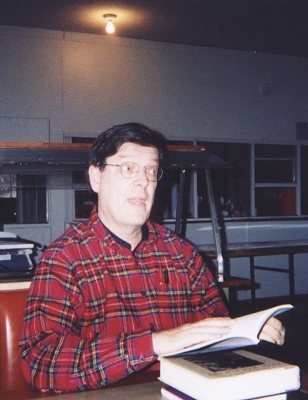
It would seem unfitting to me not to mention Dr. W. Nicholas Knight–who died this past year–when educating others about William Shakespeare. His obituary explains:
“Nick was a popular professor of English, first at Indiana University Bloomington, then Wesleyan University in Connecticut, and lastly Missouri University of Science and Technology, previously the University of Missouri – Rolla. He earned his B.A. in English from Amherst College, M.A. from the University of California at Berkeley, and Ph.D. from Indiana University. He knew his students well, encouraging them in their endeavors and writing. Three of the known signatures of William Shakespeare were discovered or authenticated by Nick. Professor Knight rendered college more accessible by teaching community college courses at night, sponsoring the Black Student Union, taking senior citizens on field trips to St. Louis, teaching Shakespeare in prison, and mentoring English majors whose parents thought they should major in engineering. Nick Knight’s representative works include his book Shakespeare’s Hidden Life and his off-Broadway play “The Death of J.K.” He was active in Arts Rolla, Rotary Club, and the National Endowment for the Humanities.”
My whole conceptualization of who I was to become professionally was first modeled after this man. He was my favorite professor, my advisor, my mentor, and my friend. I was witness not only to Dr. Knight’s knowledgeable passion for all things Shakespeare but also to his passion for Civil War miniature soldiers, model trains, and the fascinating historical knowledge these things represented. Whether he was retelling his story of almost running over Robert Frost with his car at Amherst, giddily boasting of the number of U.S. Poet Laureates he had driven around in his car, or showing off the blurb John Updike had written for his Arthurian poetry collection, he made the undergraduate experience of this literature lover nothing short of magical.
(I was also reminded by former classmates of his story of personal friendship with Superman actor Christopher Reeve, and how the character of Clark Kent in those movies was supposedly modeled after Dr. Knight. The resemblance and mannerisms are uncanny…).
Two Poems by Philip A. Lisi
2023 Best of the Net Nominee
2024 Pushcart Prize Nominee
Not Killing a Spider
Yesterday, my colleague in the room next door
reported a sighting–
So disgusting! The ones that look like baby tarantulas.
Horrifying. I kill them on sight.
I am seated at my desk when you arrive,
feel you before I see you–
an uncanny sensation of weight
and dread in the air, then nothing–
but I know you are there,
and I cannot find my next breath.
Now I see you–
black mass of eight-legged menace,
and I consider my colleague’s quick solution–
the crush and crunch of dominion,
and this appeals for a moment–
but two of your eight segmented limbs,
the pair framing what I take for your head,
positioned on either side of venomous black scythes,
reach gently, slowly, into the air,
as I hear my father’s voice–
Spiders are friends.
My father never discarded things unnecessarily,
spiders or otherwise–
closet full of old tennis shoes fortified with duct tape,
baskets stacked with remnants
of worn out red plaid pajamas for dusting,
a toolbox filled with shards of bar soap
others would have thrown away
without a thought as to their second life as
material for coating wood screws.
This is how he cultivated his peace,
his place in the world,
and spiders were friends–
even the ones I imagined lurked
in the recesses of the cellar,
watching from little lairs of dust and shadow.
I have tried to see the world as my father did,
as he so wanted me to see it–
a place of good hearts and mercy
and potential for repair
and new uses and purposes and lives.
Yet, then, as now, I cannot help but notice
the dark things in the corners of the cellar–
ancient, otherworldly things,
alien to waxed floors and artificial light–
or any light at all.
I am not my father,
and I see dark things still–
but, as you raise and lower your arms,
Considering something in the air,
I find my breath again
in your return to the liminal
beyond desk and wall.
Elegy
Your paws have always reminded me
of a ballerina’s pointe shoes,
beauty in seal-brown silk.
You look at me with disdain
(as any self-respecting cat would)
as I gently scoop you up to help you climb
the last few steps to my office–
oh, excuse me–
your office.
You yowl in protest–
your voice still strong–
and I wonder how a sound
that resonates with such ferocity
can come from such a frail body,
diminished to next to nothing
in a period of weeks.
Tantrum over, pride restored,
you sit at my feet as I write,
cerulean eyes fixated on my lap–
which is also yours.
I pause and let you know I love you–
and I remember when you were a kitten
and used to wait for me at top of the stairs,
perched regally in the manner
of your ancient sister, the sphinx,
before bounding down to meet me at the door.
You seem content this evening,
sitting with me at my desk,
and I can feel the little rumble
from deep in your chest against my own–
a purring of tiny timpani,
a fanfare of feline affection–
too proud for andante con dolore.
You look up at me–
old eyes framed by long whiskers
the color of clotted cream.
Do you know?
I hold you now–
my arms wrapped around your body,
your dainty, dark-socked feet
indignant in a final pas de chat.
Beautiful girl–
I do not want to let you go.
Philip A. Lisi lives in Lancaster, Pennsylvania, where he teaches English at his high school alma mater by day and writes poetry and flash fiction by night alongside his family and the ghost of their cantankerous Wichienmaat cat, Sela. His work has appeared in Sparks of Calliope, The Abbey Review, Litbreak Magazine, Rosette Maleficarum, and the Serious Flash Fiction anthology.
“Speculative Marriage” by Kate Falvey
i.
So we presented ourselves
to some bored local judge
dressed in our least crumpled finery,
accepted the baffled family diners
and the checks, then came back
to our rented rooms and wondered
how this changed us.
We’d already amassed
cast-off silverware and china,
mirrors and chairs from the roadside,
lamps and radios bargained from heaps
of dated mayhem in a down-and-out
old barn in the woodland damp
of mid-coast Maine.
We were married to Maine,
each in our separate terrain, you
on an icy cliff edge by the sea, me
humbled in a grove of ancient cedar
or an isolated glade ringed by white pine,
pent with the possibility of deer and mother
turkeys trailed by endless hopping chicks.
We both loved the fires
you meticulously stoked in our camp,
the dark lake eerie with loon wails
and the human laughs of teals.
We loved the night winds
and the shimmy of starlight
through the maddened branches
when a storm muscled in,
lightning scarier than bears,
thunder moving us together
like nothing else ever could.
ii.
The space between us
in the canoe is where
our lives might have been –
life vests not worn;
flip flops cast off;
a canvas tote filled
with peasant bread,
odd smokey local cheddar,
purple grapes and wine –
no safety gear or shoes
for nimble walking
over rutted, shaky ground –
just food we’d pack
for a solo jaunt anyway,
except, perhaps
for the wine.
We were caught once
in the marsh weeds,
the eely creek
a dead-end alleyway
I needed to explore.
You’d had too much
sun and wine,
too much
aimless agitation,
rowing nowhere
over the wind-raked rivulets,
against the brawny heat
and the unanticipated
roiling of the clouds.
We tried to shrug it off but
were stranded in gauzy,
otherworldly light
and crawling vegetation,
a fierce storm lowering.
A kindly passing boatman
dragged us out with pole and rope.
We were chastened,
dopey with fatigue,
embarrassment, and
flustered gratitude.
We offered him
our uneaten grapes and cheese,
tipped them into his boat
as he glided greenly
into the boggling haze.
We were always kind to others,
always aware of kindness
as a shared belief in virtue, you
with your altar boy conditioning,
a scamp from way back,
but venerating the rituals
and holy offerings of
stringently regulated spasms
of chastening peace,
me with my residue of faith
in saints and sinners, desperate
for signs of detectable, inviolable life.
iii.
Fire doused, camp struck, and home
is soup cans and threadbare, dusty brocade.
Even the sea we live by tosses with
frothy disdain, riddled with glimmers
of more remarkable tide pools on craggier,
more abundant, evergreen shores.
iv.
Peeling the carrots, I wonder
what will be left when I leave
and how this leaving will change us.
There will be artifacts: wooden bowls
scored with years of dinnertime blades;
a scoff of bedclothes, frayed from over-
wear and washing; a trove of stones slipped
into pockets or packs, their origins forgotten;
and the usual detritus of cards and ticket stubs,
testaments to doings and occasions, forgotten
like the stones.
Kate Falvey has been published in many journals and anthologies; in a full-length collection, The Language of Little Girls (David Robert Books); and in two chapbooks, What the Sea Washes Up (Dancing Girl Press) and Morning Constitutional in Sunhat and Bolero (Green Fuse Poetic Arts). She co-founded (with Monique Ferrell) and for ten years edited the 2 Bridges Review, published through City Tech (City University of New York) where she teaches, and is an associate editor for the Bellevue Literary Review.
Two Poems by C. R. Cantor
At the Gulf of Patras
Arriving in Nafpaktos at dusk,
we found an old hotel above the port,
Venetian in aspect, white,
stucco flaking, iron balconies
dotted with rust.
We climbed worn stairs to bed,
our room illuminated
through closed shutters
by bars of fading light.
Awakening at dawn,
I cut my left thumb
reaching for a razor.
You laughed; I bled.
You told me how Cervantes also
injured his left hand
(in a greater cause, of course, you said)
when struck by Turkish bullets
at the Battle of Lepanto
below us in the gulf.
You opened the shutters.
All this happened decades ago.
I remember your laugh,
the bite of the blade,
the peeling shutters, how later
we walked to the harbor
and saw the morning’s catch,
fish upon fish along the quay
in iridescent piles,
blood lining their gills.
Archaeology
You return to my dreams incognito.
Tonight, disguised as a statue,
you hide among cypress roots
to waylay me on my path.
As I enter the grove
I see no one.
You lie neck deep in the ground.
Your face seems a species of stone.
Then you smile the archaic smile:
You were buried alive, you explain,
and time has turned you to marble.
You beg me to exhume you.
For love of art, you say
or for the sake of archaeology–
But too much earth lies between us
in dusty unnumbered particles.
Tomorrow I’ll see cypresses
outside my window and recall
how my hands refused to dig
in that dry soil.
When you were a woman
you withheld nothing from me.
Not mind, nor language nor embrace.
I can never forgive you for this.
C. R. Cantor lives in Swarthmore, Pennsylvania, and works at the University of Pennsylvania.
Two Poems by Kathleen Beavers
“See Me Now!”
with apologies to “Bram Stoker’s Dracula“
The me that lives
behind my face
is a creature of fire
and light
and grace,
but the mantle of flesh and blood and bone
wears thin
(I am not now
what I have been)
and I diminish by the day,
till death will have
the final say
(as for us all) so–
“See me now!”
While here for all the world to see
goes Plain Jane scarecrow
old crone she
who wanders here,
meanders there,
with wrinkles and sags
and graying hair…
But though I wear all rag-tag clothes
I’m still the me
nobody knows
(inside)
Though sometimes, yes,
I must confess,
this mask
clings tighter by the day
to form and face,
until in time
it will replace
entirely the glow,
the gleam,
the celebration,
and I’m just one more
ageing matron,
and fear of fast approaching night
will dim the cat-green glint of light
that was my younger eye and self, so–
“See me now!”
the vampire said,
and took his top hat
from his head,
till later:
“See what your God has
done to me!”
The Count, you see,
felt singled out,
but of this I know
there is no doubt:
Forever shall we all hide behind
our final masks
of grass and dirt,
and all our dreams
will lie inert…so–
“See me now!”
If Only We Knew
Old friends are
fading flowers,
a withered charm,
a still-fragrant grace.
Young friends are
bright and vibrant flowers,
cut flowers
in a sparkling vase.
Children are
wild and hardy vines,
thrusting over time’s horizon,
brash and bold.
But friends who’ve died
before their time
are petals pressed
in the pages of a misplaced book,
their absence a memory
too fragile to hold.
Kathleen Beavers attended the University of Oregon and is now living in Las Vegas with her adult son, two large dogs, and far too many books.
Two Poems by Anne Mikusinski
The Concert
At first, there’s
Silence.
Then
Loops and whorls of sound
Fill up the room
Rising and falling
Feeding on all emotion and
Anticipation
Of the waiting crowd
A flash and flood of light
Reveal
The players, at their places
Settled into
Tonight’s temporary home
And for a while
No outside world exists
Just words
And music
And connection
A fleeting smile
A brush of fingertips
Or brief clasp of hands
There’s a middle, then an end
A mournful keyboard fades
Into a last goodbye
A quick embrace exchanged
And then
Silence.
Chapter Two
In my next life
I will be
Braver
But more
Careful
To cover my
Sleeve worn heart
With an extra layer
Of camouflage.
In my next life
I will be
Quiet
In the face of onslaughts
Temperate
With words and
More
Mindful of my actions.
In my next life
I will be more
Practical
Less prone to
Dreams
Less willing to
Follow
A path of
Promises
With no set destination.
Anne Mikusinski has been writing poems and short stories since the age of seven and probably making them up for a long time before that. Her influences range from Dylan Thomas and Sylvia Plath to David Byrne and Nick Cave. She hopes that someday, she will be as much of an influence for someone as these poets were for her.
 Sparks of Calliope