At home the leaves are falling
crimson-orange through greying sky,
where misty morns are gleaming
or wind and rain are squalling.
At home the leaves are falling;
they rustle in the grass.
My sisters, laughing, screaming,
through autumn-heaps are crawling.
At home the leaves are falling;
bitter wind grows biting cold,
and my father is complaining
that this weather is appalling.
At home the leaves are falling.
Here, hibiscus bud and bloom,
but I lie on beaches dreaming
of my fiery maple sprawling.
At home the leaves are falling,
golden spirits on the wind
whose death next spring’s redeeming
in the sleeping soil is scrawling.
At home the leaves are falling.
When I stand beneath my trees
my blood with hope is teeming.
Autumn, promise-like, is calling.
Weariness
Weariness like a grey cloak I wear.
Strange that what brings me joy
can still exhaust me. There’s days
that music lifts my heart and days
when practice drains the blood from me.
A mistimed kiss can kill a budding romance.
The sun knows when to set, and stars
do not intrude on daytime’s reign.
I try to learn their gifts. I chafe.
Rest is elusive through the weariness.
Alena Casey is a poet, writer, and mother of four from Indiana. Her poetry has been published with The Road Not Taken, The Society of Classical Poets, and The Author’s Journal of Inventive Literature, among others. She can be found at strivingafterink.wordpress.com.
Geoffrey Aitken writes in Adelaide, on unceded Kaurna land as an awarded poet whose industrial minimalism communicates his ‘lived experience’ for publishers both locally [AUS] and internationally [UK, US, CAN, Fr & CN]. Recently, ‘Wishbone Words’, ‘Impspired’ [Aug ’23 – UK], ‘The Closed Eye Open,’ ‘Maya’s Micros,’ ‘Our Day’s Encounter,’ [US], ‘Oxygen,’ and ‘unusual work’ [AUS]; ‘The Canberra Times’ [Dec ‘22]. He was nominated for the annual Best of the Net anthology in 2022.
The poem formerly published here was actually a plagiarized version of a wonderful poem by Bruce Bond entitled “Neilah; Creature” which was published in TheHudson Review. Please take the time to read his poem there.
Dislocated
The poem formerly published here was actually a plagiarized version of a wonderful poem by Professor Dorsía Smith Silva entitled “The Q & A Section” which was published in Claw and Blossom. Please take the time to read her poem there.
Across the whale-roads ride Sons of Thor hulls bound for glory, heads painted for war a-wing the drake-ships for distant shores to carve our names in Ymir’s oar Embark we the Norns bescyle! Through fearsome storm, o’er water dark six hundred sail, six hundred stark for we see Hloridi in lighting arc’d He heralds the Kings of the Isles
How bleak the face of Cape Wrath’s span how rough the strait we pierce to land how dense the mist, gray-ghast the sand how gnash’d that hellmouth rocky strand Enfang we the Norns bescyle! Let Midgard tremble, let Christian flee let foes be dashed upon the scree let keen across the lochs their plea: “Rule us, ye Kings of the Isles!”
Six hundred leap from karves afoam six hundred charge onto the holm six hundred reap amuck the loam six hundred cleave into the gloam Ingrieve we the Norns bescyle! Across the moor blood-rivers wend wine-dark with woad and Pictish end tonight their weak-kneed witan bend to name us Kings of the Isles
Now fly our colors and blow the horn let feast the crows on them life-lorn this fight hard-won by men oath-sworn one hundred by five hundred mourned Arrive we the Norns bescyle! But what awaits us in the nether? bind we bonds that Skuld should sever? dream we fools to rule forever? forever as Kings of the Isles
Churl Sullivan is a writer of no repute from St. Louis, Missouri, for whom a nominal association with boorish, intractable yokels is a great badge of honor. He’s been published nowhere, as a harlot has better odds at heaven than he at literary legitimacy; and until such time as this is no longer the truth, he’ll be napping in his pithos. You can find him at @Churl_Sullivan, but you probably shouldn’t.
Sir Walter Raleigh (1552-1618) stands as a Renaissance luminary celebrated for his profound impact on poetry and literature, alongside his adventures in exploration and his complex life at the English court.
Born in Devon, England, Raleigh initially pursued a military career, where he showcased bravery and intellect in campaigns across France and Ireland. Yet, it was his charisma and intellectual prowess that enchanted Queen Elizabeth I, elevating him to a cherished courtier. Beyond his martial pursuits, Raleigh’s pen proved his might.
Raleigh emerged as a prolific and celebrated poet, his verses adorned with eloquence and poetic finesse. His literary masterpiece, “The History of the World,” attested to his intellectual acumen. However, it was his lyrical poetry that secured his status as a poetic icon.
Amid his poetic pursuits, Raleigh sponsored expeditions to the New World in the late 16th century, notably the ill-fated Roanoke Colony venture in present-day North Carolina. These ventures, though challenging, laid the foundations for future English colonization in the Americas.
Raleigh’s cultural influence extended beyond verse. He introduced tobacco to England, a legacy that endures, and popularized the “Raleigh cloak” in fashion.
Yet, Raleigh’s life took a dramatic turn with his secret marriage to a lady-in-waiting, leading to a fall from favor and imprisonment in the Tower of London.
During King James I’s reign, Raleigh embarked on a perilous journey to South America in search of El Dorado. His defiance of the King’s orders ultimately led to his arrest and tragic execution.
Sir Walter Raleigh’s enduring legacy as a poet remains etched in history, his verses continuing to inspire. He exemplified the indomitable spirit of a Renaissance man who also left an indelible mark on the world of letters, as evidenced in his poems below.
The Nymph’s Reply to the Shepherd
If all the world and love were young,
And truth in every Shepherd’s tongue,
These pretty pleasures might me move,
To live with thee, and be thy love.
Time drives the flocks from field to fold,
When Rivers rage and Rocks grow cold,
And Philomel becometh dumb,
The rest complains of cares to come.
The flowers do fade, and wanton fields,
To wayward winter reckoning yields,
A honey tongue, a heart of gall,
Is fancy’s spring, but sorrow’s fall.
Thy gowns, thy shoes, thy beds of Roses,
Thy cap, thy kirtle, and thy posies
Soon break, soon wither, soon forgotten:
In folly ripe, in reason rotten.
Thy belt of straw and Ivy buds,
The Coral clasps and amber studs,
All these in me no means can move
To come to thee and be thy love.
But could youth last, and love still breed,
Had joys no date, nor age no need,
Then these delights my mind might move
To live with thee, and be thy love.
A Vision Upon the Fairie Queen
Methought I saw the grave where Laura lay,
Within that temple where the vestal flame
Was wont to burn; and, passing by that way,
To see that buried dust of living fame,
Whose tomb fair Love, and fairer Virtue kept:
All suddenly I saw the Fairy Queen;
At whose approach the soul of Petrarch wept,
And, from thenceforth, those Graces were not seen:
For they this queen attended; in whose stead
Oblivion laid him down on Laura’s hearse:
Hereat the hardest stones were seen to bleed,
And groans of buried ghosts the heavens did pierce:
Where Homer’s spright did tremble all for grief,
And cursed the access of that celestial thief!
The informational article above was composed in part by administering guided direction to ChatGPT. It was subsequently fact-checked, revised, and edited by the editor. The editor/publisher takes no authorship credit for this work and strongly encourages disclosure when using this or similar tools to create content. Sparks of Calliope prohibits submissions of poetry composed with the assistance of predictive AI.
I rode in a mine cart, back home from the land
Of my favorite video game,
Through the pixelized prairie and vast seas of sand,
Over rivers of lava and flame.
The hero sat there in the rickety cart
Staring off into pixel-sky space,
Much older than on the game cartridge’s art,
With tears on his wide, wrinkled face.
“I’m leaving and never returning,” he said.
“Come listen and hear my sad story.
The princess and I, we hoped someday to wed,
Way back in the days of my glory.
“The dragon would kidnap the princess, then I
Would run through an obstacle course
To his minions’ dark castles in mountains up high
And take back their strongholds by force.
“My princess was in the last castle I’d raid;
I always found treasures to haul.
The Kingdom would welcome me with a parade
And a sumptuous banquet for all.
“But after some years, the dragon found ways
To undermine me and my quest.
He gave up the tactic of ‘pillage and raze’—
Bribed the people with treasure-filled chests!
“My princess then fell for the dragon’s top minion;
The Kingdom surrendered the war
And exiled me out of the dragon’s dominion—
They don’t want to be saved anymore!”
We came to my world, and we sealed up the gate
To the land of his video game.
My world is secured from his land’s tragic fate,
But I’m worried for us just the same.
For evil has bribed all the people here, too,
With shiny new gadgets galore.
No more do they care for what’s good and what’s true—
They don’t want to be saved anymore!
The Adventures of Verb
At six, I had a dictionary
Where I would meet a man named Verb,
Superb and quite extraordinary.
In every definition’s blurb,
Right at the finish, did while doing,
For example: “Verb chewed, chewing.”
In my mind, I saw Verb clearly,
With brown hair, mustache, thin, and tall.
“Verb smiled, smiling” sincerely
And “Verb told, telling” me of all
That “Verb did, doing” through his days
Within a sentence or a phrase.
“Verb ran, running,” “Verb swam, swimming,”
“Verb vaulted, vaulting,” “Verb gave, giving,”
“Verb bought, buying,” “Verb trimmed, trimming,”
“Verb flew, flying,” “Verb lived, living,”
One day I came real close to crying:
The day I read that “Verb died, dying.”
I looked up “verb,” and then I knew,
It’s not a man who lived and died;
It’s just a word that means to do.
Relieved, I put the book aside
And ran outside, where I “played, playing”
The things Verb did that still “stayed, staying.”
“Ballad of the Video-Game Hero” and “The Adventures of Verb” were first published by The Society of Classical Poets.
Joshua C. Frank works in the field of statistics and lives near Austin, Texas. His poetry has also been published in TheSociety of Classical Poets, Snakeskin, Atop the Cliffs, and The Asahi Haikuist Network, and his short fiction has been published in Nanoism.
On my way to madness I took off my housedress, left it loosely arranged like a donut on the floor where I thought I would die alone.
Then I leapt, not out the window, but to the next room where I was found by officers and neighbors naked on a puffed, white blanket, swollen with victory still stuttering to God.
The battle had been won between light and evil, predator and victim, snake and dove.
I had been deeply afraid, but when I pressed palms with death, I found myself in great company.
Does an alarm sound in the heavens when a child of the Earth is approaching the gates?
Who curates the unseen team that guides us beyond?
I purged the house, littered the lawn with a thousand glittering buttons, drowned books in garbage pails, laid out old clothes as bait, for the demons.
I was instructed to run fans to scramble my scent, stack hangers as traps, cover every black hole that could be used by spies.
Reflective surfaces became aid to keep watch, dance, a release blue flowered shawls draped me in the Holy Mother’s protection.
Now in my sane mind I ask – When does medicine become addiction? Creativity, delusion? Imagination, mania?
Is trauma the gateway to enlightenment?
How can the cries of our ancestors be soothed if we don’t fall through dimensions to sing beyond the veil?
And how will we ever shake loose that which is plaguing us if we are afraid to worship wildly in a house ,which is seldom visited?
Today I Asked the Butterfly
Today I asked the butterfly what it’s like to be a butterfly. She perched on the purple skirt of a petunia and asked – “What’s a butterfly?”
I blushed with shame at the notion of assigning a name to someone who never named herself, someone who is so absorbed in being that she doesn’t need identity.
I started to move in ways I had never moved before. Losing my name meant I could become the unknown, a pattern, an echo, a prayer.
I mimicked the bear, the great moose, the rhino, the squirrel. I morphed and shifted, but when I thought of the butterfly I felt the most uplifted.
I didn’t know the God in me until I became the small, winged one who drinks from the hearts of flowers.
Chelsea Lynn La Bate had her first psychotic episode at the age of 39 in her home in Asheville, NC. Since then she has suffered three more episodes. The poems in her newly released book “Free Roses,” tracks the ecstasy of psychosis and the interconnectivity of all living creatures which she experienced while in trance. She now lives in Florida.
The curtains were pulled askew, the floor was marked And strewn with cigarette butts, lilac perfume Lay thick upon my clothes and the bed on which I lay, Where dust and ashes crept beneath the covers. She faced away, thinking that I slept While powdering her face and humming church songs. I heard her sing, “What matters dear”, and as she turned abreast Came a soft silence, and I knew she was lighting her cigarette.
She did not touch the smoke, or run her fingers Through my trailing hair, or lift my head with tender hands And blush my face with smiles and kisses; The fairest creature from the earliest Spring, Outside her step always seemed to pity the moss it pressed; Yet inside the silent motions of passing death stifled her voice, While black fire rushed through her veins, lapped at her heart, And filled the bed chamber with hymns and smoke.
Our small village stood a long mile from town; From there, each Friday, I drove a far stretch through stormed down And shaggy woods to clear my lungs, their secret bitter throes Waning from the broad liquid waves of fresh air. To me, sheer miracles of loveliness lie in the lone man’s hike Through thorn-choked basins and wintry colds; Breathless in high altitude, foreviewing the dew dropping earth. What is more lovely than this?
At mountains peak, I glanced downwards on the grass, And the grass bowed when airs of heaven stroked its blades, Lifting itself again when the clouds had passed; Alas in the silent hours of eve, I was reminded Of her sweet-scented voice, rising to stand Like a solitary dove and spread my bright wings. I sang, “What matters dear”, and as I turned abreast Came the praises of mountain wind, and she knew I was alighting the Earth.
Days, weeks, months, years afterwards, when we both grew gray with spent skin and aches from tired bones; One day I awoke to find her Lifeless beside me, lying with a cruel stress Upon her eyelids where the powder used to crease, Where I used to plant gentle kisses upon her flowered brow. The bedchamber then began to lose its smell, lilac And smoke grew thin and faint along the floors, Even as her beauty passed quite away.
Upon a windy summit I stooped to pluck an aster And watched the grass bow upon my hand’s approach. This was the sight that called my heart to answer the lost question: Why strive when love is gone? Beneath crimson trees, wind wrapped me in a heavy embrace As I built a small fire beneath the clouds, which watched With great intensity the flames yawn in the weary sky; Where I struck flint and shut out the troublesome noise of life.
From the strokes of heat, smells of lilac And smoke roared back to life, dancing with wintry mountain air. Tears did not fall, sobs would not come, because I still loved her memory And always I would smell of smoke and mountains.
Addison Affleck is a poet, writer, and a “Romantic at heart.” Born in Washington, she grew up sandwiched between forests and the ocean, in the rainy city of Seattle, and has since lived in Northern Washington. Deeply engaged with ethnobotany, her work takes up animistic perspectives of nature and humanity’s relationship with it. Her published poetry and prose have found homes in scholastic literary magazines, the Hibiscus Review, the Raven Review, and others.
Once a day I tour his room
the cat no longer naps in, dust
the shelf his helmet used to fill,
the dresser drawers now empty. He left
his too-small clothes for me
to sort. I chose two shirts
so swiftly outgrown they weren’t
laundered and now am wrapped
to my wrists in a dark blue
new to me. Tomorrow a surgeon far
from here will splice his nerve
and tendon, re-stitch his ring
finger’s flesh, and leave a scar
from his love for somewhere else.
Charmed Weekend for Beverly and Sue
We hug as we meet in the street
for the first time in seven years,
exclaim how unchanged we appear
while local cabbies honk and glare
but fairy dust keeps all their fingers
wrapped around the steering wheel.
The hugs are tight, with arms we know
from thinner times, darkened to
admired tans in past July’s.
We sort through photos of former frogs
with too-large spectacles and hair
feathered and center-parted.
The world’s compelling charms to seek
the kiss, the crown, the dress have dropped.
We are surrounded by the spell
of easy narration: I don’t need to tell
them that once upon a time
I had a brother, but one crisp
October day I bit an apple;
or Beverly, that she was hit
with one apple after another.
We talk instead how a prince still stuns
even without hair, but he won’t—
and birds won’t either, for that matter—
bring happiness on a sparkling platter,
of teaching step-children to talk
when they’re not used to open doors,
of how we wake ourselves from sleep,
and learn to peel the fruit,
how we select the words each day
with which we shape our ever after.
Michelle DeRose teaches creative writing and African-American, Irish, and world literature at Aquinas College in Grand Rapids, Michigan. Her most recent poetry has appeared or is forthcoming in Sparks of Calliope, Dunes Review, Making Waves, The Journal of Poetry Therapy, and Healing Muse.
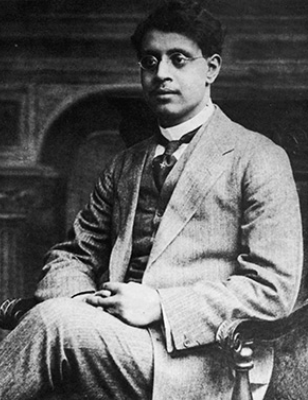
Sukumar Ray (1887-1923), a luminary in Bengali literature, graced the literary world during the late 19th and early 20th centuries with his unique blend of wit, humor, and poetic brilliance. Born into a family steeped in literary tradition, Ray inherited a legacy that would see him become a renowned poet, writer, and illustrator in his own right.
Sukumar Ray embarked on his academic journey at the prestigious Presidency College in Kolkata and later pursued higher education at the University of London in England. During his time abroad, he immersed himself in the study of fine arts, linguistics, and literature. The Western humor and literary traditions he encountered played a pivotal role in shaping his distinct brand of humor.
Upon his return to India, Sukumar Ray wholeheartedly embraced his creative calling, leaving an indelible mark as a poet, writer, and illustrator. His magnum opus, “Abol Tabol” (1923), remains a masterpiece of nonsense literature that continues to enchant readers of all ages. Filled with bizarre characters, whimsical rhymes, and satirical critiques of contemporary society, “Abol Tabol” stands as a timeless classic in Bengali literature.
Tragically, Sukumar Ray’s promising literary journey was abruptly cut short when he passed away at the tender age of 35, on September 10, 1923. Nevertheless, his legacy endures through his writings, which continue to evoke joy and laughter across generations. His talent for infusing humor with keen social observations and his gift for wordplay have established him as an enduring literary figure in Bengali literature.
The following two poems, “Baburam the Snake Charmer” and “Uncle’s Invention,” are examples of Ray’s unique literary talents.
Baburam the Snake Charmer
Hullo, there Baburam – what have you got in there? Snakes? Aha – and do you think there’s one that you could spare? You know, I’d love to have one, but let me tell you this– The ones that bite aren’t right for me – nor the ones that hiss. I’d also skip the ones that butt As well the ones that whistle Or the ones that slink about, Or show their fangs, or bristle. As for eating habits, I think it would be nice To go for ones that only take a meal of milk and rice. I’m sure you know the kind of snake I want from what I’ve said, Do let me have one, Baburam, so I could bash its head.
Uncle’s Invention
Chandidas’s uncle has invented a device Which is causing everyone to praise it to the skies. When Uncle was a year old, or maybe even younger, He came out with a lusty yell that sounded just like ‘Goonga.’ At such an age most other tots just manage ‘Glug’ and ‘Mum,’ So ‘Goonga’ like a thunderbolt, struck everybody dumb. And all who heard, said ‘Here’s a boy – provided he survives— Will one day surely bring about a change in human lives.’ It seems the day is here at last, and victory is won With what will make a five-mile walk seem like only one. I’ve seen the contrivance myself and say with confidence, Never had invention had such greater significance. Let me tell you how it strikes the eyes of a beholder: First of all, one notes that you must strap it to your shoulder. An arm extends, and from its end one notes there hangs a hook To which you bait some food – stuff which you either buy or cook. Naturally the choice depends upon you predilections (It’s wiser to restrict yourself to hookable confections). The sight of morsel dangling close provokes the urge to eat Which, transcribed to your motive force, soon propels the feet. Before you know you’re on the go, your mind, intent on feeding, But since the food is travelling too you never stop your speeding. The outcome, I need hardly add, will change our whole existence, Because we’ll walk for nourishment, and never mind the distance. No wonder there’s a move afoot to honor Uncle soon For bestowing on humanity an everlasting boon.
The first draft of the informational article above was composed in part by administering guided direction to ChatGPT. It was subsequently fact-checked, revised, and edited by the editor. The editor/publisher takes no authorship credit for this work and strongly encourages disclosure when using this or similar tools to create content. Sparks of Calliope prohibits submissions of poetry composed with the assistance of predictive AI.
These translations from the original Bengali were found on the web without attribution and are used here under the fair use doctrine for educational purpose.

 Sparks of Calliope