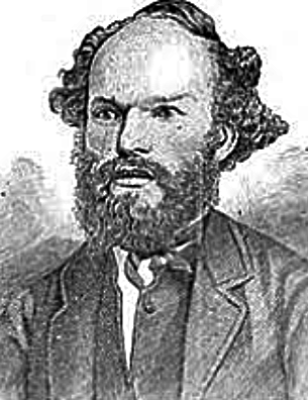
Everyone has certain things to be thankful for which come to mind around this time of year, and were Scottish born Canadian poet James McIntyre still alive, his might be achieving immortal literary fame despite being named by some critics as “The Worst Poet in History.”
James McIntyre (1828-1906) was a 19th-century Canadian poet, famously known as the “Cheese Poet” due to his unconventional choice of subjects for his verses. Born in Forres, Scotland, McIntyre emigrated to Canada in 1841, settling in Ingersoll, Ontario, where he worked as a stonemason.
Despite lacking formal education, McIntyre possessed a keen interest in poetry. His poetic endeavors gained recognition when he began composing verses that celebrated the dairy industry, particularly his ode to cheese. McIntyre’s light-hearted and whimsical poems often centered around everyday life, nature, and his surroundings.
One of his most well-known works, “Ode on the Mammoth Cheese,” humorously pays homage to a mammoth cheese produced in Ingersoll. McIntyre’s verses, characterized by their playful and sometimes satirical tone, garnered him local fame, earning him the title of the “Cheese Poet.”
While McIntyre’s poetry may not have been embraced by literary elites of his time, his work resonated with the ordinary people of Ontario. His poems were published in local newspapers, contributing to his popularity in the region. Despite the seemingly mundane nature of his chosen themes, McIntyre’s poems reflect a genuine love for his community and a unique perspective on the world around him during his lifetime.
James McIntyre’s legacy endures as a charming and eccentric, though not overly-talented, figure in Canadian literary history. His ability to find inspiration in the everyday, even in the humble cheese, sets him apart as a poet who celebrated the ordinary in an extraordinary way. McIntyre’s unconventional approach to poetry has perhaps left an indelible mark, ensuring that he is remembered not only as the “Cheese Poet” but also as a distinctive voice in the rich tapestry of Canadian literature.
Below are a couple examples of McIntyre’s odes.
Thanksgiving Ode, November 15, 1888
September came and with it frost
The season’s pasture it seemed lost,
And the wondrous yield of corn
Of its green beauty it was shorn.
Frost it came like early robber,
But gentle rains came in October,
Which were absorbed by grateful soil;
With green once more the pastures smile.
And cows again are happy seen
Enjoying of the pastures green,
And flow of milk again they yield
From the sweet feed of grassy field.
And we have now a fine November,
Warmer far than in September;
The apple, which is queen of fruits,
Was a good crop and so is roots.
The rains they did replenish springs,
And it gratitude to each heart brings,
When we reflect on bounteous season,
For grateful feelings all have reason.
Ode on the Mammoth Cheese
Weight over seven thousand pounds.
We have seen thee, queen of cheese,
Lying quietly at your ease,
Gently fanned by evening breeze,
Thy fair form no flies dare seize.
All gaily dressed soon you’ll go
To the great Provincial show,
To be admired by many a beau
In the city of Toronto.
Cows numerous as a swarm of bees,
Or as the leaves upon the trees,
It did require to make thee please,
And stand unrivalled, queen of cheese.
May you not receive a scar as
We have heard that Mr. Harris
Intends to send you off as far as
The great world’s show at Paris.
Of the youth beware of these,
For some of them might rudely squeeze
And bite your cheek, then songs or glees
We could not sing, oh! queen of cheese.
We’rt thou suspended from balloon,
You’d cast a shade even at noon,
Folks would think it was the moon
About to fall and crush them soon.

 Sparks of Calliope