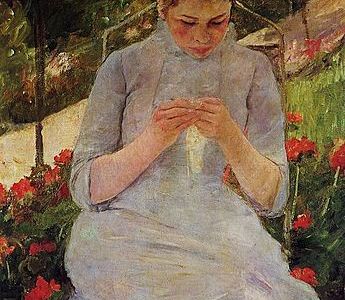
“Girl in the Garden” by Donna Pucciani

inspired by “Young Woman Sewing in a Garden,” Mary Cassatt, c. 1880-82

She could be any ordinary woman
engaged in lace-making, perhaps
tatting the edge of a handkerchief,
sitting dully in a shady spot among
a handful of poppy-bright flowers.

Intent on her task, she is oblivious
to the verdant shrubbery around her,
summer’s cloud of tepid breath.
She does not dissolve into the scene,
does not become one with the garden,
or filter herself through blossom,
but remains contained within herself.

Her plain gray dress closes around her,
leaving bare only her arms, wrists,
and hands free to engage in sewing
the tiny square of fabric that is
her raison d’être, its soft material
gathering her dreams in the task
of the moment.

The graveled path behind her
provides a horizontal stripe of dusty beige
through a haze of trees. She could easily
run away from her nearly motionless
existence, but refuses to consider escape,
her delicate labors calling her from the heart,
or not.


Donna Pucciani has been been published on four continents in such diverse journals as International Poetry Review, Spoon River Poetry Review, The Pedestal, nebu[lab], Italian Americana, Journal of the American Medical AssociationPoetry Salzburg, Shichao Poetry, Istanbul Literary Review and Christianity and Literature. Her poetry has been translated into Chinese, Japanese and Italian, and has won awards from the Illinois Arts Council and The National Federation of State Poetry Societies, among others. She has been nominated five times for the Pushcart Prize and currently serves as Vice-President of the Poets’ Club of Chicago. A list of her eight poetry books can be found on her website.

“DSM IV 298 or Am I Blue?” by Leslie Lippincott Hidley

My limbic system’s gone to sleep —
My affect’s flattened by the walrus on my head.
No difference in doing and not-doing.
The world is an ashtray, a splatted spider,

A drudgery of breathing in and breathing out,
Pushing blood through tired veins.
All is uphill.
Only sleep is sweet.

I will talk to you in words of one syllable
So even you can understand.
I will make you feel better.
I will push on your psyche —
Yank it around.

Like I would cheer you out of a broken leg
Or appendicitis.

Plotinus said, “Weather is the celestial form of music.”
I say, “Mood is the neural form of weather.”
I am in the doldrums, stupefied, dull winds droning,
Bleak-brained and dim-lighted.

Look where you’re not looking:
I am the creator of full ashtrays and garbage.
Unmade beds, floors full of wet towels and dirty clothes.
Tables stacked with unpaid bills, coffee cups,
Empty wine glasses, papers.
Ants in the kitchen. Hurt feelings.

I have a gift for disorder.
I make messes.

My tongue is shredded cardboard and junk mail,
Chopped metaphors, and broken shards of soda bottles.
My mind is a kitchen rag.


Leslie Lippincott Hidley has been writing prose and poetry for her own amusement and that of her family and friends and others for most of her 77 years. And one of her ten grandchildren is named Kalliope. She has lived in Walla Walla, Washington; Frankfurt and Bremerhaven, Germany; Upper New York State; Enid, Oklahoma; Montgomery and Prattville, Alabama; Lubbock, Texas; Dover, Delaware; West Palm Beach, Florida; Goose Bay, Labrador; Washington, D.C.; Fairfield, California; Omaha, Nebraska; and now resides in Ojai (Nest-of-the-Moon), California, where she continues to write.

Two Poems by James B. Nicola

Celibacy 6: I want this so to be

I want this so to be not about you.
But then I’d have to think about something
other than whether you think my thoughts, too.
Of course it is the thing I’ve tried to do
all week, to no avail. I tried writing
the wildest science fiction yesterday,
but it turned out to be even more true
than fact, like classic myths: what one can’t say,
but can’t not say. So every plot was due,
you guessed, to you. Le plus ça change, le plus…
The wisest writing mentor once told me,
“Write what you know.” But Creativity
dictates and will not be dictated to
—any more than Reciprocity.


Taboo

What else is there taboo to write about?
Salacious, I don’t mean; I mean forbidden:
The secrets you believe are safely hidden
by silence, that your eyes can’t help but shout
in spite of yourself to a soul like me
who then suspects there must be something there
besides what’s there: an imminent affair
that’s more than mere desire: one soul set free
in one new way, or many—that’s taboo.
Though who might be concerned with me or you
could only be a soul three times as sad,
eager to be, if not consoled, then fraught
by white spaces of poems penned to add
a little something to the world, or naught.


James B. Nicola is the author of eight collections of poetry, the latest three being Fires of Heaven: Poems of Faith and Sense, Turns & Twists, and Natural Tendencies. His nonfiction book Playing the Audience: The Practical Actor’s Guide to Live Performance won a Choice magazine award. He has received a Dana Literary Award, two Willow Review awards, Storyteller’s People’s Choice magazine award, one Best of Net, one Rhysling, and eleven Pushcart nominations—for which he feels stunned and grateful. A graduate of Yale and returning contributor to SoC, James hosts the Writers’ Roundtable at his library branch in Manhattan: walk-ins are always welcome.

Two Poems by Diane Webster

Achieved Again

The old woman totters
down the driveway
toward her morning newspaper
tossed out like bird seed
awaiting early risers
to peck away best tidbits
like this old woman
who uses her grabber pole
to scoop up the rolled paper.

She shuffles back toward home
like doves landing on telephone wires
teetering back and forth
until balance is achieved again.


Cancer Twin

The body gets bored,
decides to experiment
by mixing cells
to see what will happen.

Lo and behold it births
growth magnificent
with rapid regeneration.
Eureka! rushes throughout
the system of blood, bones and tissue
to nourish this new addition,
this new creation until the host
discovers its existence
and plots its demise with assassins.

It floats out spies
to lie in safe houses
until the attack abates.
Snipers crawl forth
and shoot lookouts
so embryo stretches outward.

It matures, flings off
residual parries to its life.
It flourishes as body rejoices
at first, then fears
tinkering twin.


Diane Webster has published in “El Portal,” “North Dakota Quarterly,” “New English Review,” “Verdad,” and other literary magazines. She had a micro-chap published by Origami Poetry Press in 2022, 2023 and one forthcoming in 2024. One of Diane’s poems was nominated for Best of the Net in 2022.

Two Poems by Angela Hoffman

Advent of a Long Marriage

A swirl of grace like the wind
clears the way for what’s underneath,
swallows what seems beyond reach,
and a feeling of deep peace is left
in this commonplace space
where we’ve been anchored.

There is a softness, a slowness,
and familiarity gives off it own glow,
so we watch, stay awake,
the wise knower in each of us
heralding what grabs our attention.
We ponder what has pierced our souls,
forcing the bloom in winter.
There is room for it all.

We become aware how each act
in a long marriage
committed to patience,
hastens towards love,
unaware we were moving mountains.
And so we begin again, another day of visitations;
spirit revealing gifts, repairing wounds,
honoring the beauty in the broken.
We fall to our knees. We quake at the light.


Breathe Deep

While reading a meditation
on the necessity of holding onto wonder,
I mistook the word nuance for manure
which took me down a subtly different path
of the mundane and extraordinary;

diamonds in a dung heap,
flowers emerging from the foul,
and not a Watchmaker but a Gardener
who thought me, brought me
into being, from who knows what.

Undeniably we sense decay;
all that is unlovely in this world,
but if we pause, breathe deep,
we will perceive the beauty dropped
into every ordinary moment.


Angela Hoffman lives in Wisconsin. With her retirement from teaching and the pandemic coinciding, she took to writing poetry. Her poetry has been widely published. Angela’s collections include Hold the Contraries, forthcoming 2024, Olly Olly Oxen Free, 2023 (nominated for the Eric Hoffer Book Award), and Resurrection Lily, 2022 (Kelsay Books).

Two Poems by Norman Solowey

Arise

Arise all ye characters of the Globe!
Play out your inward lives for all to see!
Your shrouded secrets publicly disrobe!
Naked, Shakespeare thus gave life to thee.
Kings and rascals loosed upon the stage
in treacherous villainy and Love’s sweet scope,
where thund’rous Tempers, Tempests, Heavens rage
and tragedies and fears contend with hope.
Is there an untamed author writing free,
who moves in us and in whose motion
sets us on the world, personality
afire, heaving with emotion
marveling at a strange and wondrous birth
and if something dire we have yet to do on earth?


Still Here

Death is a closed door.
No one can open it.
Not even the dead, apparently.

There is no Orpheus to sing them through the gates,
no Eurydice to look back upon in anguished wonder.

Are those on the other side
resting in perfect oblivion?

Or are those on the other side
engulfed in an unimaginable darkness,
shorn of all senses
left to wander in maddening solitude?

Or do those on the other side
stand in the pure light of Goodness?
Do they bang on the door,
frantically waving their arms,
shouting out warnings,
desperate to get our attention?

Or do those on the other side
stand in the pure light of Love,
weeping for us, as we weep for them,
reaching out to us, yearning to touch
our wracked and grieving hearts,
willing us to weep for every earthly being
as we would weep for our own
mothers, fathers, sons or daughters?

Or do those on the other side
stand in the pure light of Serenity
unjudging and unjudged?
Do they not stand before the same soul-stretching stars
as we, before the same surging seas,
before the same heaving hills and voluptuous valleys,
do they not hear the same sonorous songbirds

exultantly crying to the morning:
“Listen! After the long night, I am still here!”


Norman Solowey is a graduate of Rutgers University with a degree in psychology. He writes poetry to explore the deep mysteries of existence and for the sheer joy of creating. His wife, daughters and grandchildren are the center of his universe. His work has appeared in The Lyric. He lives, loves and writes in Lake Monticello, Virginia.

Two Poems by Kiyoshi Hirawa

The Museum of Modern Matrimony

One out of two marriages becomes a museum,
a sprawling, brawling Guggenheim
where feuding tour guides curate
dueling exhibits.

Art imprecates life
far more than life imprecates art,
so the galleries go up first.
Impressionist portraits of absinthe arguments.
Realism exhibitions on what happened
at the office at night.
Surrealistic landscapes agonizing over
the persistence of memory.

Paleontology thunders in,
with its insufferable, insoluble debates.
Did Matrimonius Rex evolve from the Pregosaur?
Would Divorciraptor hunt in packs?
Was the extinction of F. elicitas gradual or abrupt?
What, if anything, can be extracted
from an A. morous trapped in amber?

Love letters are burned,
but plenty of parchment fills the historical archives.
Declarations of war and independence.
Emancipation proclamations.
Revisionist history divided by B.C. and A.D.
Before Conjugium.
Anno Divortium.

Giant pendulums offer important lessons
on the movement of bodies.
A body in emotion tends to stay in emotion.
Force equals sass times frustration.
For every attraction, there is an equal and opposite distraction.

Rocks remember,
but everyone forgets the geology exhibits.
Eroded sentimentary layers.
Glaciation rates, permafrost expansion.
Continental drift, a few centimeters each year.

And of course,
the gift shop,
just past the “Friends of the Museum” donor wall,
where fieldtrippers buy models
to build at home.


Sleet-slapped (on Dia De Los Muertos)

Disgrace sent me spiraling back
into the single-strand spiderweb of my hometown.
Forty-two relatives
from five generations
were lying in wait.

Past the event horizon
of the cemetery gates,
I metronomed between gravesites.
Contemplated the debris of one century, then another.
Evaded the forty-second marker in Babyland.

No picnics, no pan de la muerta, no champurrado,
only the vomiting of my affliction, my unearned shame,
my words falling on dead ears.

Rising from the constellation of tombstones,
Los Muertos glittered and glowered
and suckerpunched the clouds purple and blue,
unfurling the family’s bruised tapestry:

the emigrations, and the newly arrived
building altars for the newly deceased;
the alkaline soil, and the collapsed family farms;
those who pushed farther west, and the rain that did not;
polio and scarlet fever,
stiff joints and stiff wheelchairs,
and joints that refused to bend, not even to propose;
miscarriages and SIDS deaths,
the children that never were and those that would always be;
the gas leak and house explosion,
the single wall that remained and the family that didn’t;
vehicle collisions, accidental or otherwise,
the forsaken highways and jilted gravel roads;
alcoholism and mental illness,
children raised on steady diets of abuse and suicide;
bitter feuds with relatives abiding two decades of silence,
now stashed two feet apart, headstones faced away from each other.

The rain turned brittle.
November, La abuela más antigua,
sleet-slapped my face and tugged my earlobe,
stage-whispering dirges and elegies.

I waited until my sleeves were soaked,
then wiped clean one hundred and fifty years
of sandstone, granite, and marble.
My laughter blessed the boneyard.


Kiyoshi Hirawa is a poet and writer whose work focuses on trauma, resiliency, hope, and providing a voice for the unheard, ignored, and overlooked. Hirawa’s work has been featured most recently in Plainsong Review, Hole in the Head Review, and The Shallot.
Two Poems by Peter Austin

Virginia

When Virginia walked into the river,
Too loaded down by cobbles to have floated
Her suicide note was grossly misquoted
By Time Magazine. ‘I cannot forgive her
For surrendering to wartime malaise,’
Responded a self-satisfied archdeacon:
‘Shall we follow suit and helplessly weaken,
Step, arms raised, into the Hadean blaze?

‘Not so…!’ Time, Leonard shot back, had distorted
Terror at the approach of insanity
Into purely onanistic vanity:
Were they proud at having thus misreported…?
Further deepening the article’s stain,
Next week, unmended, it appeared again.

[Virginia Woolf took her life in March,
1941. It was her note addressed to her
husband Leonard that Time Magazine
egregiously misquoted. It is now thought
that she suffered from bipolar disorder.
Among her antecedents and relatives,
mental illness was common.]


Ingrid

Falsely accused of infidelity,
From the horn-mad head of the household shorn,
Ingrid Jonker’s mother slid into beggary
And madness, before her daughter was born.
He, a pro-apartheid M.P., once more
Inflamed when Ingrid, grown, denounced his views,
Got to his feet in the chamber and swore
She wasn’t his, snatching the front-page news.

Prize-winning poet now, unreconciled
To her father’s corundum-hearted curse,
She saw the shooting death of a black child,
Spewed it out in incendiary verse
And, seeing no way on but self-remotion,
Walked on resolute legs into the ocean.

[Ingrid Jonker, winner of the Afrikaans
Press-Booksellers literary prize, in 1963,
died two years later, at the age of thirty-
one. Remotion means removal.]


Peter Austin is a retired professor of English who spends his time writing stage plays for young people and poems for adults. Of his second collection, X. J. Kennedy (winner of the Robert Frost award for lifetime contribution to poetry) said, “He must be one of the best living exponents of the fine old art of rhyming and scanning in English.”

Two Poems by Anu Kandikuppa

Evenings After Dinner

Sometimes, evenings after dinner
when I’m on all fours scouring
the kitchen floor with my Murphy
oil scented rag, having previously
done the dishes and before that
fed the children, paired socks like
to like, made lists: Drano eggs
oranges, all the while thinking I
don’t want to be here doing this

sometimes I think I ought to be
more grateful to my floor. It grounds
me. It isn’t worthy of my disdain. There
isn’t much in the whole wide world
as sure as this, is there, that floors
will become dirty and need you
to clean them again? At the end of
another day straining to bring
my bashful genius to the attention
of an unconscious world I should
think it nice to be given something,
if only an obliging squeak to a
barefoot step.


Family Reunion

Four sisters, grown old
their faces converged
to their mother’s—
not in the features of course
but in the look of comical surprise
that there wasn’t going to be
more


Anu Kandikuppa has written essays, flash fiction, and short stories appearing in journals such as Colorado Review and Michigan Quarterly Review. Anu worked as an economics consultant in a former life and lives in Boston. Her website is www.anukandikuppa.com.

Two Poems by James Mulhern

Honeymoon

She asks me to put bacitracin on her heel.
“Do you see a small cut?”
I nod and rub the ointment against the crack.
Her feet are calloused and rough.
“That feels good.” She sighs.

I see her honeymoon picture on the end table.
My mother and father could be my children.
Waving from the past, bright eyes and lips,
she resembles Elizabeth Taylor in a hat.
Both dressed in fine apparel,
expectant, happy, apprehensive expressions.
“What you looking at?” She glances to the side.
“Oh, that,” she says softly. I rub Aveeno into her feet.
Tilting her head back, she closes her eyes and smiles.

The room darkens. The rain outside taps a pane.
I think of how far these feet have walked,
the tenderness at the bottom of her sole.
Kneeling, I’m thankful to ease one hurt.
Her chest rises and falls, and soon she will sleep.

Someday later, I’ll hold the photograph
and remember this night—
the rain and the darkening eve.
I will see my mother waving to me.
Maybe I will feel the cut of pain, a sigh of love,
or nothing at all.


Session’s End

One day there is no news.
The anchors stare at empty teleprompters,
Eyes wide and twitching, lips quivering,
they look into the camera.

We change channels.
See black screens or people scrambling on sets,
Passing blank papers and whispering.
We do not hear what they say, and we do not care.

We are too tired to move.
Through the living room windows: trees and sky.
The wind blows and birds fly.
Somewhere snow falls and thunder booms.

But not here. There is no weather.
No drama, conflict, or story.
No wars, crimes, or political crises.
No empty talk. No sound and fury.

In a forest, high on a pine,
a wood thrush sings.
Deep in a dark-water cave,
the Emperor angelfish knocks.
A judge’s ruling: session’s end.
Someone shuts a door.


James Mulhern has appeared in literary journals over two hundred and fifty times and has been recognized with many awards. In 2015, Mr. Mulhern was granted a fully paid writing fellowship to Oxford University. A story was longlisted for the Fish Short Story Prize that same year. In 2017, he was nominated for a Pushcart Prize. Two of his novels were Finalists for the United Kingdom’s Wishing Shelf Book Awards. His novel, Give Them Unquiet Dreams, was a Kirkus Reviews Best Book of the Year. He was shortlisted for the Aesthetica Creative Writing Award 2020 for his poetry.