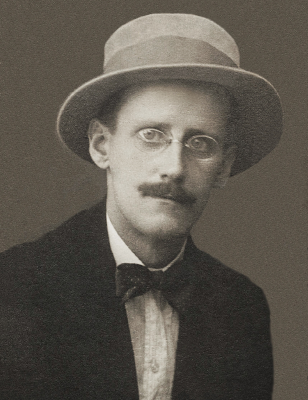
James Joyce (1882–1941) stands as one of the most celebrated and revolutionary figures in modern literature. Born into a middle-class family in Rathgar, Dublin, Joyce grew up in a rapidly changing Ireland, a backdrop that would profoundly shape his literary imagination. Educated by the Jesuits at Clongowes Wood College and later at University College Dublin, he excelled in languages and literature, developing a fascination with philosophy, aesthetics, and the complexities of human experience.
A writer of unparalleled innovation, Joyce’s works are known for their intricate use of language, stream-of-consciousness techniques, and deep psychological insight. His early collection, Dubliners (1914), presents a vivid portrait of Dublin life, marked by themes of paralysis and epiphany. His groundbreaking novel A Portrait of the Artist as a Young Man (1916) introduced his semi-autobiographical protagonist Stephen Dedalus, exploring themes of identity, rebellion, and artistic freedom.
Joyce’s magnum opus, Ulysses (1922), reimagines Homer’s Odyssey in the streets of Dublin over a single day, June 16, 1904. This modernist masterpiece employs experimental techniques, rich allusions, and meticulous detail, capturing the inner lives of its characters and elevating the mundane to the mythic. Though initially controversial and banned in several countries for its explicit content, Ulysses solidified Joyce’s reputation as a literary pioneer.
Joyce’s commitment to his craft often came at personal and financial cost. His self-imposed exile from Ireland took him to cities like Trieste, Zurich, and Paris, where he struggled with poverty and deteriorating eyesight while devoting himself to his art. His final work, Finnegans Wake (1939), pushed the boundaries of language and narrative further, presenting a dreamlike, cyclical exploration of history, myth, and the unconscious.
Joyce’s relationship with Ireland was both loving and contentious. While his works immortalize Dublin and its inhabitants, his criticism of Irish nationalism and religion often alienated him from his contemporaries. Yet, he remains a towering figure in Irish literature, capturing the essence of his homeland with unparalleled depth and complexity.
Despite his avant-garde style, Joyce’s themes of love, loss, identity, and human connection resonate universally. His legacy as a literary innovator continues to inspire writers and scholars worldwide, affirming his place as a cornerstone of modernist literature. “The Twilight Turns” and “At That Hour,” both found below, are two of his better known poems.
The Twilight Turns
The twilight turns from amethyst
To deep and deeper blue,
The lamp fills with a pale green glow
The trees of the avenue.
The old piano plays an air,
Sedate and slow and gay;
She bends upon the yellow keys,
Her head inclines this way.
Shy thought and grave wide eyes and hands
That wander as they list — –
The twilight turns to darker blue
With lights of amethyst.
At That Hour
At that hour when all things have repose,
O lonely watcher of the skies,
Do you hear the night wind and the sighs
Of harps playing unto Love to unclose
The pale gates of sunrise?
When all things repose, do you alone
Awake to hear the sweet harps play
To Love before him on his way,
And the night wind answering in antiphon
Till night is overgone?
Play on, invisible harps, unto Love,
Whose way in heaven is aglow
At that hour when soft lights come and go,
Soft sweet music in the air above
And in the earth below.

 Sparks of Calliope
If you enjoy Joyce’s verse and imagery, there is a poem and image that Joyce blended into his prose poem Giacomo Joyce. I hate posted about the cantos of Joyce’s confessional piece. If interested please see the dropdown menu at https://jamesjoycereadingcircle.com/2020/12/10/about-giacomo-joyce-gj-2/
enJoyce!
Don Ward
JamesJoyceReadingCircle.com and Finishing Ulysses
A Flower Given to My Daughter
Frail the white rose and frail are
Her hands that gave
Whose soul is sere and paler
Than time’s wan wave.
Rosefrail and fair — yet frailest
A wonder wild
In gentle eyes thou veilest,
My blueveined child.
LikeLiked by 1 person
The poems are remarkably accessible compared to the later novels. I admire the later novels too — except for those moments in Ulysses and Finnegans Wake where I just want to stop and strangle Joyce for making it so hard 🙂
LikeLike