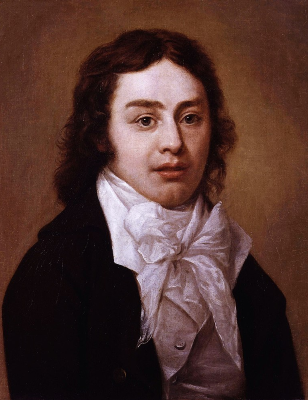
Samuel Taylor Coleridge (1772–1834) was a leading English Romantic poet, critic, and philosopher, best known for his imaginative verse and profound influence on literary theory. A central figure in the Romantic movement, Coleridge’s work is celebrated for its rich symbolism, vivid imagery, and exploration of the supernatural. Alongside his close friend William Wordsworth, he helped revolutionize English poetry with the publication of Lyrical Ballads (1798), a collection that marked the dawn of Romanticism.
Born in Ottery St Mary, Devon, Coleridge was the son of a clergyman and displayed prodigious intellect from an early age. He attended Christ’s Hospital School in London, where he formed a deep appreciation for literature, and later studied at Jesus College, Cambridge. However, financial struggles and personal turmoil led him to abandon his degree. During this period, he became interested in radical politics and utopian ideas, even briefly planning a communal society, or “Pantisocracy,” in America with fellow poet Robert Southey. Though this dream never materialized, it reflected his lifelong fascination with idealism and social reform.
Coleridge’s poetic genius is most evident in The Rime of the Ancient Mariner and Kubla Khan, two of his most famous works. The Rime of the Ancient Mariner is a haunting narrative poem filled with supernatural elements, moral ambiguity, and vivid natural imagery, while Kubla Khan, written under the influence of an opium-induced dream, captures an ethereal vision of creativity and lost splendor. His poetry often explores themes of nature, imagination, and the sublime, hallmarks of Romantic thought.
Despite his literary achievements, Coleridge struggled with ill health, financial instability, and a debilitating addiction to opium, which deeply affected his personal and professional life. His philosophical and critical writings, including Biographia Literaria (1817), had a profound impact on literary theory, introducing concepts of imagination and organic form that influenced generations of writers and thinkers.
In his later years, Coleridge withdrew from public life, living under the care of friends while continuing to write on philosophy, theology, and metaphysics. Though overshadowed in his lifetime by Wordsworth, his reputation grew after his death, and he is now regarded as one of the most original and influential minds of the Romantic era. His poetry and critical thought continue to shape literary studies, ensuring his legacy as a visionary poet and intellectual.
Samuel Taylor Coleridge is suggested quite often by readers as a poet who belongs on our list of the 5 Best Classic English Poets. And, while “Rhyme of the Ancient Mariner” is often sited as Coleridge’s best work, shorter poems that showcase his talent include “Frost at Midnight” and “Kubla Khan.” These can be read below.
Frost at Midnight
The Frost performs its secret ministry,
Unhelped by any wind. The owlet’s cry
Came loud—and hark, again! loud as before.
The inmates of my cottage, all at rest,
Have left me to that solitude, which suits
Abstruser musings: save that at my side
My cradled infant slumbers peacefully.
‘Tis calm indeed! so calm, that it disturbs
And vexes meditation with its strange
And extreme silentness. Sea, hill, and wood,
This populous village! Sea, and hill, and wood,
With all the numberless goings-on of life,
Inaudible as dreams! the thin blue flame
Lies on my low-burnt fire, and quivers not;
Only that film, which fluttered on the grate,
Still flutters there, the sole unquiet thing.
Methinks, its motion in this hush of nature
Gives it dim sympathies with me who live,
Making it a companionable form,
Whose puny flaps and freaks the idling Spirit
By its own moods interprets, every where
Echo or mirror seeking of itself,
And makes a toy of Thought.
But O! how oft,
How oft, at school, with most believing mind,
Presageful, have I gazed upon the bars,
To watch that fluttering stranger ! and as oft
With unclosed lids, already had I dreamt
Of my sweet birth-place, and the old church-tower,
Whose bells, the poor man’s only music, rang
From morn to evening, all the hot Fair-day,
So sweetly, that they stirred and haunted me
With a wild pleasure, falling on mine ear
Most like articulate sounds of things to come!
So gazed I, till the soothing things, I dreamt,
Lulled me to sleep, and sleep prolonged my dreams!
And so I brooded all the following morn,
Awed by the stern preceptor’s face, mine eye
Fixed with mock study on my swimming book:
Save if the door half opened, and I snatched
A hasty glance, and still my heart leaped up,
For still I hoped to see the stranger’s face,
Townsman, or aunt, or sister more beloved,
My play-mate when we both were clothed alike!
Dear Babe, that sleepest cradled by my side,
Whose gentle breathings, heard in this deep calm,
Fill up the intersperséd vacancies
And momentary pauses of the thought!
My babe so beautiful! it thrills my heart
With tender gladness, thus to look at thee,
And think that thou shalt learn far other lore,
And in far other scenes! For I was reared
In the great city, pent ‘mid cloisters dim,
And saw nought lovely but the sky and stars.
But thou, my babe! shalt wander like a breeze
By lakes and sandy shores, beneath the crags
Of ancient mountain, and beneath the clouds,
Which image in their bulk both lakes and shores
And mountain crags: so shalt thou see and hear
The lovely shapes and sounds intelligible
Of that eternal language, which thy God
Utters, who from eternity doth teach
Himself in all, and all things in himself.
Great universal Teacher! he shall mould
Thy spirit, and by giving make it ask.
Therefore all seasons shall be sweet to thee,
Whether the summer clothe the general earth
With greenness, or the redbreast sit and sing
Betwixt the tufts of snow on the bare branch
Of mossy apple-tree, while the nigh thatch
Smokes in the sun-thaw; whether the eave-drops fall
Heard only in the trances of the blast,
Or if the secret ministry of frost
Shall hang them up in silent icicles,
Quietly shining to the quiet Moon.
Kubla Khan
Or, a vision in a dream. A Fragment.
In Xanadu did Kubla Khan
A stately pleasure-dome decree:
Where Alph, the sacred river, ran
Through caverns measureless to man
Down to a sunless sea.
So twice five miles of fertile ground
With walls and towers were girdled round;
And there were gardens bright with sinuous rills,
Where blossomed many an incense-bearing tree;
And here were forests ancient as the hills,
Enfolding sunny spots of greenery.
But oh! that deep romantic chasm which slanted
Down the green hill athwart a cedarn cover!
A savage place! as holy and enchanted
As e’er beneath a waning moon was haunted
By woman wailing for her demon-lover!
And from this chasm, with ceaseless turmoil seething,
As if this earth in fast thick pants were breathing,
A mighty fountain momently was forced:
Amid whose swift half-intermitted burst
Huge fragments vaulted like rebounding hail,
Or chaffy grain beneath the thresher’s flail:
And mid these dancing rocks at once and ever
It flung up momently the sacred river.
Five miles meandering with a mazy motion
Through wood and dale the sacred river ran,
Then reached the caverns measureless to man,
And sank in tumult to a lifeless ocean;
And ’mid this tumult Kubla heard from far
Ancestral voices prophesying war!
The shadow of the dome of pleasure
Floated midway on the waves;
Where was heard the mingled measure
From the fountain and the caves.
It was a miracle of rare device,
A sunny pleasure-dome with caves of ice!
A damsel with a dulcimer
In a vision once I saw:
It was an Abyssinian maid
And on her dulcimer she played,
Singing of Mount Abora.
Could I revive within me
Her symphony and song,
To such a deep delight ’twould win me,
That with music loud and long,
I would build that dome in air,
That sunny dome! those caves of ice!
And all who heard should see them there,
And all should cry, Beware! Beware!
His flashing eyes, his floating hair!
Weave a circle round him thrice,
And close your eyes with holy dread
For he on honey-dew hath fed,
And drunk the milk of Paradise.
The informational article above was composed in part by administering guided direction to ChatGPT. It was subsequently fact-checked, revised, and edited by the editor. The editor/publisher takes no authorship credit for this work and strongly encourages disclosure when using this or similar tools to create content. Sparks of Calliope prohibits submissions of poetry composed with the assistance of predictive AI.
 Sparks of Calliope