Two Poems by Richard West

Requiem for a Sunset

The desert sky is shot with such a red – born of dust and fire –
that creatures pause, the plants submit, and earth itself is awed.
Vermillion is the evening’s gown and crimson glows its edge –
the rocks themselves reflect that light,
the clouds are dressed in it.

Small wonder then, that praise erupts across the desert floor
and from cathedral-canyon depths and mighty mesa spires.
Praise! the white coyote howls, and Praise! the eagle cries,
Praise the Spirit in the sky,
for wonders such that live to die.

And as the livid fire recedes and light and color dim,
choirs of faithful insects still fervent rise and sing.
But I am left to muse beneath that shattered stained-glass sky –
How can beauty be so brief,
that praise itself near turns to grief?


The Worst of Times?

We think the times in which we live
unique – or worse, that pain is ours alone.
But was ever there a time not so?
Has every age not seen the scourge of plagues
and spite of wars through endless years
when kingdoms rose and fell like waves
and empires spread like surging tides,
when religions, creeds, and schemes were born
and half the world went after them?
And what of unforeseen events –
of floods and storms and all earth’s shaking rage
as when Vesuvius spilled its awful fire
and mighty Krakatoa roared
(a shock felt round the world).
Were those times any different then?
Each age has had its own surprise
since that eon long ago
when great reptilian eyes beheld
a meteor falling through the skies –
the day the very oceans fled
and unsuspected, hell from heaven fell.


Richard West was Regents’ Professor of Classics in a large public university for a number of years. He has published numerous books, and many articles and poems under his own name or “Richard West” and other pen names.  He lives with his wife Anna in the beautiful American Southwest, where he enjoys cooking and trying to add flavor to his poems.

Two Poems by Diane Elayne Dees

A Final Offering

(an ekphrastic interpretation of George Rodrigue’s The Last Novena for Gabriel)

She kneels before the grave,
her hair in braids, a bouquet
of roses in her hand, and recalls
her wedding day. Sometimes,
she can still feel the brute pressure
on her arms as the red-coated men
pulled her out of the little church.
There was no blessing, no vows
were said. She was forced to sail
to a place called New England;
Gabriel, she heard, was in a place
called Louisiana—a land of giant
oaks and majestic birds
that skimmed the calm waters.
Evangeline searched for him
for years, crossing rivers and bayous,
only to encounter endless strands
of moss hanging from the trees
like scarves of mourning.
And now she has found his final
resting place, a simple grave
under a massive oak. The moss
hangs low over dark, foreboding
branches, forming a sacred arch
to enclose the final prayer—
her last gift to Gabriel, her love.


Le Grand Dérangement

(an ekphrastic interpretation of George Rodrigue’s A Final Look at Acadie)

Four women in long black skirts
and white-brimmed bonnets
stand on a wooden pier,
just a few feet away from a boat
that will take them to Britain,
New York, Massachusetts—
somewhere foreign—somewhere
they have never seen or imagined.
Their husbands, parents, cousins,
are scattered throughout the world.
Some made it to a place called
Louisiana, some drowned, some
were lost at sea, some died
from the ravages of winter
before they ever saw land.

Four women stand resigned,
as the dark sky behind them
foretells a fate that will change
their lives forever. Banished
from Acadie, they have already
met a kind of death. They take
one last look at the only home
that they have ever known,
and prepare to face the whims
of the rolling waves, the terror
of the unknown, the shame
of banishment. Now they must
say farewell and board the boat,
though they do not know why.


Diane Elayne Dees is the author of the chapbooks, Coronary Truth (Kelsay Books), The Last Time I Saw You (Finishing Line Press), and The Wild Parrots of Marigny (Querencia Press). She is also the author of four Origami Poems Project microchaps, and her poetry, short fiction and creative nonfiction have been published in many journals and anthologies. Diane, who lives in Covington, Louisiana, also publishes Women Who Serve, a blog that delivers news and commentary on women’s professional tennis throughout the world. Her author blog is Diane Elayne Dees: Poet and Writer-at-Large.

Two Poems by John Grey

That Fire of Long Ago

Flutter of curtain at night,
descendent of ancient flame

when the house that once stood here
was destroyed by fire
a hundred years ago –

that’s why,
within the gentle rustle,
there are shrieks to be heard

and as I slip slowly into sleep,
all around me
shadows throw themselves
against the windows
in a desperate struggle to escape –

flutter of breath at night,
my body fully rested,

though always with the caveat
that it could wake up as ashes.


The Surviving Side of the Family

Where is Mark?
At the beach rubbing oil into Janet’s fine skin.
And Marcus?
He’s from the extinct side of the family.
He has no blond, American grandchildren.

And Dinah?
She’s buttering the corn.
But Magda looked back like Lot’s wife.
And Lot and his missus have no place
on these rolling Cape Cod dunes.

Not everybody gets to be a snapshot
taken by a cell phone,
send from laptop to laptop
so much faster than the speed of history.

The water is light and salted
and filtered through years of suburban living.
There are no flashes of Jeramiah.
Everyone here can touch their nose
and raise their right hand at the same time.
The family tree may be bare on one side
but, on the other, even the third cousins
are accounted for.

What of Donna?
She’s a painter.
And Cassandra?
She’s married and has children.
The genes are in good hands.
They’re spread across the northeast.
Some have even ventured to the Midwest.
And Chloe’s scrambling eggs.
And Jake has travelled widely.
He’s even been to the old country.
No one there knew it was him.


John Grey is an Australian poet, US resident, recently published in New World Writing, North Dakota Quarterly and Tenth Muse. His latest books, Between Two Fires, Covert, and Memory Outside The Head, are available through Amazon. His work is upcoming in Haight-Ashbury Literary Journal, Birmingham Arts Journal, La Presa, and Shot Glass Journal.

Two Poems by J. A. Wagner

Visitors

visitors come, all through the day,
when the sun is here, and I am away,
soft September, days are mellow,
bright brown eyes, lashes yellow,
over the woods, to the west explore,
maybe a mile, likely more,
what nectar now, where to go?
daisies gone, hay cut low,
milkweed blowing, ragweed bent,
but one sweet source heaven-sent,
oh yes, still here, far from done,
shyly drooped, flowers of sun.


Next Summer

sweet summer zinnias,
alas, no more,
of those still colored,
maybe four,
all the rest,
though standing brave,
are dry and brown,
too gone to save–
time to pluck,
time to pull,
and gather seeds
till jars are full.


J. A. Wagner holds a Ph.D. in history from Arizona State University and has taught classes in British and American history at Arizona State and Phoenix College. A retired editor, he has written and published a dozen reference works in English and European history. His poems have appeared in Sparks of Calliope, Your Daily Poem, Blue Unicorn, WestWard Quarterly, and in the 2025 Wisconsin Poets’ Calendar. He splits his time between Wisconsin and Arizona.

Two Poems by Christopher Fried

To The Nation’s Credit

Before he sought the presidential spot
three times, (a losing gesture manifest
in all accounts), he railed against the plots
of slavocracy that had driven the test
of the states, if they should remain. His brother,
at one point, pushed to madness, (what newsmen
had said), knew that men made to rise must suffer
the meting out that causes most to give in.

His friend Fred Douglass knew that service must
be handled with responsibility.
Dear God, Not Mr. Blaine! This antitrust
legislation, the public voice agrees.


Kind words received then helped to face the hushed
retirement, where he sat dull dinners and teas.


Longstreet’s Postbellum Letters

“Bob Lee, you should’ve gone round to the right,
outflanking them that fearsome second day
as then I saw depart from those eyes light
that flickered when came back the wounded gray,
withdrawing from the charge that cracked the south’s
last hope. I knew your stolid heart was bound
with honor for the fallen men. Proud mouths
now closed, the rested were interred in grounds
too many miles from southern soil. Good sir,
I’m still “Old Pete,” your warhorse at command.
Why do they speak as if I lost the war
when only in thought did I countermand
those orders given? ’Cause I sprung my plans
for fostering the brotherhood of man?”


Christopher Fried lives in Richmond, VA and works as an ocean shipping logistics analyst. A poetry collection All Aboard the Timesphere was published in 2013 by Alabaster Leaves/Kelsay Books. His novel Whole Lot of Hullabaloo: A Twenty-First Century Campus Phantasmagoria was published in 2020. Recently, he was an advisor on the 1980s science fiction film documentary In Search of Tomorrow (2022). His recent poetry has been published in Society of Classical PoetsSnakeskin, and WestWard Quarterly, and a new collection, Analog Synthesis, is planned for publication by White Violet Press/Kelsay Books in Spring 2025.

Two Poems by Christopher Marlowe

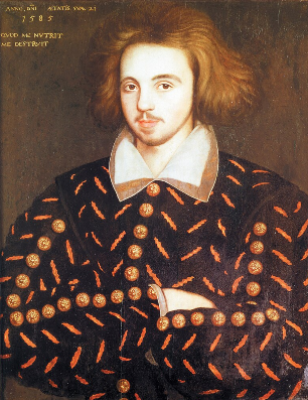
Christopher Marlowe (1564–1593) remains a towering figure of the English Renaissance, celebrated for his profound influence on Elizabethan drama and poetry. Born in Canterbury, the son of a shoemaker, Marlowe attended the King’s School and later Corpus Christi College, Cambridge, where he excelled in classical studies and earned a reputation for his brilliance and unorthodox thinking. His education, likely subsidized by influential patrons, provided him with the foundation for his later works that would redefine the English stage.

A contemporary of William Shakespeare, Marlowe is often credited with elevating the theatrical art form through his use of blank verse and grandiose themes. His plays, marked by their intellectual depth, bold exploration of power, and complex characters, include masterpieces such as Tamburlaine the Great, Doctor Faustus, and The Jew of Malta. These works delve into themes of ambition, morality, and human striving, reflecting Marlowe’s fascination with the limits of human potential and the price of overreaching.

Marlowe’s most famous play, Doctor Faustus, tells the story of a man who sells his soul to the devil in exchange for knowledge and power, a narrative that mirrors the playwright’s own interest in challenging societal and theological norms. His lyrical poetry, such as the pastoral elegy The Passionate Shepherd to His Love, showcases his ability to craft both profound and delicate verse, securing his place among the great poets of his age.

Despite his artistic achievements, Marlowe’s life was as dramatic and enigmatic as his works. A suspected spy for Queen Elizabeth’s government, he operated in shadowy political circles, which may have contributed to his mysterious death. In 1593, at just 29 years old, Marlowe was fatally stabbed in what was officially deemed a dispute over a debt, though speculation persists regarding political intrigue or espionage.

Marlowe’s untimely death robbed the world of a playwright whose genius might have rivaled or surpassed Shakespeare’s. Nevertheless, his influence endures, particularly in the development of blank verse and the portrayal of ambitious, larger-than-life characters. Marlowe’s legacy lies in his fearless exploration of human desire and defiance, his works offering a daring and innovative vision that continues to resonate with audiences and readers, cementing his status as a cornerstone of English literature.

Marlowe’s most recognizable poem (found below) would be “The Passionate Shepherd to His Love,” which was famous enough for Sir Walter Raleigh to write a response a few years later. Another notable work was the unfinished “Hero and Leander,” a lengthy poem which is also exerpted below.


The Passionate Shepherd to His Love

Come live with me and be my love,
And we will all the pleasures prove,
That Valleys, groves, hills, and fields,
Woods, or steepy mountain yields.

And we will sit upon the Rocks,
Seeing the Shepherds feed their flocks,
By shallow Rivers to whose falls
Melodious birds sing Madrigals.

And I will make thee beds of Roses
And a thousand fragrant posies,
A cap of flowers, and a kirtle
Embroidered all with leaves of Myrtle;

A gown made of the finest wool
Which from our pretty Lambs we pull;
Fair lined slippers for the cold,
With buckles of the purest gold;

A belt of straw and Ivy buds,
With Coral clasps and Amber studs:
And if these pleasures may thee move,
Come live with me, and be my love.

The Shepherds’ Swains shall dance and sing
For thy delight each May-morning:
If these delights thy mind may move,
Then live with me, and be my love.


It lies not in our power to love or hate

an excerpt from “Hero and Leander

It lies not in our power to love or hate,
For will in us is overruled by fate.
When two are stripped, long ere the course begin,
We wish that one should lose, the other win;
And one especially do we affect
Of two gold ingots, like in each respect:
The reason no man knows; let it suffice
What we behold is censured by our eyes.
Where both deliberate, the love is slight:
Who ever loved, that loved not at first sight?


The informational article above was composed in part by administering guided direction to ChatGPT. It was subsequently fact-checked, revised, and edited by the editor. The editor/publisher takes no authorship credit for this work and strongly encourages disclosure when using this or similar tools to create content. Sparks of Calliope prohibits submissions of poetry composed with the assistance of predictive AI.
Two Poems by Felicia Nimue Ackerman

Rose and Blue

My hospice room is rose and blue.
The blue is like the sky.
They think that if you’re happy here,
You’ll be content to die.
They proffer comfort, warmth, and peace,
All shining like the sun.
They strive to meet your every need.
They meet all needs but one.
So now I have another scheme,
My object all sublime.
I’ve gotten on a transplant list,
And so I bide my time.

“Rose and Blue” first appeared in Ragged Edge Online.


Professor Superstar

He values his peers, but he snubs lesser scholars
As if they could scarcely be seen.
He thinks that this shows that his standards are lofty.
It really just shows that he’s mean.

“Professor Superstar” first appeared in The Providence Journal.


Felicia Nimue Ackerman is a professor of philosophy at Brown University and has had over 300 poems published in a wide range of places, including twenty-six in past issues of Sparks of Calliope.

Two Poems by Lynn White

Spanish Room

We were pleased when the smiling nun
shook her head.
They were full, the lorry driver told us.
He was disappointed.
He thought we’d be safer
in the out of town convent than in the city.
He’d grown concerned for our safety
on our long journey through France.
He was nice – ‘doux, comme le sucre’
my friend would often tell him.
But he didn’t understand her accent.

He said his lorry wouldn’t fit
the narrow streets, so
we took a cab to the pension he knew.
Our first Spanish room
and we were happy!
The tiles were cool, if dusty.
We covered the TV.
We didn’t need it.
Two single beds pushed together
with one mattress
to make a ‘cama matrimonial’,
normality in Spain.
The owner was nice,
‘doux, comme le sucre’
my friend told him.
But he spoke no French.

We shopped in the corner shop with
it’s curved window
and explored the streets
of clubs and cafes and bars and lively people
enjoying the night.
And then we returned home.
Home to a locked door that
no amount of banging or shouting would
cause to open.
A friendly passer by understood our plight
and clapped his hands loudly.
A man appeared with a bunch of keys,
enough to fit the locks of several streets.
Normality when Franco reigned.
He let us in with a smile.
He was ‘doux, comme le sucre’
my friend told him,
but he didn’t understand.

Forty years later we found the street.
The curved shop window gave it away.
It was all still there, though only in facade,
waiting for reconstruction or demolition.
It was our first Spanish room
and we were happy.
The facade of a memory that
is still there and remains:
‘doux, comme le sucre’.
And we understand.


The Empty House

It fascinated us as children,
the empty house in the countryside
where we walked the neighbour’s dog.
Why was it empty?
Who had lived there?
We imagined secret passages
leading to priest holes,
walled up dead bodies
and buried treasure.
No one knew.
But we knew
that the dog was reluctant to go near
and we had heard that dogs were sensitive
to the spirit world.
So we knew
it was haunted.
That ghosts lived there,
spirits of the past.
We dared each other to enter
through the broken window.
Maybe we broke it first,
but I don’t remember that.
In the end we all went in,
leaving the dog outside.
But there was nothing.
Just a house.
Empty.
Ordinary.
Not spooky.
Just empty.
I passed it today,
all these years later.
There’s no entering now.
Police tapes surround it.
Maybe the dog knew
that the ghosts were of the future,
not the past.


Lynn White lives in north Wales. Her work is influenced by issues of social justice and events, places and people she has known or imagined. She is especially interested in exploring the boundaries of dream, fantasy and reality. She has been nominated for a Pushcart Prize, Best of the Net and a Rhysling Award. Visit her blog or find her on Facebook.

Two Poems by James Joyce

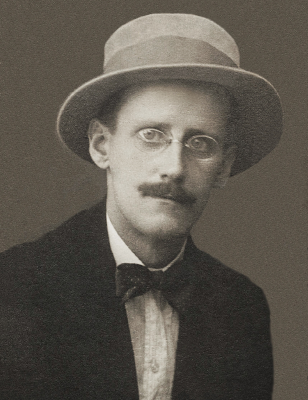
James Joyce (1882–1941) stands as one of the most celebrated and revolutionary figures in modern literature. Born into a middle-class family in Rathgar, Dublin, Joyce grew up in a rapidly changing Ireland, a backdrop that would profoundly shape his literary imagination. Educated by the Jesuits at Clongowes Wood College and later at University College Dublin, he excelled in languages and literature, developing a fascination with philosophy, aesthetics, and the complexities of human experience.

A writer of unparalleled innovation, Joyce’s works are known for their intricate use of language, stream-of-consciousness techniques, and deep psychological insight. His early collection, Dubliners (1914), presents a vivid portrait of Dublin life, marked by themes of paralysis and epiphany. His groundbreaking novel A Portrait of the Artist as a Young Man (1916) introduced his semi-autobiographical protagonist Stephen Dedalus, exploring themes of identity, rebellion, and artistic freedom.

Joyce’s magnum opus, Ulysses (1922), reimagines Homer’s Odyssey in the streets of Dublin over a single day, June 16, 1904. This modernist masterpiece employs experimental techniques, rich allusions, and meticulous detail, capturing the inner lives of its characters and elevating the mundane to the mythic. Though initially controversial and banned in several countries for its explicit content, Ulysses solidified Joyce’s reputation as a literary pioneer.

Joyce’s commitment to his craft often came at personal and financial cost. His self-imposed exile from Ireland took him to cities like Trieste, Zurich, and Paris, where he struggled with poverty and deteriorating eyesight while devoting himself to his art. His final work, Finnegans Wake (1939), pushed the boundaries of language and narrative further, presenting a dreamlike, cyclical exploration of history, myth, and the unconscious.

Joyce’s relationship with Ireland was both loving and contentious. While his works immortalize Dublin and its inhabitants, his criticism of Irish nationalism and religion often alienated him from his contemporaries. Yet, he remains a towering figure in Irish literature, capturing the essence of his homeland with unparalleled depth and complexity.

Despite his avant-garde style, Joyce’s themes of love, loss, identity, and human connection resonate universally. His legacy as a literary innovator continues to inspire writers and scholars worldwide, affirming his place as a cornerstone of modernist literature. “The Twilight Turns” and “At That Hour,” both found below, are two of his better known poems.


The Twilight Turns

The twilight turns from amethyst
To deep and deeper blue,
The lamp fills with a pale green glow
The trees of the avenue.

The old piano plays an air,
Sedate and slow and gay;
She bends upon the yellow keys,
Her head inclines this way.

Shy thought and grave wide eyes and hands
That wander as they list — –
The twilight turns to darker blue
With lights of amethyst.


At That Hour

At that hour when all things have repose,
O lonely watcher of the skies,
Do you hear the night wind and the sighs
Of harps playing unto Love to unclose
The pale gates of sunrise?

When all things repose, do you alone
Awake to hear the sweet harps play
To Love before him on his way,
And the night wind answering in antiphon
Till night is overgone?

Play on, invisible harps, unto Love,
Whose way in heaven is aglow
At that hour when soft lights come and go,
Soft sweet music in the air above
And in the earth below.


The informational article above was composed in part by administering guided direction to ChatGPT. It was subsequently fact-checked, revised, and edited by the editor. The editor/publisher takes no authorship credit for this work and strongly encourages disclosure when using this or similar tools to create content. Sparks of Calliope prohibits submissions of poetry composed with the assistance of predictive AI.
Two Poems by S. A. Crawford

Among the Tombstones

In the big, open cemetery
I walk among the tombstones
in the daylight, soft hands
scraping along the grainy granite tops
of the taller head-masts.
So many rocks here
in the big cemetery,
so many rocks
cut-carved to some undeniable perfection
of geometry,

as if they never could have been anything else,
as is shape itself simply and quietly slipped into destiny.

It’s not amazing or frightening,
thinking of being with them one day,
a common joiner of the ethereal club,
another simple member of the dirt and the dead.
Gives me peace,
knowing to enter endless
will be a time of together,
not friendless, not alone,
but of ubiquitous,
among the great, vast universal bind—
electric-warm handshake within the greatness
of ever-expanse . . .

. . . that will again wake me
in a flash of my birth.
Then, one day
again I will roam ‘n toss among the tombstones, say, “ . . .
Who knows?
since something else then I’ll be—
perhaps a flit of wings
—suddenly,
I’ll hear.


Handbook of a Painter’s Life

You, hold out you hand—

It’s forever still in time
that what handed this painted stay.

There is an ancient question that rises—
instilled universal in the infinite bind
as that, all that will come to matter.

You, holding out your hand,
Sense what, Feel what,
that what mattered summoned anew
the ancient question?

You who hold out you hand—
What touches back?
There is no forward, only
what you’ve touched
that touches back.