“Dancer? Panther?” by Maureen Teresa McCarthy

There are no cougars here
On this high ridge
Between narrow lakes
Not now, in this modern year
They’ve gone
Those sleek black cats
Lean and lithe
The panther, the cougar
The wild has been tamed
But I know what I know
And I saw one once
Not long ago

I was walking
The edge of the forest
After spring snow
Huge maples, matriarch trees
Stretched bare limbs to the road
Underfoot, the crunch of icy white
Looking up, a soft gray sky
And then, a living eye

An enormous cat, big as the average dog
Spread long overarching limb
Pointed ears, unblinking stare
A sharp feline face
Framed in black fur
Hanging down, a long thin tail
Making a perfect arc
As it swung back and forth
Marking time a metronome

My dog my lovely Shepard
Friend of fifteen years
Growled low and pulled me back
As a scream rent the air
Echoing into the silence
Fading into the forest

Later that same spring
In the first flush of new green
I walked in the city
Under trees wearing pale mist
Looking up into towering clouds
Far ahead, a woman proud

She strode out from a doorway
Poised, strong, lean, lithe
As a black cat, maybe a panther.
From her shoulders swung
A black cape lined in red
Over a slim black dress
She wore her steel gray hair
Sleek and tight
In a smooth chignon
Silver earrings dripped from her ears
A silver collar framed her neck

She flowed, easily as a cat
Into an open black car lined in red.
The engine purred and she was gone
Into the forest of city streets

As in a dream
Both faded away
The dancer and the panther
Leaving only the wonder
Under the spring sky
Which one
Is the dream of the wild?


Maureen Teresa McCarthy has published poems and essays in Bloom Later, Comstock Review, Months to Years, Pen Woman, Plum Tree Tavern, Tiny Seed, Writing in a Woman’s Voice, and others. Her work focuses on nature, imagination, and myth. She has lived and written in California, Europe, and Mexico, but is at home in the Finger Lakes of central New York.
Two Poems by Matthew James Friday

The Mole Crab

Bandon beach. An elderly woman
caged in a pink coat pokes exposed
soft shells and mechanical innards.

She calls out to ask what it all is.
We stand around hypothesizing:
prehistoric crab? Armored shrimp?

Feathery hems confuses us all.
She asks us to find out, tell her.
Her husband rolls his eyes.

The internet says: mole crab.
They live in the frothy surf,
flying little filament flags to catch

the drifting winds of plankton.
We see the woman on the way back.
Despite deafness, we inform her.

A few waves of gratitude and she
wanders off with husband to bury
herself back into our unknowing.


Route 22 Memorial

On Route 22 to Bend we pass Mill City and
the blasted heaths of last summer’s fires,
so bad they closed Portland, millions muffled.

The road passes through blackened brigades
of Santiam Forest trees and piles of the fallen,
heaped up in snow stained charnel clearances.

In vacated lots the rubble of homes linger,
indiscriminately chosen by the concentration,
a few ironic fireplaces and chimneys still standing.

Skeletal cars lay scattered like shells. Trailers
have multiplied. Blink and you might think tourists.
A few pristine houses escaped the fist of the fire.

The burnt skin of the hills with charcoaled trees
like my grandfather whose hair fell out during
World War Two’s shock and North African heat.

The Santiam river slips past guiltily. We climb
towards the Willamette National Forest, soothing
rain becoming concerning snow. At Detroit Lake,

we find a European battlefield, blackened stumps
memorialising the mud. The dead cleared to create
a buffer zone. On one side of Detroit, a motel sign

hangs by the stony scar of itself. On the other side
the grocery store is still surviving. More rubble piles,
more sudden trailer living and lonely fireplaces.

Leaving we smell woodsmoke and see smoldering
signals that in the earth not all is forgotten, people
trying to live and not worry about next summer.


Matthew James Friday is a British-born writer and teacher. He has been published in numerous international journals, including, recently: Dawntreader (UK), The Dillydoun Review (USA), VerbalArt (India), and Lunch Ticket  (USA). The micro-chapbooks All the Ways to Love, The Residents, Waters of Oregon, and The Words Unsaid were published by the Origami Poems Project (USA).  Matthew is a 2021 Pushcart Prize-nominated poet. Learn more about him at http://matthewfriday.weebly.com.

Two Poems by James A. Tweedie

Summer Days

Beneath a broad-leafed maple tree, the sun
Spreads shifting green-shade shadows on the lawn.
As overhead, where new life has begun,
The chirps of hungry hatchlings greet the dawn.

The coolness of the morning dew belies
The mid-day heat that soon will sear the air
And fall like silent rain from cloudless skies
To bathe the earth in whispered, wordless prayer.

Yet underneath the tree a freshing breeze
Anoints the sheltered shade as sacred space
Where angels, dressed as butterflies and bees,
Descend as earth and heaven interlace.

And there the little child who leads them plays,
And idly whiles away his summer days.


We Dreamed of Tomorrows

The chill winter wind bites through flesh to the bone
As grey steely skies freeze the sun in its place.
My exhaled breath adds a cloud of its own,
Congealing to ice on my hair and my face.

How often we walked on this path to the sea
On warm summer days when the dune grass was green.
We danced to the sound of the waves; we were free.
We dreamed of tomorrows and things yet unseen.

The children we raised now live lives of their own.
The years came and went, with a blink and a blur,
What once was unseen has become what is known,
And dreams we once dreamed have become what once were.

I shiver as wind chills my flesh to the bone
And walk on the path through the dune grass, alone.


James A. Tweedie lives in Long Beach, Washington. To date he has published six novels, three collections of poetry, and one collection of short stories with Dunecrest Press. His poetry has appeared nationally and internationally in both online and print publications. He received first place in the 2021 Society of Classical Poets poetry competition, and was a Laureate’s Choice Award winner in the 2021 Maria W. Faust sonnet contest.

Two Poems by Herman Melville

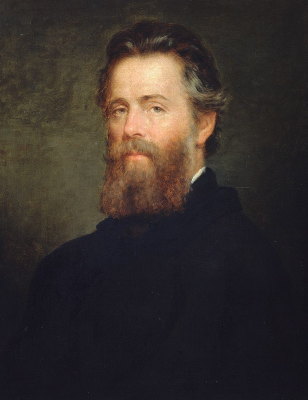
Portrait of Melville by Joseph Oriel Eaton, oils on canvas, 1870

While participating in a memorial ceremony this weekend for the Union dead from Missouri units at the battle of Shiloh, I heard an orator read the first of two poems below written by Herman Melville (1819-1891), perhaps most famous for his epic novel Moby-Dick. It struck me how his famous tale of the obsessive hunt for Captain Ahab’s whale likely more often than not overshadows Melville’s skills as a poet and his chronological place among his contemporaries. His talent is demonstrated in the two selections included below.


Shiloh: A Requiem (April 1862)

Skimming lightly, wheeling still,
     The swallows fly low
Over the field in clouded days,
      The forest-field of Shiloh—
Over the field where April rain
Solaced the parched ones stretched in pain
Through the pause of night
That followed the Sunday fight
     Around the church of Shiloh—
The church so lone, the log-built one,
That echoed to many a parting groan
          And natural prayer
     Of dying foemen mingled there—
Foemen at morn, but friends at eve—
     Fame or country least their care:
(What like a bullet can undeceive!)
     But now they lie low,
While over them the swallows skim,
     And all is hushed at Shiloh.


Sheridan at Cedar Creek (October 1864)

Shoe the steed with silver
     That bore him to the fray,
When he heard the guns at dawning—
               Miles away;
When he heard them calling, calling—
          Mount! nor stay:
               Quick, or all is lost;
               They’ve surprised and stormed the post,
               They push your routed host—
     Gallop! retrieve the day!
 
House the horse in ermine—
     For the foam-flake blew
White through the red October;
     He thundered into view;
They cheered him in the looming;
     Horseman and horse they knew.
               The turn of the tide began,
               The rally of bugles ran,
               He swung his hat in the van;
     The electric hoof-spark flew.
 
Wreathe the steed and lead him—
     For the charge he led
Touched and turned the cypress
     Into amaranths for the head
Of Philip, king of riders,
     Who raised them from the dead.
               The camp (at dawning lost)
               By eve recovered—forced,
               Rang with laughter of the host
      At belated Early fled.
 
Shroud the horse in sable—
     For the mounds they heap!
There is firing in the Valley,
     And yet no strife they keep;
It is the parting volley,
     It is the pathos deep.
               There is glory for the brave
               Who lead, and nobly save,
               But no knowledge in the grave
     Where the nameless followers sleep.

Two Poems by Bex Hainsworth

Tuesday’s Child

My dear sweet, little sister:
an annoyance sent by angry storks.
Oh, how with floppy tongues they flock.
She is a nymph and I, Medusa.
If only they would love me the way they love her.

Her room is pink as embarrassing thoughts.
Cushions flower on her bed like rose quartz.
The curtains flush with a secret,
falling crushed on the carpet.
The only survivor is a nervous wooden door.

I despair of her blushing room.
I want to throw paint on her walls
and make one vast black hole
to draw out the crimson bloom
like venom from an aching wound.

Yet, she knows the words and looks that cut
only mask an older sister’s love.
I remember the night before her operation
she crawled into my bed at 4am
and I held her while she shook.


Arcs

At twenty-two, I accepted a teaching job
and moved into my first apartment.
Tucked away in the hips
of a hollowed-out hosiery factory,
my walls were red brick and white plaster.
That winter, every morning alarm began
in the dark. I set the coffee machine spluttering
and turned on BBC News:
the perfect emulation of adulthood.
Back then, I didn’t know
we were sharing the same cold.
You lived in the ribs, in a perpetual
blanket cocoon, eyes narrowed at the puttering
of the electric heater. I dragged my duvet
to the living room and marked essays,
your almost-image, imperfect parallel.
When they dug up the king in the car park,
I wonder if you joined me in the crowd
that gathered only yards away from
the rosy bones of our chilly homes,
trying to catch a glimpse of a funeral
five hundred years in the making.
Maybe we were shoulder to shoulder,
then turned and walked away from each other
along the arcs of a five-year circle.


Bex Hainsworth is a poet and teacher based in Leicester, UK. She won the Collection HQ Prize as part of the East Riding Festival of Words and her work has appeared or is forthcoming in Visual Verse, Neologism, Atrium, Paddler Press, Canary, and Brave Voices Magazine. Find her on Twitter @PoetBex

“I Am Spending Down” by Glenn Ingersoll

I am spending down my life.
I had too much of it stored away
in jars, in file cabinets, in pecunious banks.
So I get some of it out
to spend frivolously,
to give to others some.
Getting out what was put away for later
has fascinated by what
didn’t happen,
what began but only went on so long.
I forget for a moment I was alive
even then,
doing as much as I could.
I didn’t know I was stowing away could-have-beens.
I thought the crumbs put aside
weren’t nearly enough,
not for that day,
not for any day I was already in.
Yet here they are.
Here they are piled up –
too much for me,
too much for me
even now.


Glenn Ingersoll works for the public library in Berkeley, California. His poetry reading & interview series Clearly Meant is on covid hiatus, but videos of past events can be found on the Berkeley Public Library YouTube channel. Ingersoll’s prose poem epic, Thousand, is available from bookshop.org and as an ebook from Smashwords. He has two chapbooks, City Walks (broken boulder) and Fact (Avantacular). He keeps two blogs: LoveSettlement and Dare I Read. Poems have recently shown up in Sparkle & Blink, Rejection Letters, flux, and Spillwords.

“End of the World” by Mary Paulson

While you’re taking a shower or
mowing the lawn, buying
a banana at the fruit cart—
an abrupt,
soundless silence—
alien, lacking vibration, ambition,
movement, it perforates
the tender membrane, consciousness
leaking, tiny holes punched
with impossible speed, this
un-sound surrenders
existence for you. You strain
tiny human ears to not hear
absence, unimpassioned annihilation,
feel your peripheries
dispatched, the
whole design undone—

Remember seasons? Plots of
summer books? Parents
before they got old? Wasn’t I also
going to grow old?
Remember West Wing re-runs
in bed with the dog?
In the midst of erasure, I find myself
crying for the dog. I hold
in front of me what’s left of my
open palms. Was everything
I once held impossible?

My hope is
we will be fearless—
as a species—
finally fearless, gentle,
quick to forgive—
that we gulp at the dark
last call with an open-mouthed yes.
Then, newborn sleep resembling
vastness, up in a treetop
somewhere
with the stars.


Mary Paulson‘s writing has appeared in Slow Trains, Mainstreet Rag, Painted Bride QuarterlyNerve CowboyArkanaThimble Lit MagazineTipton Poetry JournalThe Metaworker Literary Magazine, Months to Years, Speckled Trout ReviewFleas on the DogChronogramSwamp Ape ReviewPine Hills Review and Backchannels. Her chapbook, Paint the Window Open was recently published by Kelsay Books.

Two Poems by Michelle DeRose

Dilemma

Say a cat limps into your yard,
a cat with singed whiskers, a fear
of play. Say your six-year-old
pounces at the chance to love
a smaller creature, builds it forts,
blanket beds, preserves it
the last bits of his favorite dinner,
falls to sleep draped beneath
its paw and awakens early.
You try: post signs, ask around,
check the paper’s lost and found.
He pleads to put the paper down.
You finally do. He names the cat.
Wilks is sleeping on his lap
when you learn your brother’s
friend’s neighbor lost one, gone
when his son held its head too close
to a candle. Really is all
he says. I leave it up to you.


Epic of a Winter Evening

Let the muse be silent! The fire’s lit.
The only song belongs to the log’s hiss.
Cradled in perfection of the fit,
my head rests in this underworld of bliss
where the curve of my cheek slides easily to its place
of neck and shoulder joined above the heart.
I need no armor, desire only to face
you unadorned, no sting of a god’s dart.
I sing of your arms, fated to draw me
deep into this Thursday night of snow
to ponder the night’s only mystery:
the rise and fall of flicker, ash, and glow.
Though fate ordains the adversaries fight,
Hector couples with Andromache tonight.

“Epic of a Winter Evening” first appeared in The Sweet Annie & Sweet Pea Review.


Michelle DeRose teaches creative writing and African-American, Irish, and world literature at Aquinas College in Grand Rapids, Michigan. Her most recent poetry has appeared or is forthcoming in Dunes Review, Making Waves, The Journal of Poetry Therapy, and Healing Muse.

“Sold” by Susan Jarvis Bryant

I. Summer Honey Crush

Soft, silken lips shone from her screen last night.
She saw them, plump and ripe, as smooth and lush
As velvet peaches kissed by Sol’s delight.
If her smile blushed in Summer Honey Crush
She’d beam a flirty grin to light his eyes –
That guy who rides the seven-thirty train
To Charing Cross would turn her sighs to highs.
They’d brave the slate-grey skies. They’d waltz in rain.
They’d skip through puddles in Trafalgar Square
(Just like the lovers did on last night’s ad)…
Like Piccadilly clouds, they’d float on air
To rainbow zones where joy eclipses sad.
Their lips would lock and rayless days would rock…
But Summer Honey Crush is out of stock.


II. Silver-Stardust 

She rides the daily seven-thirty train
To Charing Cross – she lights his humdrum trips.
Her muted beauty has no need for vain
Displays of painted nails and glossy lips.
He dreams of wowing her with glam and glitz.
They’d cruise in bliss to bistros by the beach –
The soft-top down, they’d laugh and sing and kiss…
But wishes, priced sky-high, are out of reach.
That Silver-Stardust, red-trimmed, sporty car
(The sleek, pristine machine on last night’s ad)
Would spin them through the spheres to Shangri-La,
Secure her heart and make his ever glad…
They’d melt beneath the moon, him and his honey,
If only he had Silver-Stardust money.


Susan Jarvis Bryant has poetry published on Lighten Up Online, Snakeskin, Light, Sparks of Calliope, and Expansive Poetry Online. She also has poetry published in TRINACRIA, Beth Houston’s Extreme Formal Poems anthology, and in Openings (anthologies of poems by Open University Poets in the UK). Susan is the winner of the 2020 International SCP Poetry Competition and has been nominated for the 2022 Pushcart Prize.

Two Poems by Luca D’Anselmi

The Basement

Come with me to the basement, where we dry
prosciutto from the crisscrossed beams, and keep
clay jars of water to humidify
the air that’s always evening air, where deep

set rows of iron nails have slowly bled
their rust down ancient frescoes on the wall,
or what remains of them: a soldier’s head
that’s looking for its feet, and in a shawl

a mother clinging to her privacy
who crumbles as she views whatever sight
was painted next to her—now empty space—
her prayer unraveling for eternity
inside a ragged breathlessness of fright
and trembling as she tries to hide her face.

“The Basement” was first published by Wine Cellar Press


Librarium

I think of you in the librarium
where I store letters, histories, and memoirs
pickled chronologically in jars
of brine and vinegar, though sadly some
books of astronomy exuded scum
because their illustrations had dissolved,
and others inexplicably evolved
ecologies in equilibrium,
where algae thrive, and young monastic snails
take vows, grow old, outlive their lovers, grieve
for old miscalculations, slowly leave
mixed messages behind in slimy trails,
and clean the inky glass so I can see
unopened letters that you wrote to me.


Luca D’Anselmi teaches Latin and Greek. He lives in Bryn Mawr, Pennsylvania.