On Hiatus: February 19, 2025 – March 3, 2025

Sorry for the break folks! But labors of love are exhausting sometimes…

Unfortunately, this means no new poetry on:

February 19, 2025
February 22, 2025
February 25, 2025
February 28, 2025
March 3, 2025

All unread submissions past and present will be considered in the order they were received. Our next scheduled poetry will post on March 6, 2025. In the meantime, we encourage you to browse our past contributors, like and comment on their work, and maybe even donate to help keep this endeavor afloat if you find us worthy. We’ll be right back, bringing you the quality poetry you have come to expect from our journal. Thank you for visiting!

“3 of Hearts” by Royal Rhodes

Foolish heart, the tell-tale signs that show
discordant tempo: what was cordial, pumping
back and forth, constricting, then a slow
relaxing, fail in flushing blood. The thumping,
twitching quickly, like contrition late,
stops, a flat line, not a rhythmic wave.
Structured in a diamond pattern, plate
by plate of muscle died. It could not save
itself. For years, like cannibals who eat
their victim’s heart, I gorged upon my own.
Sad, resigned, abandoned to defeat,
the hardened heart had closed to be alone.
And then that rigor mortis ended. Life
began, as love became the surgeon’s knife.

Riven heart, the driver killed today,
crushed by steel, required “jaws of life”
to fight the jaws of death. They found a way
to extricate a heart, and someone’s wife
became a widow, as they scissored clothes
with shears, honed to cut through skin and bone,
to find that heart, and — cutting — then dispose
of mine, the broken one, the vessel grown
deficient in its task, a vital symbol
linked to all that life had come to lack,
badly patched by needle, thread, and thimble.
While naked, I was stretched upon my back.
 From cavity to cavity the soul
filled me with the fractured life I stole.

A rococo box, built of glass and gilt,
exposes on dusty velvet a dried-out heart,
with linen strips on which its blood was spilt
and sopped. Police let a fervent crowd depart,
that had joined when executioners dismembered
the rebel whose death was later termed a miracle,
but whose metric lines were burned, and none remembered.
 From the gallows the dying eye, wide and spherical,
imprinted the faces of men and angels upon
the blood that sealed the heart, and later found
inside its sheltered chambers, like the fawn
who bore a lost child’s name when run to ground.
And when I kiss your sleeping heart, that kiss
raises blood, a relic from our bliss.


Royal Rhodes is a retired educator who lives in a village in the midst of farmland in Ohio. His poems have appeared in: Sparks of Calliope, Last Stanza, Ekstasis, Ekphrastic Review, Club Plum, and others.
Two Poems by Paul Gerard Dalton

The Painter’s Eye

By spangled copse, grubbed out delves
past bosky stands
to the sound of distant bells
cross weeded streams
where Ophelia dreamed
sunlight makes its swaggering way
to light the stippled trunks
of youthful silver birches.

All this passed in blurring tones
thumbed in careless smirches.
The painter would have spent an hour
to dab a knife upon the smudges
scything colour from colours,
smearing them to get the changing hue.
The mood of light built up
like thoughts piling despair on loss.

Other pictures intervene.
Spattering rain upon the windscreen
stretches colours into different tensions
hard to tell the woodsman from the trees.
We see the gleaner’s grain
sheaved stalks and forked carts of corn
the horse its load across the field.
Now a lone tractor harvests the land

driver’s music clamped round his ears.
Then bonneted workers in shady groups
all talking with cooling jugs of beer
resting from the race
to get the crop before the rain
moonlight harvesting beneath the circling bats
the chasing of the rabbits and the rats.
Now we drive through Dedham Vale

speeding while the spider spins
missing where the wild things hale:
the shaggy ink cap, the ruddy darter,
hunting, skulking, lurking.
We could benefit to muse for half an hour
imagine Millais on the Hogsmill river
and on the River Stour
be arrested by Constable’s way of working.


Control

Waves turn and turn away.
Fingered water rattles pebbles
like rosaries in hallowed hands
sieving fizz through stones
that freeze and burn.
Day breaks on an empty beach.

There’s a flush on the horizon
a sculptor squeezing clay
reforming the world.
Local artists manifestos
pinned like Luther’s theses
fluttering on a church door.

Indulgent patient patrons
askance at rampant colours
in the swirling tide
try shoring up coasting artists
defying the curfew
on the town’s limits.


Paul Gerard Dalton is based in Southwest London, UK. His first selection of poetry ‘Fielding Memories, Poems and Other Recalls’ was published in April 2024. He is a singer songwriter guitarist and has two solo music albums available online at: paulgerarddalton.bandcamp.com. Recently he has turned to recording spoken word accompanied by tunes he has composed. His Facebook page is titled ‘Poems For The Many’ where he places early versions of unfinished work. In 2024, his poems have been published in The Cannon’s Mouth and The Crank.

Two Poems by M. Benjamin Thorne

The Argument

I.

When I was nine, God was a bush aflame,
a sacred secret burning thing alive
in some empty and forsaken desert.

At ten he became a name invoked
over the bodies of dead relatives
I once knew, lowered into the strange earth.

Then later he became You. You, who fashioned
all from nothing with a simple wish.

II.

I stand at Babi Yar’s edge, peering down
to where 33,771 Jews and 100,000 others
were laid low: here the woman
who saw her daughter shot just before;
there an old man still thinking his life
can be bought for four teeth’s worth of gold.

Where were You then, when the barrel roughly
nuzzled the nape of this boy’s neck?

Where were You, when this girl’s blood
exploded onto her killer’s shirt?

The scratches etched by finger-bones
on gas chamber walls—each of them spells Yahweh.
Did You provide them one last sweet breath?

There are times I wish to disbelieve in You,
banish you into superstitious myth;
but still my faith persists, because only in a universe
so infinite as to contain You could such cruelty exist.

It is the times I feel You with me
that are the most unforgiveable.


Oracles

There are times when I wish desperately
to hear your voice again for the first time
so that I could come to it again
innocent, move through your words
as stars guided the ships to Delphi
delivering their cargo (questions),
and stand before the oracle’s cave,
see the goat, cold-water-splashed, shivering, 
and know that I may enter the mystery
and feel my being answered.


M. Benjamin Thorne is an Associate Professor of Modern European History at Wingate University. Possessed of a lifelong love of history and poetry, he is interested in exploring the synergy between the two. His poems appear or are forthcoming in Autumn Sky Poetry, Drunk Monkeys, Sky Island Journal, Wilderness House Literary Review, Cathexis Northwest, and The Westchester Review. He lives and sometimes sleeps in Charlotte, NC.

Two Poems by Alfonse Battistelli

Central Intelligence

To Nichita

She’s not here.
Among the fireflies; the shriveled, breathing trees.
She’s gone among the office sweets
With their grizzly pale light,
skinning consciousness from my eyes.
I keep my tears close to my chest, like a game of darts
On a Saturday night; piano keys sensing words or a flotation device in a plane.
A loss of oxygen: against
the glow of your tenderness, fierce, forgetting itself
Against the rest.
It catches me strong as a square dancing hawk
or maybe a centipede galloping at a track.
All that, and a molehill of saccharine.


Cheap Perfume

Crown of stars hemmed against my head,
I walk in valleys dead by birds,
Redeemed in time— a ground of light
In kissed replies…
Pecking echoes. Soul of ice cream. Mind of hocus.
Here I am, like all the rest, crayon trails
Upon me now. Imprinted tombs of innocence bent
Afraid and slashed: like zealot flesh
To my grave by acid snails—
Waking up to cheap perfume.

“Central Intelligence” and “Cheap Perfume” first appeared on Vocal.Media.


Alfonse Battistelli is a poet from Columbus, Ohio.  He studied history and linguistics in college.  His poems have appeared in 614 Magazine and Short North Gazette.  He has a calico cat named Greta.

“Anima” by Edward Lees

I was coming home from work,
this time from Amsterdam
where I presented all day.
Now late at night it’s the last leg – a train.
Suited, tired, and 50,
I am irrelevant to the girls
that sit across from me,
sharing ear buds
and as they select tracks,
dark quays elevate East London lights
that move with the minutes,
making a pop-up stage
for their dissonant voices
and the brash half-dance
of the one on the right
who magnifies the resonance she feels
until she can’t contain it
and her fingers trace
a sonic landscape in space
that she exudes
while prim passengers steal looks.
The girls know, but that does not drive
the show,
no – they were doing this in the fishbowl
of an empty carriage
when it first arrived,
greater then in their solitude
before being diminished
by an audience,
like an allegory for something we
grasp a-priori.
Is life simpler than work makes it?
To groove in forgotten places
could be enough
and through trivial rebellions
enlarge ourselves
by flaunting how we self-define,
imbuing the darkness
with the briefest shine.


Edward Lees is an American who lives in London. He has been writing poems for many years, but has only recently started to share them. During the day he works to help the environment.

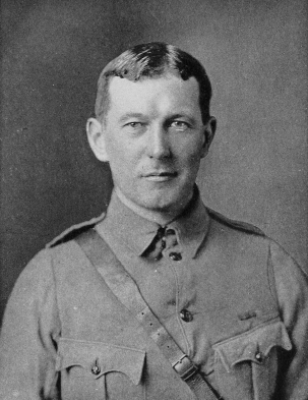
Two Poems by John McCrae

Lieutenant Colonel John McCrae

Sometimes a poet can write for their entire life and still be forgotten…and then there is John McCrae (1872-1918). With one magnificent poem, this Canadian military physician forever secured his place in the pantheon of classical poetry. First published in Punch magazine, “In Flanders Fields” has subsequently been anthologized countless times in textbooks throughout the English-speaking world. It is this poem that precipitated the adoption of the poppy by Britain and the British commonwealth as the official Flower of Remembrance to honor those soldiers killed in World War I. This poem and the poem below it, “The Pilgrims,” are two of a small handful of poems posthumously published as In Flanders Fields and Other Poems in 1919.


In Flanders Fields

In Flanders fields the poppies blow
Between the crosses, row on row,
That mark our place; and in the sky
The larks, still bravely singing, fly
Scarce heard amid the guns below.

We are the Dead. Short days ago
We lived, felt dawn, saw sunset glow,
Loved and were loved, and now we lie,
In Flanders fields.

Take up our quarrel with the foe:
To you from failing hands we throw
The torch; be yours to hold it high.
If ye break faith with us who die
We shall not sleep, though poppies grow
In Flanders fields.


The Pilgrims

An uphill path, sun-gleams between the showers,
Where every beam that broke the leaden sky
Lit other hills with fairer ways than ours;
Some clustered graves where half our memories lie;
And one grim Shadow creeping ever nigh:
And this was Life.

Wherein we did another’s burden seek,
The tired feet we helped upon the road,
The hand we gave the weary and the weak,
The miles we lightened one another’s load,
When, faint to falling, onward yet we strode:
This too was Life.

Till, at the upland, as we turned to go
Amid fair meadows, dusky in the night,
The mists fell back upon the road below;
Broke on our tired eyes the western light;
The very graves were for a moment bright:
And this was Death.

“An Unfinished Dream” by Milton P. Ehrlich

I’m reeling in a pickerel on Dyer’s pond
and have trouble unhooking the lure.
A turtle on a lily pad watches me
reach for pliers to free the fish.
In a deep voice, he growls:
“What kind of creature are you?”
I toss the fish back into the water,
and watch him swim away.
A red-tailed hawk swoops down
and decapitates the turtle’s head.
He leaves an epitaph on his shell, which says:
“Creatures great and small, the Lord God made us all.”
I walk into the nearest church doing poetry readings
where I can lie down and practice being dead.
I see the woman I’ve loved all my life, and ask:
“Will you marry me?” “I’d love to, she answers.”
I reply, “if not now, when?”


Milton P. Ehrlich Ph.D. is an 88-year-old psychologist and a veteran of the Korean War. He has published poems in The Antigonish Review, London Grip, Arc Poetry Magazine, Descant Literary Magazine, Wisconsin Review, Red Wheelbarrow, Christian Science Monitor, and The New York Times.

“Four, Three, Two, One” by Robert Nisbet

The four men would gather like geese,
cluster in the café at eleven every morning,
for a damn good cackle. Good crack.

In the Long Haul Café, they rollicked,
the four of them becoming three in time,
mocking the world of Smart-arse phones
and Farce-book. They’d all done courses once
at the local tech, and hooted now
at the Mickey Mouse degrees, the kids
who should be doing a good day’s work
(they’d done National Service themselves,
it made men of them). They loved
their mornings in the café. Then there were two.

**

Eleven one morning in a pretty spring,
Laurie came in slowly. Liz the waitress
brought his tea (one sugar, dab of milk),
said, On the house today. Pouring the milk:
How was the funeral? Laurie jollied,
Yup. Saw the old boy off. Good funeral.

Megan, his late wife’s cousin, came across.
Chit and chat of her son and his partner,
and Laurie, for the first time ever,
was looking at a Smartphone. She scrolled
and Laurie gazed, his understanding flickering.
He sent you these from Leeds? Two hours ago?

She told him of the boy’s degree
in retail management, and Laurie, aware
of the comforting thigh beside him
and her being there, smiled.
Sounds interesting. Sounds very interesting.


Robert Nisbet is a Welsh poet who lives about 30 miles down the coast from Dylan Thomas’s boathouse. His poems have been published widely and in roughly equal measures in Britain and the USA, where he is a regular in SanPedro River Review, Jerry Jazz Musician and Panoply. Robert is a 2020 Pushcart Prize nominee for his poem “Cultivation.”