The wandering spirit.
The homeless.
The stateless.
The sphinx.
Silent and heroic.
The gasps of joy
That escape
From the child’s mouth
Make yourself at home in me.
The Soul
I thought I only saw my soul while meditating In a field. And then as I read Rumi The lakes appeared–the sky cleared and the Fish and foul spoke in languages known only To them. The fog lifted and the mountains became hallowed. My soul declared itself to me.
Sandy Rochelle is a widely published and award winning poet, actress and filmmaker. Her work has appeared in publications including: Verse Virtual , Wild Word, Dissident Voice, Haiku Universe, Ekphrastic Review, Spillwords Press, Black Poppy Magazine, Lothlorien Poetry Journal, Every Day Writer, and others.
There had been no rain for months (which felt bone-deep in their ache),
the soil cavernous, the grasses turned to hay the daily harassment of summer (“Another man died today.”)
After the hundred-somethingth day I held my hands out through sky, through sweat, through the withering to welcome a distant rumbling that spoke of a coming storm.
The wind picked up, whipping my hair into my eyes, and I prayed,
for I felt her in that moment–– the cracking electricity that speaks to the presence of a Goddess.
Tip tip tip tip on the concrete the only sound in the deafening drought and the answer to our gasps for breath, we, like fish asking for relief our mouths to the sky open wide.
Rebel
One October I was resolved to ride a horse. His name was Rebel, a fierce fellow who had earned the name and an unsavory reputation. He refused to budge when offered apples and didn’t care for our softness.
Yet, when I was in the saddle he walked calmly as a dream, as if he knew my fear–– they say horses do. He lived in his might but it was foreign to me (as was the vulnerability of trusting so soon).
He did not owe me anything but he chose to honor me, or perhaps humor. I felt I had not earned it, for how do we earn an animal’s grace? I think about him often
and wonder what magic occurred and inspired a powerful beast to permit a small woman rocking passage across a silent field.
Erin Ratigan is a freelance writer and journalist with a focus on longform and narrative news features. Her poetry has appeared in multiple publications including Door is a Jar and POETiCA REViEW, and in the nature anthology Echoes of the Wild. She lives in North Texas.
He thinks he can in words what he fails to transmit in spirit; that a passage to the heart can be quickened by the intellect— or even the lips. He’s stupid and weary; a Don Quixote charging windmills for love. But all of Spain will fade before he surrenders.
A profusion of contradictions set his hands to work each day; non-existence and existence, love and liberty, life and death, kindness and malice, etc. etc. He is like everyone else. And yet, he would have her believe himself chivalry’s last stand.
His coffee pot, his kitchen, his clothes, his books, his rituals, his diet, are all modern and mundane. But his morning talk is always peppered with sorcerous dreams that begin and end with a chalice and a kiss; romances that happily spill blood.
She should crush him. Give him what he represents. Torture his soul, draw out all his marrow, claw his breast, stab his back, and sequester him in nothingness like Morgan did to Merlin. He should learn that he who lives by the sword falls by it.
Yes: bring death to this unaged, outage, ageless Don Quixote. How many turn-of-the-century enterprises must fail before we finally abscond from his mad philanthropies of mind trying to conceive a heart, and heart trying to conceive a mind?
Drown the babe, set free the man. Call his bluff; slap his face. Wring his nose and leave him coiled. Spend all his money; buy a hearse. Give Sancho Panza shovel and tequila to make space for his master to rest: Laugh as he digs, realizing why.
Falling head over hilt, Don Quixote crushed his heart. His only wisdom: remaining dumb. He lived for his love, died for her cause; with lance and horse, he made unreason stand tall. Life is but a breath and Don used his to go down like a kiss.
Jupiter (God-Father)
I am the gaseous giant moving headlong into lonely space hundreds of millions of miles away from the light. My days are short, but my years are long; my shadow my gravity, my existential paths are quixotically unrivaled. I am moving through thick ebony nothingness, orbiting fast away from the many arrows piercing my many hearts; holding onto a wretchedness I can’t remember or forget. I am the father up all night to converse with death, making deals on behalf of those dearer than his own heart. My arms are great pallbearers swinging from Heaven to Earth and back again; and my hands are trade-winds guiding the accelerative metrics of warped, bulging space. My waist is solvent weight breaking up time, clearing space of debris; whirling, spreading until I collapse. My feet are mountains that shift the tectonic grapes of wrath; they are Romeo and Juliet, a pair of actors kicking the cosmic dust: Woe on them they dance upon. Men fear, love, revile, envy, desire, and compete with me; but I am angry, happy; filled with spacious longing. Moody, moony, thunderstruck, and ringed with fire, Ruddy and ready to hide my fear: woman neither stand to be around or away from me. I am their heretic passion; their guilty fantasy, their nightmare; their fall: I am the hand that mocked them, the heart that fed; I am—was—Godspeed. Wobbling, centering, angling my ancient course, always further into the unknown, marking passages not even the sun could fathom. I was almost a star but became this man instead.
Galen Cunningham is a poet and fiction writer from Colorado. His poetry has previously been published by Literary Yard.
Today I talked to God again, While standing on an ashtray. From a lifetime of observing men, I’ve taught myself to pray.
I said to God, was this your plan? (Resolving to be direct) Was I to be an insect Or was I to be a man?
In truth, I don’t suppose That I am anything at all. I don’t feel that much different From the ash on which I crawl.
No, I am less. The ash concerned Was once a green tobacco leaf. I have not been burned or spurned, Nor felt the cold black hand of grief.
I do not know ecstacy or hope or even fear. I shiver and grow frigid Behind this misty gray veneer, And I cannot decipher why I am even here.
I have no family to grow, No kernels yet to sow, How can I be something When I have nothing to forego?
Behind me, now, the sound of wings, In the corner of my eye… Out of the empty wind, he springs – A purple dragonfly!
He studies me carefully, And in his eye…myself I see. A whisper sounds to flee the scene, But my dear God, it’s gone, it’s drowned.
Look at my eyes, Big and black, No one told me They shine like that…
Dragonfly, how close you’ve come, Come a little closer still… I’ve never seen myself before, Let me look a minute more.
Kalina Mishev is an aspiring poet and writer living in Brooklyn, New York. She received her Certificate in Creative Writing from the University of Texas at Austin in 2021 and is working on her first poetry collection.
The go-round brings round merrily the steed midstride, robbed of its motion, thus (maybe) furious, foaming
as (now!) the shutter stops it, blurred, mid-glide, ictus-click, there, here, known, not known, come
round contained in its own orbit, fury-eyed, fantastically alone, caught out, mid-stride, mid-
vault here in its arc— it’s just a ride and surely one hears waves somewhere, gears
groaning, slats creaking, a siren hailing, more laughter, candy corn, it rears forward furious-
seeming in its un- motion, only motion, deferred, inferred, caught—its own and only motion.
Ham
Cut-glass carafes, two white, two red, wheels of Neufchatel (cheese for the body,
wine for the head)— someone laughs, dings a dinner bell, upon which we
come over rowdily drawn thus to you, the stuff around you, the dying bell-sound:
you are the primal victim of our primal faith in the roasting pit, the special honeydew
sauce, pineapple-crowned before us hunkered round you in the blackened pan, blistering fat-driblets,
clove-chafed, hide studded with peppercorns and bits of lemon rind.—Ham, you ooze your best
in savory death, how is it that to host and guest there’s nothing in this whole damn world except you now?
Terence Culleton has published poems in a variety of reviews, including Sparks of Calliope. He has been nominated for several Pushcarts, and he has appeared on TV and radio shows in both the Philadelphia area and New York City. Several of his poems have been featured on NPR. A former Bucks County, PA, Poet Laureate, Mr. Culleton’s third volume of poetry, a collection of sonnets entitled A Tree and Gone, is now out through Future Cycle Press and has been featured on the New York Review of Books Independent Press “New Releases” list. It’s available on Amazon or through his website: terenceculletonpoetry.com.
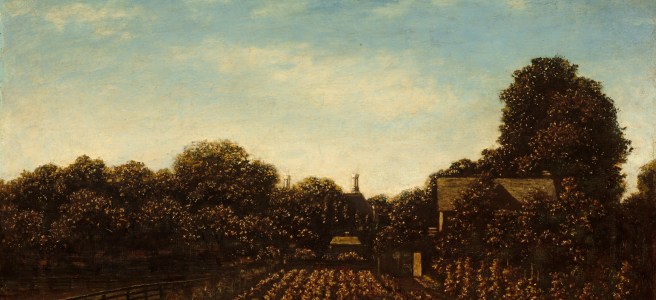
(Inspired by Ralph Albert Blakelock’s painting The Artist’s Garden — 1880 — American.)
An artist’s garden— too commonplace to think that it could happen here: the dusk gathering by degrees its forceful melancholy, demanding to be more than daylight’s dwindling, asserting itself until it changes with uncanny exactness into a state of mind.
While the hues of blooming flowers fade, the once-bright pathways turn gray— taper to blackened ends.
Fragrances linger in the springtime air that holds unanswered questions. The elm trees’ shadows deepen until they portray the void within the artist’s soul. Rows of cultivated flowerbeds bow to unrealized dreams. This, while the fading sky and indelible gloom suffuses the dimming hedges.
Diminutive, in the distance, a church spire, to which the dying day’s light clings. Faith, assurance, and hope give way to the moment when disillusionment renders every leaf and stem colorless.
Gregory E. Lucas writes fiction and poetry. His short stories and poems have appeared in many magazines, such as The Ekphrastic Review, The Horror Zine, and Blueline. He lives on Hilton Head Island in South Carolina. Follow him on Twitter X @GregoryELucas.
As a literary journal, there is often more risk than reward, but as a labor of love we carry on. The more cynical among us might even agree that misfortune strikes eventually should you travel any road long enough. As an editor, you really want pick the diamonds in the rough, and while you try to vet every submission you receive meticulously, you tell yourself that you can’t possibly catch everything. So, while I have tried to do right by you and will continue to do so, it seems that on one occasion I failed. You see… there is a plagiarist among us.
On September 22, 2023, I published two poems entitled “Harbor” and “Dislocated” allegedly written by a Mr. John Kucera (aka John Siepkes). And while they say imitation is the best form of flattery, these poems were copied with only a couple word changes from poems published in The Hudson Review entitled “Neilah; Creature” by Bruce Bond and in Claw and Blossom entitled “The Q & A Section” by Dorsía Smith Silva. This is intellectual property theft on the part of Mr. Kucera. I am profoundly sorry for the editorial oversight and hope Mr. Kucera is appropriately ashamed of himself.
I am replacing Mr. John Kucera’s plagiarized work with links to the original poems and removing Mr. Kucera from our list of contributors. I commend Mr. Bond and Professor Silva on the quality of their poems and extend my apology to them as well.
I am grateful to the editor of another literary journal who also inadvertently published a plagiarized poem submitted by Mr. Kucera and was kind enough to bring this matter to my attention.
Elizabeth I, Queen of England and Ireland from 1558 to 1603, made significant contributions to English poetry during the Renaissance era. Her reign is often referred to as the Elizabethan Age, a period marked by flourishing arts and culture. Elizabeth I herself was not only a political figure but also a patron of the arts, supporting and influencing the literary endeavors of her time.
One of the notable aspects of Elizabeth’s impact on poetry was her support for poets at her court. She surrounded herself with a circle of talented writers, including some of the most celebrated poets of the period such as Sir Philip Sidney and Edmund Spenser. The court became a vibrant hub for literary activity, fostering creativity and innovation in poetry.
Elizabeth I also played a role as a poet herself. She was well-educated and fluent in multiple languages, allowing her to engage in literary pursuits. Her own works, often written in Latin, French, and English, showcased her intellect and poetic prowess. Her poem “On Monsieur’s Departure” is a poignant exploration of love and loss, reflecting the complexities of her personal life.
Moreover, Elizabeth I’s reign witnessed the rise of the Elizabethan sonnet tradition. The sonnet, a fourteen-line poetic form, gained popularity during this era, and poets like Sir Philip Sidney and William Shakespeare made significant contributions to its development. Elizabethan sonnets often explored themes of love, beauty, and nature, reflecting the intellectual and emotional richness of the time.
Elizabeth I’s influence extended beyond her lifetime, as her patronage and support laid the groundwork for the flourishing of English literature in the subsequent Jacobean era. The cultural and literary legacy of the Elizabethan Age endured for centuries, shaping the trajectory of English poetry.
In summary, Elizabeth I’s contribution to English poetry was multifaceted. As a patron of the arts, she created a nurturing environment for poets at her court. Additionally, her own poetic endeavors and the cultural milieu she fostered contributed to the vibrant literary landscape of the Elizabethan Age, leaving an indelible mark on English poetry.
Two of Elizabeth’s better known poems can be read below.
On Monsieur’s Departure
I grieve and dare not show my discontent,
I love and yet am forced to seem to hate,
I do, yet dare not say I ever meant,
I seem stark mute but inwardly do prate.
I am and not, I freeze and yet am burned,
Since from myself another self I turned.
My care is like my shadow in the sun,
Follows me flying, flies when I pursue it,
Stands and lies by me, doth what I have done.
His too familiar care doth make me rue it.
No means I find to rid him from my breast,
Till by the end of things it be supprest.
Some gentler passion slide into my mind,
For I am soft and made of melting snow;
Or be more cruel, love, and so be kind.
Let me or float or sink, be high or low.
Or let me live with some more sweet content,
Or die and so forget what love ere meant.
When I Was Fair and Young
When I was fair and young, then favor graced me.
Of many was I sought their mistress for to be.
But I did scorn them all and answered them therefore:
Go, go, go, seek some other where; importune me no more.
How many weeping eyes I made to pine in woe,
How many sighing hearts I have not skill to show,
But I the prouder grew and still this spake therefore:
Go, go, go, seek some other where, importune me no more.
Then spake fair Venus’ son, that proud victorious boy,
Saying: You dainty dame, for that you be so coy,
I will so pluck your plumes as you shall say no more:
Go, go, go, seek some other where, importune me no more.
As soon as he had said, such change grew in my breast
That neither night nor day I could take any rest.
Wherefore I did repent that I had said before:
Go, go, go, seek some other where, importune me no more.
The informational article above was composed in part by administering guided direction to ChatGPT. It was subsequently fact-checked, revised, and edited by the editor. The editor/publisher takes no authorship credit for this work and strongly encourages disclosure when using this or similar tools to create content. Sparks of Calliope prohibits submissions of poetry composed with the assistance of predictive AI.
Stitched into my brain, Dad’s favorite saying:
A job half-done is better not begun.
When I start a poem I’m only playing.
But it’s my job and I’m my father’s son.
And so my duty is to make you feel
as if the top of your head were taken off.
Anything short of that has no appeal.
To write a half-baked rhyme’s not good enough.
Is a job worth doing not worth doing badly,
the perfect not the enemy of the good?
So many questions I would have asked my dad,
but I was busy doing what I could
to garner his approval, honor the old man,
and emulate the little engine: I think I can.
The Swimmer
I undulate my body, dolphin kick,
windmill my arms to breach and dive back in.
With a flick of my fluked tail I’m dolphin;
airborne, I torque my pec-fins, flip and spin.
My podmates, wowed by my new tricks,
celebrate with whistles, squeaks and clicks.
Bobbing on sleep’s surface, drownproofing,
davening before the Wailing Wall,
I rise to clear my blowhole, stoke my lungs,
plunge into the depths of the Kabbalah.
Belly-up, spread-eagled, I embrace
the feathered pillows of the ocean-sky,
enter heaven’s rainbow-pattern gates,
see my face reflected in God’s eye.
John Whitney Steele is a psychologist, yoga teacher, assistant editor of Think: A Journal of Poetry, Fiction and Essays, and graduate of the MFA Poetry Program at Western Colorado University. His poems have been published widely in literary journals and both his chapbook, The Stones Keep Watch, and his full length collection of poetry, Shiva’s Dance, were published by Kelsay Books. John lives in Boulder, Colorado, and enjoys hiking in the mountains. You can visit his website at www.johnwhitneysteelepoet.com.
Every day caress my cat. Brush him to a golden sheen. Surf the Net and tour the world Here on my computer screen. See that every single meal Features cookies, pie, or cake. Resolutions on this list Surely I will never break.
“My New Year’s Resolutions” first appeared in The New York Times Metropolitan Diary.
The Guest Selects Her Own Indulgences
with apologies to Emily Dickinson
The guest selects her own indulgences, Then fills a plate With sweets whose sheer deliciousness Brooks no debate.
Unmoved, she notes the carrots waiting, Then turns away, Unmoved, until her eyes alight on The pastry tray.
I’ve known her from an ample table, Choose four, Then set the force of her attention On more.
“The Guest Selects Her Own Indulgences” first appeared in The Emily Dickinson International Society Bulletin.
Felicia Nimue Ackerman is a professor of philosophy at Brown University and has had over 280 poems published in a wide range of places, including twenty in past issues of Sparks of Calliope.

 Sparks of Calliope