“Antechamber” by John Watts

Suits arranged like mute clones on chairs,
either swallowing fashion failure
or wishing to boast about tailor
fits. Ties could voice a thousand cares
about the adjustment of knots
but rest pains in Italian silk.
Buttons pose like exquisite dots
in the silence, uncomprehending
to the state of matters. Shirts, white
as a glass full of soya milk,
dream ignorantly under vests.
Wax-rubbed shoes know they aren’t pretending
and hope gaudy socks aren’t in sight,
wants to remind them they are guests.
Wristwatches want to smuggle out
from under sleeves and seduce eyes.
Make-up is confident of its
power but thinks the pierced nose unwise,
the cheek-glitter something to doubt.
Earrings don’t fret, knowing they’re trusted.
Tattoos cower rather than shout.
The handkerchief knows where it sits.
Meanwhile the pictures seem offended
by the turquoise walls. There’s a little
empathy if it could be said.
The air is the reproach of prattle;
this is anticipated, fits
that which is known to be ahead.


John Watts lives in West Sussex and studied English Literature at Kingston University. He is now studying for his MA. He has had work published with the Academy of the Heart and Mind, Friends of Falun Gong, and Homeless Diamonds.
Two Poems by Patricia Furstenberg

I Am Built

I am built on my ancestor’s dreams,
Of glass that was shores and wood that was trees;
I am built on my parent’s blueprints,
Of tears of joy, and white nights of dreams.

I stood on land that came all wrapped up,
Bows of rivers and a note of clouds.
I grabbed it, too eager, I opened my gift,
Forgot to say “thank you”, too greedy to live.

I lived and I loved and I used up my gift,
I forgot to look back; now I’m lost in my dream.
One last chance I am given, build my blueprint,
Gift others life, and love, and dreams.

I am sand, I am earth, I’m the seed of a tree,
I’m the foundation where others can raise their dreams.
I know for I looked back this time;
Life moves forward by recalling the past.


Like a Ladybird on a Daisy

A ladybird
dashes through my field of view,
recklessly she aims for all directions at once
like a hysterical airplane
that lost an engine.
Acute are the depths
of its diving
and the smears or red
in the still day,
like the tick line
of a teacher’s pen,
break the silence.
How do you perform CPR
on a ladybug
crossed my mind.
I’ve even drawn back
and offered her
my personal space:
the garden table,
wrought iron painted green,
my notebook
where I doodled
a daisy in black ink.
She darts still,
diving and nearly crash-landing
then performing an emergency recovery
and soaring again.
It knows geometry, I see,
it swirls and traces circles now
frisky over my notebook
where it lands.
On my doodled daisy.
I bow and thank
for such a compliment.
and look around
for an offering of sorts.
A cookie crumb,
for I can’t bring myself
to sacrifice an ant.
Wouldn’t that be execution?
The ladybird reads my mind
and saves me,
spryly dashing away.
I bow in thanks.


Patricia Furstenberg, with a medical degree behind her, has authored 18 books imbued with history, folklore, and legends. The recurrent motives in her writing are unconditional love and war. Her essays and poetry have appeared in various online literary magazines. Romanian-born, she resides with her family in South Africa.

Two Poems by Felicia Nimue Ackerman

Professor Superstar Turns 65

Today is your 65th birthday.
Your status is ever so clear.
Your colleagues have set up a tribute
Extolling your shining career.

They bask in the secondhand honor
That flows from their honoring you.
They thrill to the visiting speakers,
Who radiate eminence too.

“Society’s far too unequal,”
Your colleagues are prone to lament.
But strictly within their profession,
They worship the top one percent.

“Professor Superstar Turns 65” first appeared in The Chronicle of Higher Education.


Dessert is Counted Sweetest

after Emily Dickinson’s “Success”

Dessert is counted sweetest
By those who need to diet.
When doctors won’t stop nagging,
I fantasize a riot.
Not one of all the cakes and pies
I might forgo today
Could fail to bring me pleasure–
Though later, much dismay.

“Dessert is Counted Sweetest” first appeared in The Emily Dickinson International Society Bulletin.


Felicia Nimue Ackerman is a professor of philosophy at Brown University and has had over 250 poems published in a wide range of places, including sixteen in past issues of Sparks of Calliope.

Two Poems by Diane Webster

Rust Background

Rust is the background
to the white paint chiseled
into graffiti petroglyphs.

The hunter stalks through
rocks and stone
for a deer creature
poised for flight;
its antler carving
snarls in branches,
in hiding.

No other picture
glorifies the kill.
No picture celebrates
the hunter empty-handed.
Rust awaits another
hunting expedition
as rain and sunshine
strip away more paint.


Shell Echoes

The abandoned Shell gas station
lies washed up near the highway.
Heatwaves rise like dreams
in traffic blurring past
to destinations beyond.

Weeds are allowed
to grow in cracks
like tree seeds dropped
into boulder crevices
to sprout and heave roots
like Samson leaning
on the temple pillars.

Shell gas station;
a conch shell pushed
ashore by waves
like mirage heat
boiling once reality.

Listen to the conch
echo whispers of the ocean
like abandoned gas station
hearing tires buzz on the pavement.


Diane Webster‘s goal is to remain open to poetry ideas in everyday life, nature, or an overheard phrase and to write. Diane enjoys the challenge of transforming images into words to fit her poems. Her work has appeared in El Portal, North Dakota Quarterly, Eunoia Review, and other literary magazines. She also had a micro-chap published by Origami Poetry Press in 2022.

“Hapless Decoration” by Shelly Elizabeth Sanchez

In those old days
Upon that ceramic floor
I stared into her back
Where she was resting on her knees
And staring in the water

As if she was finely brushed
With ocean blue tears
Devoid of salt
Teasing at the seam
Of her existence

She harkens to the girl
Wet from chlorine
On a holy afternoon
Staring at the flesh
Of her youthful thighs

Who could imagine
A being so small
So fragile and fair
As to wonder why
And for what purpose

She rests in that frame
Bathed in clinical light
Mirrored by the one
Dripping onto the floor
Into the vast sea below

“Hapless Decoration” first appeared in The Colton Review.


Shelly Elizabeth Sanchez grew up in the North Carolina Piedmont beginning at age six. Her earliest memories include playing with the boys, some freaky nightmares, and random sessions on the family Nintendo 64. Her existential poem, “Hapless Decoration,” won first place in Poetry in The Colton Review: Volume 17, and she published flash fiction in The Colton Review: Volume 18.

Two Poems by Carole Greenfield

Cracked (A Rondeau for You)

Our future cracked open, fortune cookies brought
at meal’s end in restaurants drenched in gold and red, not
for nothing, opulence of lucky money colors, seats
where my kosher grandparents made exception for treats
like lobster sauce, pork fried rice, a sin sought,

consumed, dismissed with smiles, quite as you thought
of our stepping beyond what we’d been taught
as we lay kissing between peach-colored sheets
while our future cracked open.

Continue tempting fate until one’s caught,
live with heightened pitch, all nerves stretched taut
or keep to separate time zones, walk lonely moonlit streets,
travel up and down that tangle, one advances, one retreats,
penitence and passion weaving in, around, out until, so fraught
our future cracked open.


Shell

Shards of abalone traced across and down my skin,
beginning at the hairline, skating over my closed eyes,
slight slope of nose, half-open lips, to reach my chin
and leap aloft, the landing soft between my throat bones’ rise.

Descend from there to spiny sternum, stomach’s curving swell,
their edges sharp enough to pierce, sides grown smooth by sand.
For years to come, they’ll hold a secret, ours alone to tell.
Slipped from their bag, held lightly in my hand.

You gave me shells of moonlight sheen, a rock in shades of rust,
gifts that could shatter in a moment, scatter into gleaming bits of dust.

So what to do? Break myself away, or trust
my heart, my soul, in hands that hold me like a shell,
that carefully, that lovingly, that well?


Carole Greenfield was raised in Colombia and now lives in New England. Her work has appeared in Red Dancefloor, GulfstreamThe Sow’s EarWomen’s Words: ResolutionArc, Sparks of Calliope, and The Eunoia Review.

Two Poems by Janice Canerdy

Do Not Enter; Do Not Exit

A sad-faced little man sits all alone.
His pricey suit is wrinkled, and his tie
is loosened. He’s exhausted to the bone.
His once-bright eyes no longer shine. His sigh
is inward. No one hears his weary cry.

“For thirty years I’ve had the same career,”
he mumbles to his lap. “I’ve known success,
but failing health has wrought a gnawing fear
that I can’t persevere. My happiness
may hinge on new employment with less stress.”

The lavish lifestyle he’s accustomed to,
he wishes to maintain. He can’t retire,
stay home, read books, and watch tv in lieu
of working; but the next job might require
REAL people skills. His circumstance is dire.

For decades, from behind his smiling mask,
he’s been convincing clients that he cares
about their futures, that his most-loved task
is helping them succeed. He never bares
his real self. Now, alone, he sits and stares.

If he stops getting richer, he will lose
his fiancée, who’s shallow, just like him,
and money-grubbing. He knows he must choose
to move—that he must jump in, sink, or swim.
His vision of the future’s looking dim.

He’s like a man ‘twixt doors with taunting signs.
The “Do Not Exit,” he cannot ignore,
for his predicament it well defines.
The “Do Not Enter” sign afflicts him more.
“Now what?” It seems he’s questioning the floor.


There’s Much to Be Said for Porch Swings

My porch swing is a special place
where past and present intersect.
While swaying at a peaceful pace,
on days of childhood I reflect.

Where past and present intersect,
with eyes closed I soon drift away.
On days of childhood, I reflect.
I see three happy kids at play.

With eyes closed I soon drift away,
I think of yards with rope-held swings.
I see three happy kids at play
on carefree days the summer brings.

I think of yards with rope-held swings
while swaying at a peaceful pace.
On carefree days the summer brings,
my porch swing is a special place.


Janice Canerdy is a retired high-school English teacher from Potts Camp, Mississippi. Her poems have appeared in numerous publications, including Light Quarterly, The Road Not Taken, Lyric, Parody, Bitterroot, the Society of Classical Poets Journal, Westward Quarterly, Lighten Up Online, Halcyon Days, Penwood Review, the Mississippi Poetry Society Journal, Whispering Angel Books, and Quill Books. Her book, Expressions of Faith (Christian Faith Publishing), was published in 2016.

On Hiatus: June 22, 2023 – July 20, 2023

After four years of posting almost every three days (or about 121 posts per year), Sparks of Calliope is taking a month-long hiatus to rest, recoup, and regroup. All unread submissions past and present will be considered in the order they were received. Our next scheduled poetry will post on July 21, 2023. In the meantime, we encourage you to browse our past contributors, like and comment on their work, and maybe even donate to help keep this endeavor afloat if you find us worthy. We’ll be right back, bringing you the quality poetry you have come to expect from our journal. Thank you for visiting!

Two Poems by Joshua C. Frank

The Ballad of the Heroic Mother

a true story

A toddler into water fell
And sank as quick as rock.
At nine feet deep, she couldn’t yell
Or jump or thrash in shock.

Her mother heard the splash portend
Her daughter’s water grave;
She dove into the pool’s deep end,
Her little girl to save.

She grabbed her daughter, held her tight,
And with a presto prayer
Sprang toward the shimmering sun of white
To give her girl some air.

She held her up while sinking down,
And knew to save her daughter
That she herself might well soon drown
So inched toward shallow water.

Seconds before her lungs gave out,
Her face felt heat and air.
Her feet on ground, she breathed a shout:
“Success!” An answered prayer!

The whole crowd cheered the mom en masse;
She gained a hero’s glory.
She told the public-speaking class—
I still think of the story.


Signs of a Broken Home

“The bigger the issue, the smaller you write.  Remember that.  You don’t write about the horrors of war.  No.  You write about a kid’s burnt socks lying on the road.” -Richard Price

At the foot of the dumpster lay signs on the ground,
But I wonder why these were there lying around.

I would never have guessed that there someone had laid
The sign: “Home is where all the best memories are made.”

And a heartbreaking counterpoint next to it lay:
“We create our tomorrow by dreaming today.”

There are people who write of the horrors of war,
But a child’s burnt socks on a road will say more.

At the foot of the dumpster lay signs on the ground,
But I wonder why these were there lying around.


Joshua C. Frank works in the field of statistics and lives near Austin, Texas.  His poetry has also been published in The Society of Classical PoetsSnakeskinAtop the Cliffs, and The Asahi Haikuist Network, and his short fiction has been published in Nanoism.

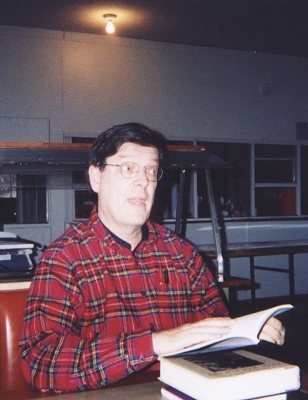
Dr. W. Nicholas Knight (April 18, 1939 – October 23, 2022)

Dr. W. Nicholas Knight teaching a class at a Southwinds Magazine Writer's Workshop, 1998.
Dr. W. Nicholas Knight teaching a class at a Southwinds Magazine Writer’s Workshop, 1998.

It would seem unfitting to me not to mention Dr. W. Nicholas Knight–who died this past year–when educating others about William Shakespeare. His obituary explains:

“Nick was a popular professor of English, first at Indiana University Bloomington, then Wesleyan University in Connecticut, and lastly Missouri University of Science and Technology, previously the University of Missouri – Rolla. He earned his B.A. in English from Amherst College, M.A. from the University of California at Berkeley, and Ph.D. from Indiana University. He knew his students well, encouraging them in their endeavors and writing. Three of the known signatures of William Shakespeare were discovered or authenticated by Nick. Professor Knight rendered college more accessible by teaching community college courses at night, sponsoring the Black Student Union, taking senior citizens on field trips to St. Louis, teaching Shakespeare in prison, and mentoring English majors whose parents thought they should major in engineering. Nick Knight’s representative works include his book Shakespeare’s Hidden Life and his off-Broadway play “The Death of J.K.” He was active in Arts Rolla, Rotary Club, and the National Endowment for the Humanities.”

My whole conceptualization of who I was to become professionally was first modeled after this man. He was my favorite professor, my advisor, my mentor, and my friend. I was witness not only to Dr. Knight’s knowledgeable passion for all things Shakespeare but also to his passion for Civil War miniature soldiers, model trains, and the fascinating historical knowledge these things represented. Whether he was retelling his story of almost running over Robert Frost with his car at Amherst, giddily boasting of the number of U.S. Poet Laureates he had driven around in his car, or showing off the blurb John Updike had written for his Arthurian poetry collection, he made the undergraduate experience of this literature lover nothing short of magical.

(I was also reminded by former classmates of his story of personal friendship with Superman actor Christopher Reeve, and how the character of Clark Kent in those movies was supposedly modeled after Dr. Knight. The resemblance and mannerisms are uncanny…).

Obituary of Dr. William Nicholas Knight

Video of Dr. Knight’s 1991 televised lecture on Shakespeare