Two Poems by Deb Levine

Healing: Under a Mangrove

Akin to the albatross on Española
I have flown far —
BWI, Quito, Baltra, Isla Isabela —
and emerged from an egg laid on bare ground
to lie under a mangrove,
watching frigate birds glide like silent pterosaurs,
the arcane arch of their wings distinct, defining.

Settled on warm sand, expanding memories of
ferries, water taxis, day boats, zodiacs,
emerge under a sky so blue it stings.
Stretched shadows cast on sand
run fast to a molten-glass turquoise sea,
bringing to mind blue-footed boobies, with their improbably
azure webbed feet. And the inevitable tacky T-shirts.

I recall biology colleagues piecing together
a creature from found bleached bones —
rib, femur, clavicle, vertebra —
as I have pieced myself together from stray snippets
to lie under a mangrove
watching frigate birds circle like silent pterosaurs
glimpsed through a lacework of branches.

It smells slightly of sea and slightly more of sea lion.
Ubiquitous, appropriating every flat surface —
walkway, bench, table, pier —
they sleep, emitting stentorious grunts when they budge.
As whim strikes, they waddle-crawl
down to the sea, and fall under the surface,
morphing into graceful, playful naiads.

Snorkeling in lucid teal bays, transformed
by water, in my element, life is everywhere —
Pacific Seahorse, Sargent Major, Marble Ray, Reef Shark.
I feel right in my skin, settled into my skeleton. Later
I will lie under a mangrove
watching frigate birds float like silent pterosaurs.
I came three thousand miles to borrow my self.

At Playa de los Perros courting iguanas sprawl
everywhere — black, deliberate, craggy, sneezing
salt in brief blasts. Males sport seductive seasonal color.
Here a bachelor, there an iguana patriarch
with six small basalt-colored wives.
I want a hand to hold. Scared, gamely descending the tenuous
ladder to the boat, I’m weaker than I wish; stronger than I know.

My mind skips, like a Sally Lightfoot crab —
rock to rock, thought to thought.
Galápagos. Forming over a hotspot, drifting east,
growing softer, more habitable, less jagged, more open.
I lie under a mangrove
watching frigate birds sail like silent pterosaurs.
How far have I come?


Bogged Down

I am ankle deep in a stinking bog
which squelches, rudely pulling at my foot.
Stranded alone in so much sucking sog
I marvel at the places I’ve been put.

If I try to struggle against this slime
I know I shall go under with no trace;
perhaps I should surrender hope this time,
and, slowly sinking, muster dying grace.

Or, maybe if I, graceless, lay me down,
immersed halfway in lukewarm reeking muck,
and float, suspended, manage not to drown,
I’ll find myself aground on firmer luck.

          If, rank and damp, I knock upon your door
          will you mind my dripping on the floor?


Deb Levine is a (mostly) formalist poet, scientist, and life coach. She was first published in Bay to Ocean 2023. She is Academic Chair for Physical Science at Anne Arundel Community College. Although she majored in Physics at UNC-Chapel Hill, she also completed most of the coursework for the Creative Writing major as a short fiction author. Dr. Levine lives in Stevensville, Maryland, on Kent Island with one cat, two parrots, eight chickens, and the neighbor’s rooster. She dreams in sonnet form.
Two Poems by Cynthia Forbes

Bonding

When the first contraction comes
I clutch the bathroom doorframe,
paralyzed by waves of pain,
thinking this may be the day I die.
My eyes in the mirror catch mine
as if to say good-bye.

The midwife comes to deliver,
probes me with a gloved hand,
looks at me with panicked eyes,
sponging back my sweaty hair.
“I think I’m feeling toes,” she says,
“You need a doctor’s care.”

In the hospital emergency room
I wait in a wheelchair,
answering the admission clerk’s questions
until a contraction seizes me again.
I see her eyes pop wide with surprise
before I slump into the pain.

Legs spread on the hard table,
a masked doctor tells me when to push.
I latch onto his eyes, kind and steady,
until a boy is born, blue as the sky.
When they whisk him into the ICU
I’m thinking my baby may die.

He was born face first, not breech,
and stayed too long in the birth canal.
The nurses won’t bring him to me,
so I dry the tears in my eyes
and push my IV through the cold halls
to the incubator where he lies.

The nurse there yields to my insistence.
She sets me in a rocking chair,
places the baby in my arms, and I fall
into his solemn eyes, like an ancient man’s,
telling me he’s traveled far, he is strong,
and happy to be in this strange new land.


The Sharpshooter

Our father
shot family photos.
The early years on slides
we watched again and again
like a favorite movie.

Our father
shot big-antlered bucks,
always killed with one clean shot.
His trophies appeared in the slideshow
between gap-toothed grins and Christmas mornings.

Our father
collected arrowheads—
a bullet box filled with delicate points
carefully wrapped in cotton—
that he found on rocky hilltops.

Our father
collected our wounded hearts
in a box he never opened—
lacerated, poisoned by his biting tongue,
sloppily patched with wet kisses.

Our father
charmed both the ladies and the men,
regaling and joking with unmatched wit,
praising and flattering to their faces,
scorning them all behind their backs.

Our father
charmed his children, too, until in anger
he shot his cruel words to draw blood
and violated the hunter’s creed
never to abandon your injured prey.


Cynthia Forbes is a retired teacher and instructional designer living in Houston, Texas. She writes poetry, fiction and nonfiction.

Two Poems by Miriam Manglani

Their Music

He stopped playing when she died.
The piano lay trapped in a white dusty sheet,
a dead body waiting for the morgue.

His fingers ached for the feel
of the slippery keys,
extensions of his long fingers.

She came to him in a dream,
danced again as he played,
her long, nimble legs threaded
the air like sewing needles,
the music’s current
coursed through her
like a second heart beat.

The last song she danced to
played over and over again
in his mind for years,
hibernated in his finger tips,
a caged bird longing for release.

He pulled the sheet off,
clouds of dust swirled
like clusters of insects in the sunlight.

As he played,
the notes surged
through him like rising tide.

And her ghost performed in front of him,
her movements flowed like water,
like the rain that fell from his eyes,
in a sea of sound.


Sewing Memories

She is sewing the tapestry of her life
with tender threads of time.

Memories faded like laundry hanging
out to dry in the sun
are stitched together piece by piece.

Red fabric with the “S” Superman logo —
from the T-shirt she lived in
when she was five.

Rough black fabric —
her father’s stubble that pricked her
skin when he hugged her goodnight.

Green shimmery fabric —
the color of ocean waves
she rode every summer as a child.

Yellow fabric —
the color that danced into her mind
when she smelled her mom’s Egyptian soup.

Rainbow fabric —
for the wistfulness she felt
when dancing to “their song”
“Forever Young” on her wedding day.

Black fabric —
the color of her daughter’s
long beautiful lashes.

Gray fabric —
the absence of her father,
sick with dementia,
gone long before he died.

Burp cloth fabric —
a reminder of the sleepless nights
she spent nursing twin boys.

Jean fabric —
her mom’s jeans torn
to save her life on the day of her stroke.

She sees them all now,
her memories threaded together.

She feels them all now,
sliding through her fingers.


Miriam Manglani is a writer with poetry recently published in Sparks of Calliope, One Art, Glacial Hills Review, Paterson Literary Review, and Lothlorian Poetry Journal.

Two Poems by Russell Rowland

Wound Wood

In the tutorial of the hills,
Closed Gentians taught me to keep confidences.

A mother bear
demonstrated never putting your best assets up
the same tree twice.

Pine Warblers convinced me, though,
it’s all right to repeat a song, if it’s a good song.

When I edged between tall cliffs,
pairs of bald eagles modeled how to mate for life.

One particular trait of trees
resonated through my thickening skin of bark—

how they generate “wound wood,” to seal off
or callus over injuries.
Some survive for decades, entirely on self-repair.

I would learn to do what trees can do.


No Leftovers

Our trail-boss Larry found the carcass of a moose
on a distant section of the High Ridge.

Larry contacted New Hampshire Fish and Game
for advice—was told, just leave it.

When he went up on the High Ridge a month later,
no more carcass, not even a bone.

That Fish and Game man was right—
in the economics of survival nothing is wasted;

even bones gnawed,
down toward the sweetmeat of marrow. So,

no leftovers. And before reading gruesomeness
into this, we should consider

how it made life easier for Larry,
and how many guests ate their fill at the banquet.


Russell Rowland writes from New Hampshire.  Recent work appears in Red Eft Review, Wilderness House, Bookends Review, and The Windhover. His latest poetry book, Magnificat, is available from Encircle Publications.  He is a trail maintainer for the Lakes Region Conservation Trust.

Two Poems by Sara McClayton

In Praise of Motion

You are discontented, lonely, and you cannot find the ground,
You keep a barren grievance that you cradle like a child,

In the past you were a dervish, spinning vigilant and wild,
You hurtled through the blackness, you marveled every sound,
A beautiful persistence, with your eyes so raw and round.
Now you toil for your wonder, and the world that once beguiled
You with sunrise, with precision, has grown indolent and mild,
And you suffer, that the earth exists to keep your spirit bound.

Home is a cathedral, and it glows behind your eyes,
You were born a simple pilgrim; you must beg before you know.
Beyond sorrow lies the rolling path that strips you from your past
And feeds your limbs like soil. Move; for motion will deny
Stagnation and revulsion and the clogging weight of snow,
And bear you into solace, where you spread your roots at last.


Sestina for the Present

In summer you are waiting for the fall,
While purring leaves spread outward to the sun,
And berries ripen, decadent from light,
You cannot determine sloth from rest.
You ride the wailing currents of regret,
And taste the salt that augurs your decline.

You are weary, for you fear the close decline
Of mothers, lovers, gaping as they fall.
Their lives stained in the rank pulp of regret
Like fruit turned slick and mealy in the sun.
You vow to blossom greater than the rest
You spread your precious tendrils to the light

And watch the others lose their air and light.
They choke on offerings that the blessed decline.
The image of their grief tears you from rest
For what new god will reap you if they fall?
You can merely take your guidance from the sun,
And nurture and with-hold without regret.


Sara McClayton is an educator and writer from Baltimore, Maryland. She enjoys spending time with her husband and dog, exploring nature, and practicing yoga. Her work can be seen or is upcoming in Unbroken Journal, Neologism Poetry Journal, Ink in Thirds, and Club Plum Literary Journal.

Two Poems by Peter J. King

A Fall Can Be a Little Thing

A fall can be a little thing
When bones are young and blood is thick —
Hardly noticed in your Spring
A fall can be.

          But time will play its usual trick:
          Your body struggles to take wing,
          Your mind still thinks itself a chick,

And when you walk, your arms aswing,
Disdaining a supporting stick,
You find how dangerous a thing
A fall can be.


Bedtimes

The pleasure gained from getting into bed,
          Relaxing into softness with a sigh,
          When I was young came only once a night,
And then oblivion till darkness fled.

But now thrice nightly I am forced to tread
          The path to loo and back to where I lie —
          An aging bladder serves to multiply
The pleasure gained from getting into bed.


Peter J. King, born and brought up in Boston, Lincolnshire, now lives in the Oxfordshire Cotswolds. He has been widely published in journals and anthologies; his latest collection is Ghost Webs (The Calliope Script). Aside from his own poetry, he also translates, mainly from modern Greek (with Andrea Christofidou) and German, writes short prose, and paints.

Two Poems by David D. Horowitz

Substance

Let every spammer, crook, and scammer
Purvey false images of glamor,
I still won’t trust them. To be sure,
No person’s perfect, godly, pure,
But honesty and truth still matter
Far more than sales from phony patter.
Snake oil sells, but truth’s the cure.


Talk is Cheap

As shadows coat the warehouse, pit bulls bark
Behind steel, padlocked, folding safety gates;
Spike-peaked rail fence; surveillance cams; barbed wire;
Chain-closed-off parking lot. One crazy spark
Could conflagrate into a block-long fire
Where every pair of eyes already hates.

Work here, compassion, in the cold and dark.


David D. Horowitz founded and manages Rose Alley Press, through which he has published eighteen titles, including his latest poetry collection, Slow Clouds over Rush Hour. His poems have appeared in many journals and anthologies, including Raven Chronicles, Better Than Starbucks, The Lyric, Coffee Poems, and Light. His essays regularly appear in Exterminating Angel. David frequently organizes and hosts poetry readings in the Seattle area, where he lives. Visit www.rosealleypress.com.

Two Poems by Shamik Banerjee

The Garden

Dense boughs and variegated blooms
    That well-festooned a garden
Are dying as November births
    Pellucid forms that harden
On them, my attic's roof, and grass.
   
Now every morning when I pass
    This place, once deeply green,
A stark, white blandness greets my eyes;
    No colour's to be seen.
But still, I thank the gardener who,

With high élan, prepared the view
    For all to like last spring.
He knows: next April, once again,
    This fertile spot will bring
Fresh leaves and blossoms like before.

I step into the garden's door
    Located in my heart
And wish to plant sweet buds of love
    For those now far apart—
Shunned kindred and deserted friends—

So when my wintertime ascends
    And I begin to harden,
Watching my frame, they'll think about
    The joy drawn from this garden
Whose soil will never yield again.


Black and White

The happy wind was singing to
September’s maiden day;
The friendly Sun was clinging to
The hillcrest and the bay;
And man with his assertive crown,
Proceeded through this vibrant town;
No hurdle clogged his way.

The girls were lowly chunnering,
And boys were raucous, yelling;
The pink-tinged clouds were colouring
The heaven’s vault, their dwelling;
But not one being, large or small,
Had the minutest clue at all
What rainfrogs were foretelling.

At noon, a bellow from the skies
Alarmed the birds in flight,
The spendthrift shoppers’ sated eyes
Shrank low from shock and fright;
Each shuffling soul then rushed to find
A roof or shelter of some kind;
The day appeared as night.

But far away, that leaden clime
Perked up the rural men,
Their fields lay bare all summertime—
No raindrops fell since then;
But those oppressive days had flown,
The fields were wet, their faces shone,
And life revived again.

How strange and polar nature is,
How magical its plan!
How orderly it metes out bliss,
And hopelessness to man!
Just as it did to us that day:
With its stormy onrush turned one gay,
And turned the other wan.

“Black and White” first appeared in Westward Quarterly.


Shamik Banerjee is a poet from India. His poems have been published in Sparks of CalliopeThe HypertextsLighten Up OnlineWestward Quarterly, and Disturb The Universe.

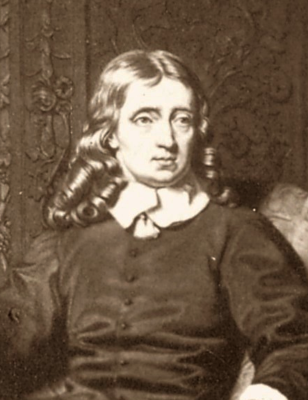
Two Poems by John Milton

John Milton (1608-1674)

John Milton (1608-1674) was a towering figure in English literature, best known for his epic poem Paradise Lost. Born in London to a prosperous scrivener, Milton received an exceptional education, attending St. Paul’s School and later Christ’s College, Cambridge. His deep classical knowledge, coupled with a fervent religious belief, profoundly shaped his literary and political career.

Milton’s poetry is marked by its rich language, intellectual depth, and complex themes, often exploring human existence, divine justice, and individual liberty. Paradise Lost, published in 1667, stands as his magnum opus and one of the greatest works of English literature. The epic poem recounts the biblical story of the Fall of Man, delving into themes of free will, obedience, and the nature of good and evil. With its grand style and powerful blank verse, Paradise Lost not only reflects Milton’s mastery of classical epic conventions but also his innovative approach to poetic form and narrative.

In addition to his literary achievements, Milton was deeply involved in the political and religious upheavals of 17th-century England. A staunch Puritan and republican, he served as a civil servant under Oliver Cromwell’s Commonwealth and wrote several influential pamphlets advocating for freedom of speech, press, and divorce, most notably Areopagitica (1644). His political writings reflect his commitment to individual rights and a deep suspicion of tyranny in all its forms.

Milton’s later years were marked by personal and physical hardship. He became completely blind in 1652, yet continued to write and dictate his works, producing Paradise Regained and Samson Agonistes in his final years. Despite his blindness, Milton’s literary vision remained clear, his works continuing to inspire readers and writers with their exploration of the human condition, freedom, and divine justice. His influence can be seen in the works of later poets and thinkers, securing his place as one of the most important voices in English literature.

While Milton was most famous for his epic Paradise Lost, he wrote shorter poems such as these as well:


An Epitaph on the Admirable Dramatic Poet W. Shakespeare

What needs my Shakespeare for his honored bones
The labor of an age in piled stones?
Or that his hallowed reliques should be hid
Under a star-ypointing pyramid?
Dear son of Memory, great heir of Fame,
What need’st thou such weak witness of thy name?
Thou in our wonder and astonishment
Hast built thy self a livelong monument.
For whilst, to th’ shame of slow-endeavoring art,
Thy easy numbers flow, and that each heart
Hath from the leaves of thy unvalued book
Those Delphic lines with deep impression took,
Then thou, our fancy of itself bereaving,
Dost make us marble with too much conceiving,
And so sepulchred in such pomp dost lie
That kings for such a tomb would wish to die.


On His Blindness

When I consider how my light is spent
    Ere half my days in this dark world and wide,
    And that one talent which is death to hide
    Lodg’d with me useless, though my soul more bent
    To serve therewith my Maker, and present
    My true account, lest he returning chide,
    “Doth God exact day-labour, light denied?”
    I fondly ask. But Patience, to prevent
    That murmur, soon replies: “God doth not need
    Either man’s work or his own gifts: who best
    Bear his mild yoke, they serve him best. His state
    Is kingly; thousands at his bidding speed
    And post o’er land and ocean without rest:
    They also serve who only stand and wait.”


The informational article above was composed in part by administering guided direction to ChatGPT. It was subsequently fact-checked, revised, and edited by the editor. The editor/publisher takes no authorship credit for this work and strongly encourages disclosure when using this or similar tools to create content. Sparks of Calliope prohibits submissions of poetry composed with the assistance of predictive AI.

Two Poems by Michael R. Burch

Sunset

for my grandfather, George Edwin Hurt Sr., on the day he departed this life

Between the prophecies of morning
and twilight’s revelations of wonder,
the sky is ripped asunder.

The moon lurks in the clouds,
waiting, as if to plunder
the dusk of its lilac iridescence,

and in the bright-tentacled sunset
we imagine a presence
full of the fury of lost innocence.

What we find within strange whorls of drifting flame,
brief patterns mauling winds deform and maim,
we recognize at once, but cannot name.

“Sunset” first appeared in Contemporary Rhyme.


Man at Sixty

after Donald Justice

Learn to gently close
doors to rooms
you can never reenter.

Rest against the stair rail
as the solid steps
buck and buckle like ships’ decks.

Rediscover in mirrors
your father’s face
once warm with the mystery of lather,
now electrically plucked.


Michael R. Burch‘s poems have been published by hundreds of literary journals, taught in high schools and colleges, translated into 19 languages, incorporated into three plays and four operas, and set to music, from swamp blues to classical, 57 times by 31 composers.