Two Poems by Herman Melville

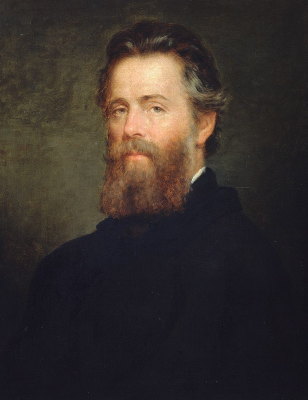
Portrait of Melville by Joseph Oriel Eaton, oils on canvas, 1870

While participating in a memorial ceremony this weekend for the Union dead from Missouri units at the battle of Shiloh, I heard an orator read the first of two poems below written by Herman Melville (1819-1891), perhaps most famous for his epic novel Moby-Dick. It struck me how his famous tale of the obsessive hunt for Captain Ahab’s whale likely more often than not overshadows Melville’s skills as a poet and his chronological place among his contemporaries. His talent is demonstrated in the two selections included below.


Shiloh: A Requiem (April 1862)

Skimming lightly, wheeling still,
     The swallows fly low
Over the field in clouded days,
      The forest-field of Shiloh—
Over the field where April rain
Solaced the parched ones stretched in pain
Through the pause of night
That followed the Sunday fight
     Around the church of Shiloh—
The church so lone, the log-built one,
That echoed to many a parting groan
          And natural prayer
     Of dying foemen mingled there—
Foemen at morn, but friends at eve—
     Fame or country least their care:
(What like a bullet can undeceive!)
     But now they lie low,
While over them the swallows skim,
     And all is hushed at Shiloh.


Sheridan at Cedar Creek (October 1864)

Shoe the steed with silver
     That bore him to the fray,
When he heard the guns at dawning—
               Miles away;
When he heard them calling, calling—
          Mount! nor stay:
               Quick, or all is lost;
               They’ve surprised and stormed the post,
               They push your routed host—
     Gallop! retrieve the day!
 
House the horse in ermine—
     For the foam-flake blew
White through the red October;
     He thundered into view;
They cheered him in the looming;
     Horseman and horse they knew.
               The turn of the tide began,
               The rally of bugles ran,
               He swung his hat in the van;
     The electric hoof-spark flew.
 
Wreathe the steed and lead him—
     For the charge he led
Touched and turned the cypress
     Into amaranths for the head
Of Philip, king of riders,
     Who raised them from the dead.
               The camp (at dawning lost)
               By eve recovered—forced,
               Rang with laughter of the host
      At belated Early fled.
 
Shroud the horse in sable—
     For the mounds they heap!
There is firing in the Valley,
     And yet no strife they keep;
It is the parting volley,
     It is the pathos deep.
               There is glory for the brave
               Who lead, and nobly save,
               But no knowledge in the grave
     Where the nameless followers sleep.
Two Poems by Henry Wadsworth Longfellow

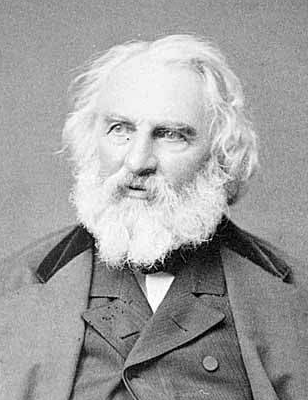
When writing poetry in high school and as an undergraduate English major, one of the highlights of finishing a piece was sharing it with my paternal grandfather. He was an encouraging voice in those beginning years of my craft, and I particularly remember him telling me that his favorite classical poet was Henry Wadsworth Longfellow (1807-1882). The most popular poet of his generation, it was said by a contemporary that “no other poet was so fully recognized in his lifetime.” His 70th birthday was an occasion of national celebration marked with parades, poetry readings, and similar fanfare. Arguably most famous for “Paul Revere’s Ride” and “Song of Hiawatha,” his talent is also demonstrated in the two popular selections included below.


A Psalm of Life

Tell me not in mournful numbers
Life is but an empty dream–
For the soul is dead that slumbers,
And things are not what they seem.

Life is real! Life is earnest!
And the grave is not its goal;
Dust thou art, to dust returnest,
Was not spoken of the soul.

Not enjoyment, and not sorrow,
Is our destined end or way;
But to act, that each to-morrow
Find us farther than to-day.

Art is long, and Time is fleeting,
And our hearts, though stout and brave,
Still, like muffled drums, are beating
Funeral marches to the grave.

In the world’s broad field of battle,
In the bivouac of Life,
Be not like dumb, driven cattle!
Be a hero in the strife!

Trust no Future, howe’er pleasant!
Let the dead Past bury its dead!
Act,—act in the living Present!
Heart within, and God o’erhead!

Lives of great men all remind us
We can make our lives sublime,
And, departing, leave behind us
Footprints on the sands of time;

Footprints, that perhaps another,
Sailing o’er life’s solemn main,
A forlorn and shipwrecked brother,
Seeing, shall take heart again.

Let us, then, be up and doing,
With a heart for any fate;
Still achieving, still pursuing,
Learn to labor and to wait.


The Children’s Hour

Between the dark and the daylight,
When the night is beginning to lower,
Comes a pause in the day’s occupations,
That is known as the Children’s Hour.

I hear in the chamber above me
The patter of little feet,
The sound of a door that is opened,
And voices soft and sweet.

From my study I see in the lamplight,
Descending the broad hall stair,
Grave Alice, and laughing Allegra,
And Edith with golden hair.

A whisper, and then a silence:
Yet I know by their merry eyes
They are plotting and planning together
To take me by surprise.

A sudden rush from the stairway,
A sudden raid from the hall!
By three doors left unguarded
They enter my castle wall!

They climb up into my turret
O’er the arms and back of my chair;
If I try to escape, they surround me;
They seem to be everywhere.

They almost devour me with kisses,
Their arms about me entwine,
Till I think of the Bishop of Bingen
In his Mouse-Tower on the Rhine!

Do you think, O blue-eyed banditti,
Because you have scaled the wall,
Such an old mustache as I am
Is not a match for you all!

I have you fast in my fortress,
And will not let you depart,
But put you down into the dungeon
In the round-tower of my heart.

And there will I keep you forever,
Yes, forever and a day,
Till the walls shall crumble to ruin,
And moulder in dust away!


Additional Resources

The Untold Story of Love and Loss Behind the Beautiful Poems of Henry Wadsworth Longfellow