Two Poems by Gregory E. Lucas

Two Friars on a Hillside

Inspired by Two Friars on a Hillside by Fra Bartolommeo, pen and brown ink, Florentine, 1472-
1517.

Two friars stroll on a hillside
while the feeble sun hides
in a sky as gray as stones.
The wilderness is barren and motionless,
but bent trees still stand like decrepit men.
Under their withered branches, leaves
lie buried in midwinter’s calm.
The friars clutch their robes
and bow their heads.
They ponder holy verses
and a mystic’s cryptic words.
One extols the virtues of a saint;
the other praises the glories of this world
but dreams of a paradise to come.
As the day slips through a misty door, otherworldly
light floods the earth, and silence offers proof.


The Tragedy

After Pablo Picasso’s painting The Tragedy, 1903. Spanish-born artist.

Cloud cover thins and rises
above the moon’s wounded eyes.
The barefoot family of three
shivers at the ocean’s rippled brink.

The frigid wind
whispers warnings of a gaping void
and carries scents of decay.
Turning her back on hope, the mother
rocks the dead baby cradled in her arms.

Her sobs reverberate
in the indifferent night, while
again, the haggard father asks, Why?

The only answer is a far-off
seabird’s fading dirge.
Glitters on the sea dim.
The sky’s last gleams vanish, leaving
no star to offer guidance.

A baffled boy of six or seven
begs for explanations, and finality
replies in the language of shattering waves.

No more shifting shadows among varied hues.
Grief stains Earth with a dull monochrome.

Nothing’s left except them—
huddled, gazing inward.


Gregory E. Lucas writes fiction and poetry. His poems and short stories have appeared in many magazines, such as The Ekphrastic Review, Blueline, and The Horror Zine. His X handle is @GregoryELucas.
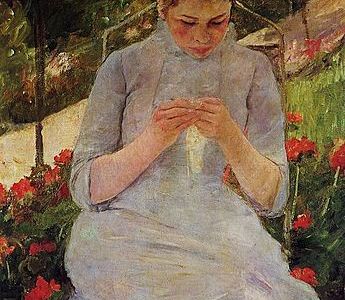
“Girl in the Garden” by Donna Pucciani

inspired by “Young Woman Sewing in a Garden,” Mary Cassatt, c. 1880-82

She could be any ordinary woman
engaged in lace-making, perhaps
tatting the edge of a handkerchief,
sitting dully in a shady spot among
a handful of poppy-bright flowers.

Intent on her task, she is oblivious
to the verdant shrubbery around her,
summer’s cloud of tepid breath.
She does not dissolve into the scene,
does not become one with the garden,
or filter herself through blossom,
but remains contained within herself.

Her plain gray dress closes around her,
leaving bare only her arms, wrists,
and hands free to engage in sewing
the tiny square of fabric that is
her raison d’être, its soft material
gathering her dreams in the task
of the moment.

The graveled path behind her
provides a horizontal stripe of dusty beige
through a haze of trees. She could easily
run away from her nearly motionless
existence, but refuses to consider escape,
her delicate labors calling her from the heart,
or not.


Donna Pucciani has been been published on four continents in such diverse journals as International Poetry Review, Spoon River Poetry Review, The Pedestal, nebu[lab], Italian Americana, Journal of the American Medical AssociationPoetry Salzburg, Shichao Poetry, Istanbul Literary Review and Christianity and Literature. Her poetry has been translated into Chinese, Japanese and Italian, and has won awards from the Illinois Arts Council and The National Federation of State Poetry Societies, among others. She has been nominated five times for the Pushcart Prize and currently serves as Vice-President of the Poets’ Club of Chicago. A list of her eight poetry books can be found on her website.

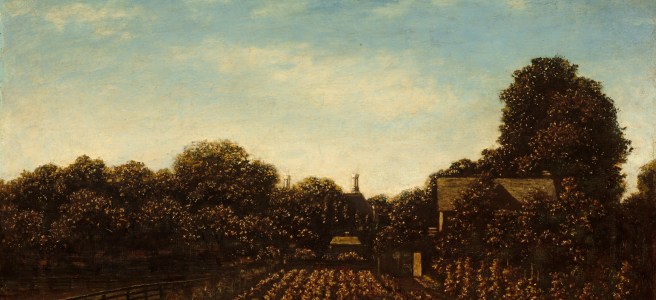
“The Artist’s Garden” by Gregory E. Lucas

(Inspired by Ralph Albert Blakelock’s painting The Artist’s Garden — 1880 — American.)

An artist’s garden—
too commonplace to think that it could happen here:
the dusk gathering by degrees
its forceful melancholy,
demanding to be more than daylight’s dwindling,
asserting itself until it changes
with uncanny exactness
into a state of mind.

While the hues of blooming flowers fade,
the once-bright pathways turn gray—
taper to blackened ends.

Fragrances linger
in the springtime air
that holds unanswered questions.
The elm trees’ shadows deepen
until they portray the void within the artist’s soul.
Rows of cultivated flowerbeds
bow to unrealized dreams.
This, while the fading sky and indelible gloom
suffuses the dimming hedges.

Diminutive, in the distance,
a church spire, to which
the dying day’s light clings.
Faith, assurance, and hope
give way to the moment
when disillusionment
renders every leaf and stem colorless.


Gregory E. Lucas writes fiction and poetry. His short stories and poems have appeared in many magazines, such as The Ekphrastic Review, The Horror Zine, and Blueline. He lives on Hilton Head Island in South Carolina. Follow him on Twitter X @GregoryELucas.

“Hapless Decoration” by Shelly Elizabeth Sanchez

In those old days
Upon that ceramic floor
I stared into her back
Where she was resting on her knees
And staring in the water

As if she was finely brushed
With ocean blue tears
Devoid of salt
Teasing at the seam
Of her existence

She harkens to the girl
Wet from chlorine
On a holy afternoon
Staring at the flesh
Of her youthful thighs

Who could imagine
A being so small
So fragile and fair
As to wonder why
And for what purpose

She rests in that frame
Bathed in clinical light
Mirrored by the one
Dripping onto the floor
Into the vast sea below

“Hapless Decoration” first appeared in The Colton Review.


Shelly Elizabeth Sanchez grew up in the North Carolina Piedmont beginning at age six. Her earliest memories include playing with the boys, some freaky nightmares, and random sessions on the family Nintendo 64. Her existential poem, “Hapless Decoration,” won first place in Poetry in The Colton Review: Volume 17, and she published flash fiction in The Colton Review: Volume 18.

“Drifting Notes” by Sultana Raza

Inspired by Alan Senez’s painting, “Les Annees de Pelerinages.” Featured with permission.

Time abandoned, history lost in swirls,
Lost tunes trill eternally in vain,
Driving weeping branches, gradually insane.
Along river bank, notes writhe and curl.

In ethereal dimension, as player shifts,
Phantoms gather, nodding heads enthralled,
Wayward spumes of tunes start to drift.
In the ‘no time’, glissandos pitched, and called.

Musical shivers of rivulets, streams,
Dotted by light, drops bathed in gold,
Help dried leaves to hope and dream,
As unseen vibes transform their mold.

Eighty-eight molecules of wild spirits whirl,
Octaves reach crescendo at zenith of the sun,
As new formations in time’s streams unfurl,
Zephyrs whisper that soulful tunes have won.


Sultana Raza has published poems in 150+ journals, including Columbia Journal, The New Verse News, Copperfield ReviewLondon Grip, The Society of Classical Poets, Dissident Voice, and The Peacock Journal. Her fiction has received an honorable mention in Glimmer Train Review, and has been published in SetuColdnoon Journal, Knot Magazine, Entropy, and ensemble (in French). Of Indian origin, she has read her fiction/poems in India, Switzerland, France, Luxembourg, England, Ireland, the US, WorldCon 2018, CoNZealand 2019, and Chicon8. Find her on Facebook here.

Two Poems by M. Brooke Wiese

Cormorants Prepare for the End Times

A bullfrog harrumphs somewhere in the tall
grass along the edge of the reservoir.
A cormorant is fishing for his midday
meal; he stays under a long time

looking for plunder. When he pops up,
unsuccessful, he shrugs it off – a flash
of feet and he’s gone again. His wet feathers
iridesce in the sunlight like an abalone shell.

Up on a corner of North Pump House,
a mated pair of sleek cormorants puff
their chests and spread their wings to dry,
facing into the sun. The day is hazy,

the air is thick from the fires out West,
burning up the land from the Pacific
to the Mississippi. The birds flutter
their throats against the heat, a neat

trick to cool off in this man-made sauna,
a strategy never needed this far
north before, but we are in another
war, this time with the avifauna.

Last night, the moon rose luminous
above the reservoir, the color of
tangerines, a photo-op for social
media, unsettling all the same. Relief

is promised today, when sudden thunderstorms
will unleash monsoon rains, giant hail,
and wind shear strong enough to blow a house
down, and clear away the smoky air.


Memento Mori

In my kitchen, musing on Cézanne’s Still Life with Skull (1898)

Apples, oranges and pears fill the bowl,
bananas and grapes spill over its lip;
the footed bowl is cinnabar, jewel-
like against the black walnut tabletop
burnished by a hundred years of eating.
It is an uneventful scene, and ours
is a modest home. Life is fleeting.
Many days I hear Charon’s oars
thunk against the oarlocks as he slowly
rows dead souls across the River Styx,
their mouth-coins his recompense. Such folly
to think I can escape with either promises or tricks
when even luscious fruit, if forgotten,
shrivels, molders, leaks, and grows rotten.


M. Brooke Wiese’s work has appeared in numerous publications, most recently in The Raintown Review, Poem, and The Orchards. Her poems have also been published in Sparks of Calliope, Atlanta Review, Barrow Street, and Grand Street, and her chapbook, At the Edge of The World, was published by The Ledge Press in 1998. After a very long hiatus, she has again been writing furiously. She has worked in education and nonprofit social services.

“Hopper’s Dories” by Donald Wheelock

—after Edward Hopper’s The Dories, Ogunquit, 1914 (public domain)
Whitney Museum of American Art

Attentive to the forces of the tide,
they point up into open ocean breeze
like hungry pets anticipating food.
They feel the breeze enliven what they see.
A distant shore encloses open sea.

A view of coast as crisp and deep as life
itself, before the smudges of mankind
applied a slick to every shore and reef;
even the clouds are swept clean by the wind.

Feathery skies of sun-made summer choose
a clear-eyed, optimistic morning view
to paint the cove profusions of its blues.

The froth of distant ocean surf and light
explodes into the dory-sides as white.


Donald Wheelock spent forty years writing formal poetry before reaching the stage of submitting his favorites for publication. Formal poetry, once relegated to second fiddle in a career of writing chamber, vocal and orchestral music, has now demanded equal time. Indeed, it has taken over his life. He has published a chapbook, In the Sea of Dreams, with Gallery of Readers Press, and placed poems in Blue UnicornEkphrasis, EquinoxLinea, The Lyric, and elsewhere. He is trying to place two full-length books of his poems. He lives with his wife Anne in an old house at the edge of a hayfield in Whately, Massachusetts.

Selections from “The Woman in an Imaginary Painting” by Tom Montag

No, you do not
know who she is.
And you do not

know how you know
her. She is not
of common face.

She has no fame
other than her
loveliness. Yet

somehow you still
recognize the weight
of this moment

and you cannot
turn from her,
you cannot turn.
______________________

There are no
abstractions
in her world:

The idea
of table
is the table
she rests against.

The idea
of window
is the window
in her wall.

The idea
of breast
is her breasts,
their loveliness.
______________________

Breath and spirit
lend beauty
to her silence.

The woman
in the painting
wears the air

like wet silk.
Nakedness is not
her only promise.
______________________

She does not
show pain. Her

strength revels
in other light.

She can hold this
pose forever.
______________________

We can’t see it:
we can only

imagine
the happiness,

the anticipation
as she waits

for the moment
the posing is done

and she can be
the woman she wants.


Tom Montag‘s books of poetry include: Making Hay & Other Poems; Middle Ground; The Big Book of Ben Zen; In This Place: Selected Poems 1982-2013; This Wrecked World; The Miles No One Wants; Imagination’s Place; Love Poems; and Seventy at Seventy. His poem “Lecturing My Daughter in Her First Fall Rain” has been permanently incorporated into the design of the Milwaukee Convention Center. He blogs at The Middlewesterner. With David Graham he recently co-edited Local News: Poetry About Small Towns.