Two Poems by Philip A. Lisi

Order of Operations

First Tuesday of every month for six,
I drive you to the hospital.
You like riding high in my truck,
seeing everything, even as your legs,
skeletal parentheses in denim,
might not make the step up
after this latest round of chemotherapy.

Outside your house, I wait on your porch.
Always prompt, you appear at the door,
corners of your mouth accented with dried saliva,
math textbook tucked tightly under your arm,
the laminate peeling back from the edges,
no pocketbook, no cardigan
draped over your arm.
I suspect you know its precise dimensions
and calculated its weight
in proportion to your featherweight frame.

Inside the treatment room,
Rosen’s Discrete Mathematics Teacher’s Edition
holds your attention.
Perhaps, there is comfort in the familiarity–
brackets, square roots, variables,
old friends to polynomials, a fleeting balm,
one last attempt to solve,
the calculus of cancer.

Last night, on the eve of your final treatment,
I think about how I cried over the same tattered text
and endless algebraic equations,
sitting at your kitchen table, mind wandering,
wishing your oatmeal cookies
would somehow make the numbers make sense.
Now, abstract calculations take your mind away
from the discrete pain of the needle
and the drip that kills as it sustains.


Among the Hemlocks

Among the hemlocks,
on the shores of Lake Wallenpaupack,
a thick-pelted mink scampers
up and over lichen-coated granite
left dry on the banks,
just out of aqueous reach.

I marvel at her slinky deftness,
her effortless, oily movement among the stones,
her back flexing to match the gentle waves,
rippling astride her hop-dive-curl-stretch:
lovely syncopation in walnut brown.
Then, finally, in mid hop-curl,
she is gone.

My father has made it halfway down
the steep stone steps
that lead to the water’s edge.
From there, I take his hand
and help brace his body,
so fragile now I barely feel
its weight against my arm.

I take care he does not misstep—
a fall would surely mean a break,
the final hobbling of an already
failing frame.

Together, we reach level ground and pause.
We talk about the great blue heron
seen from the window early this morning–
how enormous they must be to take up
so much of the pane at a glance—
and at that distance!
I tell him of the wooly mink,
long and sleek and blink-swift.

My father says little—
A manifestation of his condition,
his neurologist tells me.
But I suspect he is thinking
about the mink with envy
as I offer my arm for ascension.


Philip A. Lisi lives in Lancaster, Pennsylvania, where he teaches English at his high school alma mater by day and writes poetry and flash fiction by night alongside his family and the ghost of their cantankerous Wichienmaat cat, Sela. His work has appeared in Sparks of CalliopeThe Abbey ReviewLitbreak MagazineRosette Maleficarum, and the Serious Flash Fiction anthology.

Two Poems by Gerard Manley Hopkins

Gerard Manley Hopkins, 1889

Gerard Manley Hopkins (1844-1889), an English poet and Jesuit priest, was largely unrecognized for his poetic contributions during his lifetime. Posthumously, Hopkins has been celebrated for his innovative use of language and rhythm, as well as the deep spiritual and nature-oriented themes in his work.

Hopkins was profoundly influenced by his religious faith, which permeated much of his poetry. His critical view of the industrial revolution’s impact on nature, combined with his unique prosody—termed “sprung rhythm”—and vivid imagery, positioned him as a precursor to modernist poets. The fluctuating recognition of literary figures often reflects the evolving tastes and critical frameworks of successive generations rather than an objective measure of their work’s value within their own time.

The eldest of nine children, Hopkins was educated at Highgate School and Balliol College, Oxford. After converting to Catholicism under the influence of John Henry Newman, he entered the Society of Jesus in 1868. His commitment to his vocation led him to burn his early poems, only to be encouraged to write again later by his religious superiors. Hopkins’ poetry remained largely unpublished until after his death, with his friend Robert Bridges playing a significant role in bringing his works to public attention.

Hopkins’ most recognizable poems include “The Windhover” and “Spring and Fall: To a Young Child,” both of which are found below.


The Windhover

To Christ our Lord

I caught this morning morning’s minion, king-
    dom of daylight’s dauphin, dapple-dawn-drawn Falcon, in his riding
    Of the rolling level underneath him steady air, and striding
High there, how he rung upon the rein of a wimpling wing
In his ecstasy! then off, off forth on swing,
    As a skate’s heel sweeps smooth on a bow-bend: the hurl and gliding
    Rebuffed the big wind. My heart in hiding
Stirred for a bird, – the achieve of, the mastery of the thing!

Brute beauty and valour and act, oh, air, pride, plume, here
       Buckle! AND the fire that breaks from thee then, a billion
Times told lovelier, more dangerous, O my chevalier!

       No wonder of it: shéer plód makes plough down sillion
Shine, and blue-bleak embers, ah my dear,
       Fall, gall themselves, and gash gold-vermilion.


Spring and Fall

To a young child

Márgarét, áre you gríeving
Over Goldengrove unleaving?
Leáves like the things of man, you
With your fresh thoughts care for, can you?
Ah! ás the heart grows older
It will come to such sights colder
By and by, nor spare a sigh
Though worlds of wanwood leafmeal lie;
And yet you wíll weep and know why.
Now no matter, child, the name:
Sórrow’s spríngs áre the same.
Nor mouth had, no nor mind, expressed
What heart heard of, ghost guessed:
It ís the blight man was born for,
It is Margaret you mourn for.


The informational article above was composed in part by administering guided direction to ChatGPT. It was subsequently fact-checked, revised, and edited by the editor. The editor/publisher takes no authorship credit for this work and strongly encourages disclosure when using this or similar tools to create content. Sparks of Calliope prohibits submissions of poetry composed with the assistance of predictive AI.

Two Poems by Carl Palmer

His Limbo Soliloquy

Actually, I like lockdown. I already was before COVID anyway,
but now I’ve got my privacy. No family feeling forced to visit
or hold vigil in my netherworld,
he confides through the phone.

Both of us former Army soldiers placing us on common ground
made introductions easier with the usual “where were we when”
comparisons of duty assignments all military members embrace.

Though sharing multiple telephone calls these past seven months
since my assignment to be his companion as a hospice volunteer,
I have yet to meet him face-to-face due to pandemic restrictions.

Using his bedside number at the nursing home I can call anytime,
not worry about visiting hours. I ask if he’s busy, got time to talk.

His answer’s most always the same, Just busy here being alone,
too close to death to complain.
Clicking me to speaker he begins
what he calls “me-memories from a time when when was when.”

Mostly musing of being anywhere but there, lost in an actual place,
blurring “what was with what is” behind and in front of his shadow,
recalling dreams as a younger man, of a future in past perfect tense.

And times talking of present times from his no man’s land outpost,
All days end as they begin in purgatory, today recopying yesterday,
cared for by hosts of faceless masked angels not letting me die alone.

Forgive me only thinking of myself, I just need you to hear I’m here.
Inside I’m your age, the two of us sharing a brew at the NCO club,
years ago and oceans away, comrades-in-arms talking of our day.

To me he’s the sergeant with permanent change of station orders
in transition for his final mission, ending his time on active service,
in hopes his God is religious and his terminal assignment is good.


November 21, 1963

He took the harmonica
from the bib pocket of his overalls
blew thru left to right, low to high
back and forth a couple times,
slapped it on his palm
like he’d tamp his cigarette,
one of those unfiltered camels
on his silver Zippo lighter,

He blew a quick riff up the scale,
inhaled it back down,
spun his harmonica around
slapped it a couple more times,
stopped as if thinking
about what he’d play
then smile that smile he’d smile
while looking at her,
start in on The Tennessee Waltz
watching her close her eyes,
hug herself, stand up and sway.

As he played he moved to her side
wrapping one arm around her waist,
she draped both arms on his shoulders
and they glided around the living room
in a world of their own
viewed by us six kids,
all of us grinning and smirking
and making kissy faces
watching mom and dad,
mom singing the words
motioning us all up to dance
that night before our president was killed.


Carl “Papa” Palmer of Old Mill Road in Ridgeway, Virginia, lives in University Place, Washington. He is retired from the military and Federal Aviation Administration (FAA), enjoying life as “Papa” to his grand descendants and being a Franciscan Hospice volunteer.

And the winner is…

Sparks of Calliope is pleased to announce its nomination of

“My Father Remembers” by Laurie Kuntz

has been selected for inclusion in Pushcart Prize XLIX (2025 edition).

Congratulations, Laurie!


Read “My Father Remembers” in Sparks of Calliope here.

In accordance with the contract provided by Pushcart Press, Sparks of Calliope and Ms. Laurie Kuntz will receive a copy of this edition of the anthology, and Ms. Kuntz will be appointed to the editorial board for all future editions.

Two Poems by Audrey Towns

Stheno and Euryale’s Sister

There was a heckled birdsong through
the window this morning.
An aged peeled-back seal let in
the laughter. I can’t see
how they think it’s funny,
the way my bones
hang like autumn leaves,
and I don’t seem to soar
like I used to…head up up up,
in the crowd, red dress
smooth against tight
skin that could make you
a believer. The crowing, the singsong,
and there was nothing funny about it.
They told me to enjoy it; it goes fast.
But do the birds outside
enjoy flying more just because it
will be over one day, feather-plucked,
scales shed without the fresh body underneath?
So, fly as high as you wish.
No one’s laughing. No one would dare.
Touch the sun before the wax and water take your wings.
You’re immortal. Hydra.
I believe. I believe.
I believe.


Odyrmós

Even catacombs of cacti with broken bowels push daisies.
beaks nurse nectar from their verdant lobes cradled
near cracked areoles, cochineal youths entombed in
bony spines, a festoon of feathers hiraeth for hummingbird hearts,
the lacuna of drumming echoed in long-ago fluvial formed
barrancas of breached bellows, drowning in desiccated
desserts of stone where mortar and pestle grind
fresh herbs for Darwin’s feast of fitness, their children carmine
for foreign tapestries, a death whistle woven through the loom.

As brute beaks break their tender skin, what name do they beseech
when each trip around the sun equates transformation with consumption?
Morrigan? Mars? Apophis? Odin? They have beaks of their own,
feasting upon the slippery skin of Pelops.
          Such cycles make meals of our children,
small ivory shoulders heavy with Demeter’s distraction and Myrtilus’s
malevolence. Gone, the crimson cadence of their cores, lost
to the scorched seas of war, now tomb to the ill-fated dog, her bark
a breathless warning bloomed from parched blue lips, a sibyl
from frothed laurel-eating throats, poison turned to prophecies,
spreading like tendrils of yellow rot in empty stems, a nostrum of violence
quenched by the liquor of lament, torched eyes guiding
like a north star for travelers weary of revenge,
          navigating dark turbulent waters,
a tempest of tears their triumph.

Stars ascend and fall still wearing thick thorn crowns of ancient
cacti or the cochineal robes of conquest; unity is not all hymns of hope.
Grief, breaking and branching from polyped pores,
ribs yawning, callus ripened, not offered, but eaten, where finely formed
glochids pierce neighbor’s dominion, rash spreading, inflamed.

Those closest to the fires of Niflhel water roots with searing
cauldrons of grief, Pair Dadeni, reborn mute, intimate
prayers without alter, they weep ambrosia potions.
How good are tears, how sweet are dirges,
repatriation of splintered flesh, transformation without consumption,
Ι would rather sing dirges
than eat or drink.

 
Through throttled throats held tight, cries
rising, vibrating in the chasm
of their chests, tongue-splitting
siphons, rattling, raging
into a lore of lament
 
and protest


Audrey Towns, a literature and composition instructor in the heart of Fort Worth, Texas, dismantles the nature/culture binary in her prose and verse. New materialism is her muse, landscapes her canvas, and the connection between the human and nonhuman her essence. She has published in several places, including The Stone Poetry Quarterly, Beyond Words Literary Magazine, and You Might Need to Hear This.

“Someone Here” by Kathryn Ruth Stam

Inspired by Rig Veda and poet Frank Gaspar

The brown bricks in the courtyard offer up their histories of clay and ash,
There is someone here who is the daughter of the moon.
She is awake, having gone where the sky is thin.
She has uncovered the edges of the horizon.

In Kamala’s house, the pressure cooker spins and spits streams of hot steam.
My right hand scoops the rice with my fingers,
My thumb, the trigger.
I did it the way they taught me, the rice and curry airborne.

Kamala told me that she and Narayan were lovers back in Nepal.
I asked her for how long. She said, “Always.”

Once, I saw a goose separate the milky ocean back into milk and water.
Milk is truth and water is not.
A smart human accepts the truth.

If you listen, I can tell you.
Once, Krishna painted the entire world on his thumbnail.
Once, I saw my son’s father hold our baby up in the air,
           the baby standing on his palm.

Trickster is not a common magician or horse thief.
Trickster is driven by appetite.
They know best the places where one must never walk.
When sunset is visible, the sun has already set below the horizon.

Trickster cooked lamb curry and made from it a vulva.
Trickster took squirrel kidneys and made from them a kiss.

What is the world is trying to say to us?
Sky and earth, Guard us from the monstrous abyss.


Kathryn Ruth Stam is a professor of cultural anthropology at the SUNY Polytechnic Institute in Utica, NY.  She writes about the people she has known in Thailand, Nepal, and Central New York, and the joys of getting to know the resettled refugees who are our newest neighbors and friends. Her creative non-fiction work has been published in Griffel, Exposition Review, the Santa Ana River Review, Wanderlust, Flumes, and the Write Launch. She was a finalist for the Nowhere 2020 Emerging Writers Contest with her story, “Elephant Crush.” 

Two Poems by Dan Raphael

Not Even Halfway Through Winter

waiting for something to fall,
to be broken through, to crumble
a faulty form of weaving, s scent of unraveling
holding up to the wind to winnow, to filter,
to enhance with partial exposure

sheets in the wind and rain, thread count, space count
what chords at what speed driven where, the margin of humidity
window air, patchwork air of various -parencies, -lucencies
& focus lengths, unstill reflections in attention’s pan,
refractions in chameleon-eye air

the angle and speed of my turning
enticing vision to correct itself
to not accept how others see it
what’s 20 got to do with it
a thirst for light, a jones for void

trust that the air will be there
that we can get back without turning around
the shaker says salt, white crystals come out, but

the language of reality is changing but mine continues
its erratic spread, away from the weave
pockets in the turbulence, fairly still, somewhat porous
certain angles get in at certain times
of day or season, wind speed and direction

my breath isn’t me, thee world outside my window
as distant as the snippet lives and headlines on my screen
I tempt the mirror to enter, we take time to reflect
but don’t talk about projection, giggle at conjecture,
not all injections are judged equally, the strength
to reject rejection, to bathe in rain, the endless potential
in all these shades of grey


Re Quest

Can a story be all questions
Will this ladder hold me
Is the water safe to drink
I talk to myself to be ready if anyone else appears

Are there times light is more important than heat
If the sound is coming from both directions, do I have to choose
or wait, learning to doppler, to separate, sending agents or drones
while staying at home, monitoring more sources than I have fingers

Is there somewhere so barren you can’t tell if there’s wind just by looking
When putting on more clothes makes me colder
Where every window and mirror is a monitor, taking more than they give
Is there any personal data left in me

Can a story be nothing but facts, connecting conjectures
above my pay grade, the only AI I can access is Advertising Intensive
My credit score is too low cause I pay all my bills
and have only one card—what kind of a story is that

Like a topographical map of time, mountain ranges of wars and plagues
narrow valleys of peace and isolation. I’m nowhere on the map
now here, as the map continues to scroll and evolve
Why are the same stores at every exit
Why do gas prices rise as my tank nears E

Time for a new chapter in a new city in my fictional memoir
of what’s to come—is it my fault reality didn’t read the script
yet sends its own consequences, sometimes misaddressed,
rarely with instructions, never a return response


Dan Raphael, a vibrant presence in Portland’s poetry scene since 1977, engages as poet, performer, editor, and reading organizer. His anthology Impulse & Warp: The Selected 20th Century Poems showcases works from his initial 13 collections. Notable among his new poetry volumes are The State I’m In, Breath Test, and Showing Light a Good Time. Collaborating with jazz artists Rich and Carson Halley, he released the CD Children of the Blue in February. With over 250 performances, including Wordstock and Portland Jazz Festival, Dan’s impact extends across diverse venues. Editor of NRG magazine for 17 years, he founded 26 Books, spotlighting regional poets. Additionally, he curated reading series at Borders and St Johns, and orchestrated the monumental event Poetland, featuring 80 poets across 8 locations in an 8-hour span.

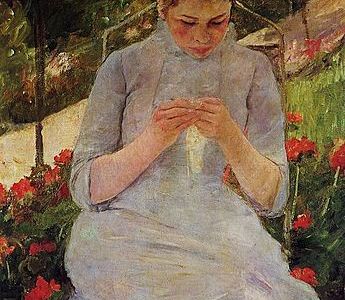
“Girl in the Garden” by Donna Pucciani

inspired by “Young Woman Sewing in a Garden,” Mary Cassatt, c. 1880-82

She could be any ordinary woman
engaged in lace-making, perhaps
tatting the edge of a handkerchief,
sitting dully in a shady spot among
a handful of poppy-bright flowers.

Intent on her task, she is oblivious
to the verdant shrubbery around her,
summer’s cloud of tepid breath.
She does not dissolve into the scene,
does not become one with the garden,
or filter herself through blossom,
but remains contained within herself.

Her plain gray dress closes around her,
leaving bare only her arms, wrists,
and hands free to engage in sewing
the tiny square of fabric that is
her raison d’être, its soft material
gathering her dreams in the task
of the moment.

The graveled path behind her
provides a horizontal stripe of dusty beige
through a haze of trees. She could easily
run away from her nearly motionless
existence, but refuses to consider escape,
her delicate labors calling her from the heart,
or not.


Donna Pucciani has been been published on four continents in such diverse journals as International Poetry Review, Spoon River Poetry Review, The Pedestal, nebu[lab], Italian Americana, Journal of the American Medical AssociationPoetry Salzburg, Shichao Poetry, Istanbul Literary Review and Christianity and Literature. Her poetry has been translated into Chinese, Japanese and Italian, and has won awards from the Illinois Arts Council and The National Federation of State Poetry Societies, among others. She has been nominated five times for the Pushcart Prize and currently serves as Vice-President of the Poets’ Club of Chicago. A list of her eight poetry books can be found on her website.

“DSM IV 298 or Am I Blue?” by Leslie Lippincott Hidley

My limbic system’s gone to sleep —
My affect’s flattened by the walrus on my head.
No difference in doing and not-doing.
The world is an ashtray, a splatted spider,

A drudgery of breathing in and breathing out,
Pushing blood through tired veins.
All is uphill.
Only sleep is sweet.

I will talk to you in words of one syllable
So even you can understand.
I will make you feel better.
I will push on your psyche —
Yank it around.

Like I would cheer you out of a broken leg
Or appendicitis.

Plotinus said, “Weather is the celestial form of music.”
I say, “Mood is the neural form of weather.”
I am in the doldrums, stupefied, dull winds droning,
Bleak-brained and dim-lighted.

Look where you’re not looking:
I am the creator of full ashtrays and garbage.
Unmade beds, floors full of wet towels and dirty clothes.
Tables stacked with unpaid bills, coffee cups,
Empty wine glasses, papers.
Ants in the kitchen. Hurt feelings.

I have a gift for disorder.
I make messes.

My tongue is shredded cardboard and junk mail,
Chopped metaphors, and broken shards of soda bottles.
My mind is a kitchen rag.


Leslie Lippincott Hidley has been writing prose and poetry for her own amusement and that of her family and friends and others for most of her 77 years. And one of her ten grandchildren is named Kalliope. She has lived in Walla Walla, Washington; Frankfurt and Bremerhaven, Germany; Upper New York State; Enid, Oklahoma; Montgomery and Prattville, Alabama; Lubbock, Texas; Dover, Delaware; West Palm Beach, Florida; Goose Bay, Labrador; Washington, D.C.; Fairfield, California; Omaha, Nebraska; and now resides in Ojai (Nest-of-the-Moon), California, where she continues to write.

Two Poems by Diane Webster

Achieved Again

The old woman totters
down the driveway
toward her morning newspaper
tossed out like bird seed
awaiting early risers
to peck away best tidbits
like this old woman
who uses her grabber pole
to scoop up the rolled paper.

She shuffles back toward home
like doves landing on telephone wires
teetering back and forth
until balance is achieved again.


Cancer Twin

The body gets bored,
decides to experiment
by mixing cells
to see what will happen.

Lo and behold it births
growth magnificent
with rapid regeneration.
Eureka! rushes throughout
the system of blood, bones and tissue
to nourish this new addition,
this new creation until the host
discovers its existence
and plots its demise with assassins.

It floats out spies
to lie in safe houses
until the attack abates.
Snipers crawl forth
and shoot lookouts
so embryo stretches outward.

It matures, flings off
residual parries to its life.
It flourishes as body rejoices
at first, then fears
tinkering twin.


Diane Webster has published in “El Portal,” “North Dakota Quarterly,” “New English Review,” “Verdad,” and other literary magazines. She had a micro-chap published by Origami Poetry Press in 2022, 2023 and one forthcoming in 2024. One of Diane’s poems was nominated for Best of the Net in 2022.