“Appendectomy” by K. Irene Rieger

I.

I am not she who falls asleep, nor do
I drift to dreamland, no. I’m too inflamed
to fall for it; I curl and clutch and claw
for it, my legs linked ells and ankle-clamped,
my forearms cinched, contorted, clenched, and car-
pal tunnel-tight. I clap at Syncope
With hands that quake with clasping—she: condensed,
compact, hard nut to crack. Hope gleams from gaps
in prayer-palms grasped. Can’t peep—could spook the fick-
le snitch of sleep, nor souse myself—my son
could call me helpless from the hospital.
My son. I wish I were there with him now
that worst has come to worst. But if God’s grant-
ing wishes, I would have him fix him first.

II.

I’m certain that the hospital is where he ought to be— 
My boy’s bile-bloated bowels may have burst and must be mended 
—But though I know it’s toddler talk, I want him here with me. 
 
His sister needs a parent, though I’m rotten company. 
I feed her, then deposit her with Elmo, unattended. 
I’m not a fool; I realize he’s where he ought to be. 
 
I’m haunted by the ghost of an umbilical IV. 
If he were home it’d have to span across two states, suspended. 
Ridiculous, it wouldn’t reach!  I want him here with me. 
 
And though hospital duty’s always been my specialty, 
My husband’s had the shot; I’ve not.  Routines must be amended. 
Yet I can’t shake suspicion that he’s where I ought to be. 
 
My son, who renders tendered kisses now quite dutifully 
Once giggled when I nibbled on his crepe-sweet ears, so when did 
Dad’s noogies beat my nibbles out?  I want him to need me. 
 
My baby boy in pain and all our lives again upended 
And Mommy’s just another organ shown to be appended. 
I know that he’s well cared for in the place he ought to be. 

The mind knows, but the body balks.  I want him here with me.

III.

“Make friends with the problems in your life… Approach them with familiarity rather than dread.” ˗˗ Sarah Young, Jesus Calling

Sarah says we should view problems more fondly; 
Mine has a certain symmetric appeal. 
Here is the beauty of Gabriel’s quandary: 
Twice intervention has severed the seal 
Of his soft baby skin.  Now stigmatical lesions 
Prevent the peds surgeons from plying their trade. 
Still these same sweet (because saving!) adhesions 
Mean surgery’s vital and can’t be delayed. 
Fool’s errand: seeking the surgical scholar, 
A very Vizzini her logic won’t stop. 
The cons in each column grow taller and taller 
But always incessantly equal at top. 
Congruent conundrum.  What else can I say? 
My problem’s a beautiful one, anyway.


K. Irene Rieger is Associate Professor of English at Bluefield University in Bluefield, Virginia.  A Martha’s Vineyard Institute of Creative Writing Fellow, she is the First Place winner of the 88th Annual Writer’s Digest Writing Competition in Rhyming Poetry.  Her work has appeared in The College English Association Critic, the Journal for the Liberal Arts and SciencesTalking Writing, and MUSE

“September Soliloquy” by Michael Ceraolo

My name is James Benjamin Parker
and, quite unoriginally,
I was called Big Jim because I was a big man
And I want to say 
that fate,
              or destiny,
or whatever you choose to call it,
is real

I worked many jobs in my life,
and lived in many places
One of those places was Buffalo, New York,
and one of those jobs was at a restaurant
during the Pan-American Exposition
I was laid off from the restaurant job
in early September 1901,
              which
meant I could go to see the President,
who was greeting people at the Exposition
on September 6th

The line to see him moved slowly,
and I tried to talk to the man
standing ahead of me,
              but
he just ignored, I didn't know why at the time,
though I found out when we reached the President:
he pulled his wrapped hand from his pocket
and shot the President

I hit him in the neck and face
and knocked the gun from him
"I am told I broke his nose---
I wish it had been his neck"
"I am sorry
I did not see him four seconds before"

Afterwards, people wanted to sell my photograph,
               but
"I do not think the American people
would like me to make capital
out of the unfortunate circumstances"
I did give some lectures about the event
when asked to do so by various groups,
but I was never the same after that day:
became a vagrant,
               had hallucinations,
was placed in an institution,
and died there a little over five years 
after the assassination
No one claimed my body,
so I was donated to science

I never did get to shake the President's hand


Michael Ceraolo is a 64-year-old retired firefighter/paramedic and active poet who has had two full-length books published: Euclid Creek from Deep Cleveland Press and 500 Cleveland Haiku from Writing Knights Press. He has two more in the publication pipeline.

Two Poems by Rudyard Kipling

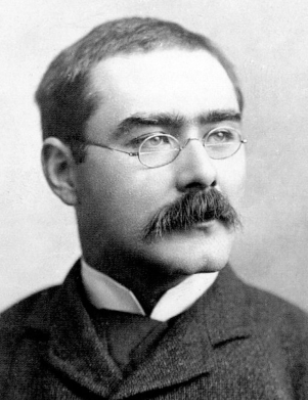
Joseph Rudyard Kipling, 1895

While arguably best known for his collection of short stories entitled The Jungle Book (1894), English writer Rudyard Kipling is also widely recognized as a talented poet. Voted the UK’s most popular poem in a 1996 poll conducted by the BBC, Kipling’s “If—” still resonates more than 125 after its 1895 conception.

Kipling’s Diamond Jubilee poem, “Recessional” might have some familiar lines to even casual observers. The phrase “lest we forget,” commonly associated with Remembrance Sunday in the UK and even Memorial Day in the U.S., originated from this poem.

It is often argued that both of these poems are far more complex in sentiment than Kipling is often given credit for. Decide for yourself after reading each of these classic pieces, provided here below.


If—

If you can keep your head when all about you
      Are losing theirs and blaming it on you,
If you can trust yourself when all men doubt you,
      But make allowance for their doubting too;
If you can wait and not be tired by waiting,
      Or being lied about, don’t deal in lies,
Or being hated, don’t give way to hating,
      And yet don’t look too good, nor talk too wise:

If you can dream—and not make dreams your master;
      If you can think—and not make thoughts your aim;
If you can meet with Triumph and Disaster
      And treat those two impostors just the same;
If you can bear to hear the truth you’ve spoken
      Twisted by knaves to make a trap for fools,
Or watch the things you gave your life to, broken,
      And stoop and build ’em up with worn-out tools:

If you can make one heap of all your winnings
      And risk it on one turn of pitch-and-toss,
And lose, and start again at your beginnings
      And never breathe a word about your loss;
If you can force your heart and nerve and sinew
      To serve your turn long after they are gone,
And so hold on when there is nothing in you
      Except the Will which says to them: ‘Hold on!’

If you can talk with crowds and keep your virtue,
      Or walk with Kings—nor lose the common touch,
If neither foes nor loving friends can hurt you,
      If all men count with you, but none too much;
If you can fill the unforgiving minute
      With sixty seconds’ worth of distance run,
Yours is the Earth and everything that’s in it,
      And—which is more—you’ll be a Man, my son!


Recessional

God of our fathers, known of old,
      Lord of our far-flung battle-line,
Beneath whose awful Hand we hold
      Dominion over palm and pine—
Lord God of Hosts, be with us yet,
Lest we forget—lest we forget!

The tumult and the shouting dies;
      The Captains and the Kings depart:
Still stands Thine ancient sacrifice,
      An humble and a contrite heart.
Lord God of Hosts, be with us yet,
Lest we forget—lest we forget!

Far-called, our navies melt away;
      On dune and headland sinks the fire:
Lo, all our pomp of yesterday
      Is one with Nineveh and Tyre!
Judge of the Nations, spare us yet,
Lest we forget—lest we forget!

If, drunk with sight of power, we loose
      Wild tongues that have not Thee in awe,
Such boastings as the Gentiles use,
      Or lesser breeds without the Law—
Lord God of Hosts, be with us yet,
Lest we forget—lest we forget!

For heathen heart that puts her trust
      In reeking tube and iron shard,
All valiant dust that builds on dust,
      And guarding, calls not Thee to guard,
For frantic boast and foolish word—
Thy mercy on Thy People, Lord!

Two Poems by Michelle Faulkner

For Sadie

By the back door
I find her chipped red bowl
Sunk into cold mud.
Cupping my hands, I hold gently
my last piece of her
I think she knew, that gray morning
Putting her nose on my lap to say goodbye – but I,
Distracted by jobs and chores,
Left her asleep on her frayed blanket
I returned too late and she was gone
A decade past, but I still cry
Dusty tears for yesterday
Yet when I lift my face
Through silver cracked clouds, I can glimpse her
Paw prints on heaven’s grass.


Her Legacy

She is not conflicted youth
Nor is she wisdom’s solace
Not untroubled virtue
Nor aloof neglect
She is not the condemned’s justice
Nor the penitent’s salvation
She is not barricaded faith
Nor is she candlelit belief
She is not invisible
Although she is unseen
She is not pity’s allurement
Nor is she pride, unshamed
She is but a cold gravestone’s
Crumbled, abandoned name


Michelle Faulkner is a prolific poet who has self-published quite a few poems, including the two above, on a site called PoetrySoup. She also recently had a poem published in Literary Yard, an online publication based in India.

“The Walking Wounded” by Nolo Segundo

I see us everywhere anymore,
at the supermarket or the mall,
moving slowly, often cane-less
(old folks can be vain too) along
a sidewalk like lost zombies, and
of course every time I visit one
of the plethora of doctors I rely
upon to keep my rusting body
and creaking heart working….

Why did I not see old people
when I was young?
They must have been there,
in my world of swiftness and
sex, of sprawling on a beach or
dancing under the boardwalk
or driving fast enough to
challenge death itself—but
when I saw old people—and it
seemed rare back then—it was
like watching a scene from an
old black-and-white movie,
not quite real, even quaint—
I liked old people and I loved
my Nana and Pop-pop, but only
now in my 8th decade do I know
how much they had to put up with
in living a long life, how time has
a tendency to whittle away your
strength and confidence and grace,
shrinking your bones, drying out
your joints, slowing your brain
and poking holes–oh, so many
holes in your memory….

I am not as fond of old people
now I am one—it is the young
I now see fondly—
but they can’t see me….


Nolo Segundo, pen name of retired teacher L. J. Carber, 74, became a published poet in his 8th decade with work in over 70 online / in print literary magazines in the U.S., U.K., Canada, Portugal, Romania, and India. In 2020, a trade publisher released a book-length collection titled The Enormity Of Existence and, in 2021, a second book titled Of Ether And Earth. A 2022 nominee for the Pushcart Prize, Segundo is currently working on a yet-to-be-titled third collection of poetry.

Two Poems by Henry Stimpson

Why I Became a Writer

The recess bell was buzzing as I ran
to prop up my fallen bike, but Miss Williams
shooed me away: “I don’t care
if it’s the king of England’s bicycle!”

A tall angular woman with reddish hair,
my fourth-grade teacher
was a descendant of Roger Williams,
she told us more than once,

and a distant cousin of Ted Williams
of the Red Sox, with his terrible temper.
Signing my report card in perfect
schoolteacher script, Miss Williams

flunked me in handwriting.
Next year, when I told her I passed,
she asked to see my scribbling, snorted
and said Miss Shields was far too easy.

But once when I wrote a composition
about driving up Mount Washington,
Miss Williams circled “crystal clear air”
and other fine phrases and gave me an A.

Constance Williams is long dead.
I’m the only one in the world
thinking of her right now
and how it’s her fault.


My Italian Grandfather

looked up from his sickbed
and said “Henry Timpton!”
to gently tease me and chuckled
to have a grandson with such a name
in America, where anything’s possible.
I was six, wary in that dark room.
Grampa was very sick,
Mom said, but I couldn’t catch it.
He’d given me a hot, itchy
summer haircut a month earlier.
I fussed and squirmed, I was bad.

In his linoleum barbershop
a framed photo of the invincible
Rocky Marciano watched over
bottles of Bay Rum, a push broom,
a massive leather barber’s chair
and an ornate cash register with numbers
that popped up ding!
A crumbling butt in the toilet
spewed brown curlicues in the water.
In a drawer, his brass knuckles lurked.

“Muscarales,” he’d say and give me
a dime to buy Three Musketeers,
and I’d run up to Garceau’s for his beloved bars.

Adamo in Italy, he was Adam
in that Rhode Island mill town,
where with thousands of haircuts
in he floated a big house,
a wife and ten kids through the Depression.
He refused to cut his price below 50 cents,
made red wine in his dirt basement,
smoked Camels and stiffed the IRS
until cancer took him at 62.

On a website, I find a grass-covered grave marker
          Adam Iervolino 1893 – 1955
He was born a year later than I thought.


Henry Stimpson has been a public relations consultant and writer for decades. His poems, articles, and essays have appeared in Poet Lore, Cream City Review, Lighten Up Online, Rolling Stone, Muddy River Poetry Review, Mad River Review, Aethlon, The MacGuffin, The Aurorean, Common Ground Review, Vol1Brooklyn, Poets & Writers, The Boston Globe and other publications. Once upon a time, he was a reference librarian, a prison librarian, and a cab driver. He lives in Massachusetts.

Two Poems by Leo Aylen

A Pastiche of William Shakespeare

Shall I compare thee to a summer fruit
Nature has blessed with colour, scent, and taste,
Which seem to bid each passing stranger ‘Loot
My beauty now, for later ’twill be waste’?

Shall I compare thee then to golden pear,
Whose beauty hath briefest perfection,
And once impaired hath no way to repair,
Meriting but foul-mouthed rejection.

Oh pare away thy peel of modesty.
Allow my lips to touch thy melting flesh.
Ripeness is not for all eternity.
We are but for one golden summer fresh.

Corruption creeps too near us. So prepare
To follow Love’s sweetest command… and pair.


A Pastiche of William Butler Yeats

Green fruiting nature is a paltry thing.
Leaves wither, fall, and rot to food for worms.
I’ll be no gardener, spread no muck. I’ll sing
Only of trees in rare Byzantine terms,
Whose fruit will be pure gold, fit for the king
Of a Platonic realm, whose councillors
Gather to praise his reign’s eternity
Untouched by nature’s rank impurity.

To my enamelled trees with fruit of gold
Will come the daughter of some prince of Spain
Caught in the timeless music of an old
Legendary mosaic stance. In vain
Will men plead blindly for her young, unsoiled,
Virginity. No one shall ever gain
Her for his sensual coupling, since, uncracked
By time, she is eternal artefact.


Leo Aylen was born in KwaZulu, South Africa. He has nine published poetry collections, the latest being The Day The Grass Came; five international prizes; 100 poems in anthologies; approx. 100 poems broadcast; performances in theatres, universities, and schools in Britain, North America, and Africa, including venues such as Albert Hall, St Paul’s Cathedral, Round House, New York night clubs, and to 4000 Zulus in an open-air amphitheatre. Recently poetry by Leo Aylen has been published in The Able MuseAmethyst ReviewGrand Little ThingsWestward QuarterlyThe Road Not TakenBetter than StarbucksScarlet Leaf Review, and Orchards Poetry Journal.

“The Keeping” by Philip A. Lisi

On the third floor,
The air is particled with old life—
When children drew
Broad-whiskered cats
And wrote leaden cursive
On lines of yellow tablet paper
The color of yarrow.

She keeps these things,
Carefully pressed together
In files labeled with our names,
Preserving what we might have been.

Sometimes I imagine
They whisper together,
These fragile parchments of the past,
Like papery wasps
Inside a dusty lampshade:
“Do you remember
When they were young
And belonged to her?”

In winter, she ascends
To visit us in our youth,
Reminding herself of a time
When keeping and filing
Labored to fill a space
That would always be hollow.

After she is gone,
I must enter there,
And I find it hard to breathe.
Bound to sort through
What is left of us,
I am held between lives
Captured in time on fading pages
And want to burn them—

If only to martyr those memories
That once sustained
Something like love
And stifle the regret
That comes so quickly to me now.


Philip A. Lisi lives in Lancaster, Pennsylvania, where he teaches English at his high school alma mater by day and writes poetry and flash fiction by night alongside his family and the ghost of their cantankerous Wichienmaat cat, Sela. His work has appeared in Litbreak MagazineRosette Maleficarum, and the Serious Flash Fiction anthology.

Two Poems by Diane Elayne Dees

The Last Cat

The last cat left this world today;
his tender Siamese heart gave out,
his blue eyes shut one final time,
just months after his brother died.

His tender Siamese heart gave out;
he really hadn’t been the same
the months after his brother died.
We knew the end had finally come.

I really haven’t been the same
since both of them moved out the day
we knew the end had finally come.
A marriage ends, cats are divided—

both of them moved out that day
while the sisters stayed and lived with me.
A marriage ends, cats are divided—
and things would never be the same.

The sisters stayed. They lived with me,
we learned to master new routines.
Though things would never be the same,
we made a peaceful, cozy home.

I learned to master a new routine
when cancer came for both of them.
It was still a peaceful, cozy home,
but they were always symbiotic—

so when cancer came for both of them,
they died, as they had lived—together.
They were always symbiotic,
but I had to manage twice the grief.

The brothers died—almost together;
those blue eyes shut one final time.
And I gave up on the math of grieving
when the last cat left this world today.


Free-Fall

Lying still on my mat,
I hear the soothing voice
of my yoga teacher,
telling me that there’s nothing
I have to hold, nothing
I have to carry. For a moment,
I feel as though my body
has released a heavy load—
that some mysterious force
has burned through a cord
that I didn’t realize was wrapped
around me. The cord snaps,
and suitcases filled with memories,
worries, regrets, obsessions—
my impressive collection
of cerebral junk—slide onto the floor.

Yet a moment later, I’m thinking
about what just happened,
wondering if it’s a delusion—
filling another suitcase with junk.
I am attached to the junk.
Like Willy Loman, hunched
over and defeated, I am afraid
to let go of the handle.
And like Willy, I believe
that I am too old to drop
this collection of a lifetime.

I hear my teacher’s voice again,
telling me to wiggle my fingers
and toes, to make circles
with my wrists and ankles;
in a few moments, I’ll be rolling
my mat, putting away my props,
putting on my shoes, and leaving
the studio. I know that I will hear
her voice again in my head,
reminding me that there’s nothing
I have to hold, nothing I have to carry.

It will haunt me, this voice, as I cling
to a burden that feels like part of my body—
afraid to allow the mystery that burns
the cord, yet wondering what it would feel
like to be standing, empty-handed,
holding nothing—not even my breath.


Diane Elayne Dees is the author of the chapbook, Coronary Truth (Kelsay Books) and the forthcoming chapbook, The Last Time I Saw You (Finishing Line Press). She is also the author of three Origami Poems Project micro chapbooks, and her poetry, short fiction, and creative nonfiction have been published in many journals and anthologies. Diane, who lives in Covington, Louisiana—just across Lake Pontchartrain from New Orleans—also publishes Women Who Serve, a blog that delivers news and commentary on women’s professional tennis throughout the world. Her author blog is Diane Elayne Dees: Poet and Writer-at-Large.

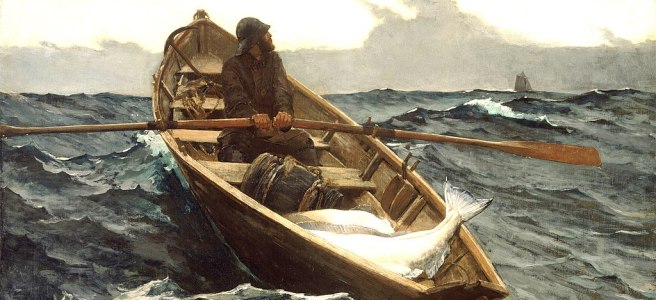
“The Fisherman in His Dory” by Gregory E. Lucas

(Inspired by Winslow Homer’s painting, The Fog Warning, 1885, USA.)

Toward the distant ship, the fogbank rolls.
Fraught, wearied and alone, on darkened waves,
with no time to lose, the fisherman rows.

Get back, or else he’s lost at sea, he knows.
He’s strayed so far, too far to be seen or saved,
and faster, toward the ship, the fogbank rolls.

Above the ship, clouds brighten, purple and rose,
but the fogbank thickens, and the masts are vague.
No time to lose. Onward, the fisherman rows,

then, for a moment, stops. He turns and holds
both oars quite still, insults the sky and prays.
Closer to the ship, the fogbank rolls,

and soon it’s sure to cut him off. His sole
hope is to find more strength. Ignoring pains,
with now less time to lose, again he rows.

His two big halibut he won’t unload;
he’ll carry the catch no matter what it weighs.
Toward the distant ship, the fogbank rolls.
With no time to lose, the fisherman rows.


Gregory E. Lucas writes fiction and poetry.  His short stories and poems have appeared in The Horror Zine, Blue Unicorn, The Ekphrastic Review, and many other magazines.  He lives on Hilton Head Island in South Carolina.