“Doppelganger Daughter” by Sharon Waller Knutson

When the tall lanky millennial
who just bought land up the road
tells me his girlfriend looks just
like me and has my mannerisms,
I am skeptical but curious.

But when the twenty-something
schoolteacher walks through
the door with a pixie cut, saucer
eyes dominating an elfin face,
giggling, fingers fluttering,
I feel like I am in a time capsule,
watching my twenty-something self.

You look just like Goldie Hawn,
I say like everyone said to me
when I was her age. Of course,
she has no idea who I am talking
about. She points to my younger
photos plastering the wall.
Is that Goldie Hawn? she asks.

When all the neighbors file in
with their casserole dishes
and salads, they tell her:
You look just like your mom.
If I doubt she exists, all I do
is look at the wall and there
we stand two golden goddesses
with identical cheekbones and smiles.


Sharon Waller Knutson is a retired journalist who lives in Arizona. She has published several poetry books including My Grandmother Smokes Chesterfields (Flutter Press 2014) and What the Clairvoyant Doesn’t Say and Trials & Tribulations of Sports Bob (Kelsay Books 2021) and Survivors, Saints, and Sinners forthcoming by Cyberwit. Her work has also appeared in Black Coffee Review, Terror House Review, Trouvaille Review, ONE ART, Mad Swirl, The Drabble, Gleam, Spillwords, Muddy River Review, Verse-Virtual, Your Daily Poem, Red Eft Review, The Five-Two, and The Song Is…

Two Poems by J. K. Durick

Precisely

She takes off her glasses
examines them
looks at the lens from
several angles
decides
then spritzes the lenses
with a glasses cleaner
she bought just for this ritual
each lens gets two squirts
per side
then she takes a cloth
designed for this task
and rubs each lens
then examines them again
satisfied she puts them back on.
This is precision
this is being precise
orderly, methodical, thorough
a study in precise detail
step by step
a common task done in depth
achieving its end.
And then
with her glasses finally clean
she goes back to her needle work
each stitch as exact
as the one before.


Rainbow

You caught it, saw it out of the corner
Of your eye
A full rainbow, a double rainbow –
Like an exclamation point
At the end of our day.
The slight rain we knew
But didn’t know it had promise in it,
Had the makings of this sight, something
Memorable, something you called to
Everyone’s attention – Look
And we gathered around the door.
I tried briefly to video it
It came out okay but nothing can match
That moment
When you called it to our attention
And we witnessed the double rainbow
That marked our time together.


J. K. Durick is a retired writing teacher and online writing tutor. His recent poems have appeared in Literary Yard, Black Coffee Review, Literary Heist, Synchronized ChaosMadswirl, Journal of Expressive Writing, and Highland Park Poetry.

Two Poems by John Keats

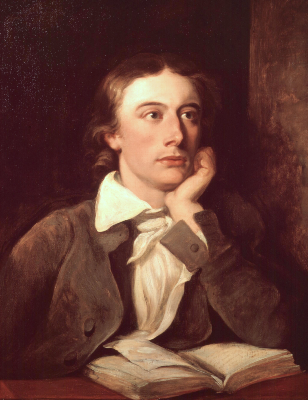
John_Keats_by_William_HiltonDead from tuberculosis by the age of 25, British poet John Keats (1795-1821) nonetheless has become second perhaps only to William Shakespeare as a renowned poet of classical English literature. He is, to the present day, looked upon with reverence as an inspiration to the craft. Regarded as among the most skilled of the Romantics, Keats’ poetry is noted as being heavily loaded with emotion, most often expressed through natural imagery. Keats is one of the many poets whose work was only fully appreciated after his death. The poems below, “Ode to a Nightingale” and “Ode to a Grecian Urn,” are two of his most celebrated works.

Ode to a Nightingale

My heart aches, and a drowsy numbness pains
    My sense, as though of hemlock I had drunk,
Or emptied some dull opiate to the drains
    One minute past, and Lethe-wards had sunk:
'Tis not through envy of thy happy lot,
    But being too happy in thine happiness,—
        That thou, light-winged Dryad of the trees,
                In some melodious plot
    Of beechen green, and shadows numberless,
        Singest of summer in full-throated ease.

Darkling I listen; and, for many a time
    I have been half in love with easeful Death,
Call'd him soft names in many a mused rhyme,
    To take into the air my quiet breath;
        Now more than ever seems it rich to die,
    To cease upon the midnight with no pain,
        While thou art pouring forth thy soul abroad
                In such an ecstasy!
    Still wouldst thou sing, and I have ears in vain—
    To thy high requiem become a sod.

Ode to a Grecian Urn

Thou still unravish'd bride of quietness,
       Thou foster-child of silence and slow time,
Sylvan historian, who canst thus express
       A flowery tale more sweetly than our rhyme:
What leaf-fring'd legend haunts about thy shape
       Of deities or mortals, or of both,
               In Tempe or the dales of Arcady?
       What men or gods are these? What maidens loth?
What mad pursuit? What struggle to escape?
               What pipes and timbrels? What wild ecstasy?

Heard melodies are sweet, but those unheard
       Are sweeter; therefore, ye soft pipes, play on;
Not to the sensual ear, but, more endear'd,
       Pipe to the spirit ditties of no tone:
Fair youth, beneath the trees, thou canst not leave
       Thy song, nor ever can those trees be bare;
               Bold Lover, never, never canst thou kiss,
Though winning near the goal yet, do not grieve;
       She cannot fade, though thou hast not thy bliss,
               For ever wilt thou love, and she be fair!

Ah, happy, happy boughs! that cannot shed
         Your leaves, nor ever bid the Spring adieu;
And, happy melodist, unwearied,
         For ever piping songs for ever new;
More happy love! more happy, happy love!
         For ever warm and still to be enjoy'd,
                For ever panting, and for ever young;
All breathing human passion far above,
         That leaves a heart high-sorrowful and cloy'd,
                A burning forehead, and a parching tongue.

Who are these coming to the sacrifice?
         To what green altar, O mysterious priest,
Lead'st thou that heifer lowing at the skies,
         And all her silken flanks with garlands drest?
What little town by river or sea shore,
         Or mountain-built with peaceful citadel,
                Is emptied of this folk, this pious morn?
And, little town, thy streets for evermore
         Will silent be; and not a soul to tell
                Why thou art desolate, can e'er return.

O Attic shape! Fair attitude! with brede
         Of marble men and maidens overwrought,
With forest branches and the trodden weed;
         Thou, silent form, dost tease us out of thought
As doth eternity: Cold Pastoral!
         When old age shall this generation waste,
                Thou shalt remain, in midst of other woe
Than ours, a friend to man, to whom thou say'st,
         "Beauty is truth, truth beauty,—that is all
                Ye know on earth, and all ye need to know."
Two Poems by Vyacheslav Konoval

Spring Rush

Residential neighborhoods, like those targets,
accept a fiery gift from a polar bear, a tricolor eagle.
There is a whistling, roaring, and pounding,
which bleeds into the body of an innocent woman.
You are helpless, but heartily you swallow a bitter tear.
Spring is born outside the window.


Spring Heat

Among the clouds, bundling
against the arms of the whistling wind,
slowly a beautiful stranger goes stumbling.
Finally, spring had been illuminated by the sand of the mind.

Ah, you are a colorful stranger.
You sway me with the singing of birds.
I will be enchanted by you and forget about the danger
that lurks in Ukraine on the borders, sadness beyond words.


Vyacheslav Konoval is a Ukrainian poet. He adores writing about nature, impressions, and people. The significant work of the author is devoted to acute social problems such as overcoming poverty, ecology issues, the relationship of people with the government, etc.

Two Poems by Patricia Peterson

Parts

First a tooth, then maybe a
not-too-important inner organ
diminishment, the process like a play
without applause.

Curtain up
a rustling audience
spotlight pricks the dark
There’s M. in blue scrubs
stepping carefully to center stage
with all those tubes
but still, what dash!
R. enters from the left with
great guffaws and laughs
the music in him bubbles up
like oxygen
From stage right now comes J.
moving slowly
to accommodate her
limping dog

Alto, tenor, and something else,
it’s hard-to-tell
They find a tune
more Broadway than Barbershop
a sharp, some flats
and now piano, piano, piano
In such bright light
they almost blend

Remember the Rockettes?
The arms do what those lovely legs did then
swing right, now left,
The spotlight roseate and trembling:
they reach for that high G
“o’er the land of the free, and the home of the brave’’

Here we all are, diminishing
but still on stage.


Lost in London

In London, walking past
Wigmore Hall perhaps
she can hear the Bach fugue as it
slips beneath those heavy doors.
On her own again, to study,
to walk the Regents Crescent,
Trafalgar Square and the church
where everyone is masked
against the gross invasion
she’s already known.

At the British library
          So quiet here
          How he insisted there were
          two St. Paul’s, reaching back
          to pull at the neck of his t-shirt
          with that little smile —
          and there really were two – there are.

A stack of books
the table shines
beneath their weight.
Here is respite to smooth
the jagged hours

Her daughter will arrive
sometime. When? Now!
To take her hand, to wonder at
the paucity of rice
served with that misspelled Indian dish,
to have known him, too
to share the loss.


Patricia Peterson is an editor, teacher, and student of the piano. Her poems have appeared in EOEAG, Front Porch, and in the chapbook HomeBound.

“Deep in My Couch” by Michael Lee Johnson

Deep in my couch
of magnetic dust,
I am a bearded old man.
I pull out my last bundle
of memories beneath
my pillow for review.
What is left, old man,
cry solo in the dark.
Here is a small treasure chest
of crude diamonds, a glimpse
of white gold, charcoal,
fingers dipped in black tar.
I am a temple of worship with trinket dreams,
a tea kettle whistling ex-lovers boiling inside.
At dawn, shove them under, let me work.
We are all passengers traveling
on that train of the past—
senses, sins, errors, or omissions
deep in that couch.


Michael Lee Johnson lived ten years in Canada during the Vietnam era. Today he is a poet in the greater Chicagoland area, IL.  He has 248 YouTube poetry videos. Michael is published in 43 countries, has several published poetry books, was nominated for four Pushcart Prize awards, and has five Best of the Net nominations. He is editor-in-chief of three poetry anthologies, all available on Amazon, and has several poetry books and chapbooks. He has over 536 published poems. Michael is the administrator of six Facebook poetry groups and a member of the Illinois State Poetry Society.

Two Poems by Felicia Nimue Ackerman

A Cat Declawed

What happens to a cat declawed?

Does it curl up
Like a circle in the sun?
Or flex its little paws–
And then run?
Does it twist and turn and hide?
Or settle on the sofa–
With its head by your side?

Maybe it just purrs,
Heedless of its plight.
Or does it bite?


Do your friends want to reform you?
Do they try to mend your ways?
Do they prod you to get moving:
Jog, recycle, fill your days,
Start your own organic garden,
Eat more carrots, eat less fat?
Well, there’s always my solution –
Blow them off, and get a cat.


Felicia Nimue Ackerman is a professor of philosophy at Brown University and has had about 200 poems published in a wide range of places, including multiple appearances in Sparks of Calliope.

Two Poems by Megan Walker

Gloriana mortuus est

When the signet from the chamber window dropped
and mournful bronze its dirge caused to be rung,
‘cross moor and fen a Eulogy was flung,
to farthest reaches of the hare and hawk.

The scholar and the cleric passed, hooded, by
their mourning was in many tongues intoned,
their island kingdom restive, empty-throned,
a darkened, chasm’d heart where Sovereign lies.

Faith did lift the scepter to the hand,
and raise it through deluge and through flame,
no plot nor poison could such Regent stay,
in truth as strong and wise as any man.

I hope, though my heart and robes are black
that Gloriana in pace requiescat.


Petrarchan sonnet for Mary Stuart

She draws her cloak as thistle plumes are driven,
blown coldly toward a heart and family lost,
in robes of state worn by cathedral’s ghost,
to languish in the tower at Lochleven.
This is not youth, or will, or golden power,
gone is the comfort of a young love’s breath,
-surrounded by the lust of blood and death,-
now armed with naught but prayer to still the hours.

“Like a commoner, I am to meet my death at eight”.
When morning broke, she came as calm as dawn.
Her relics all would burn, to not a martyr make.
Now knelt, far from her lands and men, her fate
a cipher of her own, her own blood drawn.
To You a soul is given, for Mary’s sake.


Megan Walker calls Washington state home, where she writes in a fortress of books and dog hair.

“Dancer? Panther?” by Maureen Teresa McCarthy

There are no cougars here
On this high ridge
Between narrow lakes
Not now, in this modern year
They’ve gone
Those sleek black cats
Lean and lithe
The panther, the cougar
The wild has been tamed
But I know what I know
And I saw one once
Not long ago

I was walking
The edge of the forest
After spring snow
Huge maples, matriarch trees
Stretched bare limbs to the road
Underfoot, the crunch of icy white
Looking up, a soft gray sky
And then, a living eye

An enormous cat, big as the average dog
Spread long overarching limb
Pointed ears, unblinking stare
A sharp feline face
Framed in black fur
Hanging down, a long thin tail
Making a perfect arc
As it swung back and forth
Marking time a metronome

My dog my lovely Shepard
Friend of fifteen years
Growled low and pulled me back
As a scream rent the air
Echoing into the silence
Fading into the forest

Later that same spring
In the first flush of new green
I walked in the city
Under trees wearing pale mist
Looking up into towering clouds
Far ahead, a woman proud

She strode out from a doorway
Poised, strong, lean, lithe
As a black cat, maybe a panther.
From her shoulders swung
A black cape lined in red
Over a slim black dress
She wore her steel gray hair
Sleek and tight
In a smooth chignon
Silver earrings dripped from her ears
A silver collar framed her neck

She flowed, easily as a cat
Into an open black car lined in red.
The engine purred and she was gone
Into the forest of city streets

As in a dream
Both faded away
The dancer and the panther
Leaving only the wonder
Under the spring sky
Which one
Is the dream of the wild?


Maureen Teresa McCarthy has published poems and essays in Bloom Later, Comstock Review, Months to Years, Pen Woman, Plum Tree Tavern, Tiny Seed, Writing in a Woman’s Voice, and others. Her work focuses on nature, imagination, and myth. She has lived and written in California, Europe, and Mexico, but is at home in the Finger Lakes of central New York.

Two Poems by Herman Melville

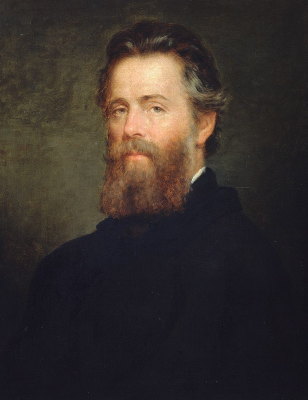
Portrait of Melville by Joseph Oriel Eaton, oils on canvas, 1870

While participating in a memorial ceremony this weekend for the Union dead from Missouri units at the battle of Shiloh, I heard an orator read the first of two poems below written by Herman Melville (1819-1891), perhaps most famous for his epic novel Moby-Dick. It struck me how his famous tale of the obsessive hunt for Captain Ahab’s whale likely more often than not overshadows Melville’s skills as a poet and his chronological place among his contemporaries. His talent is demonstrated in the two selections included below.


Shiloh: A Requiem (April 1862)

Skimming lightly, wheeling still,
     The swallows fly low
Over the field in clouded days,
      The forest-field of Shiloh—
Over the field where April rain
Solaced the parched ones stretched in pain
Through the pause of night
That followed the Sunday fight
     Around the church of Shiloh—
The church so lone, the log-built one,
That echoed to many a parting groan
          And natural prayer
     Of dying foemen mingled there—
Foemen at morn, but friends at eve—
     Fame or country least their care:
(What like a bullet can undeceive!)
     But now they lie low,
While over them the swallows skim,
     And all is hushed at Shiloh.


Sheridan at Cedar Creek (October 1864)

Shoe the steed with silver
     That bore him to the fray,
When he heard the guns at dawning—
               Miles away;
When he heard them calling, calling—
          Mount! nor stay:
               Quick, or all is lost;
               They’ve surprised and stormed the post,
               They push your routed host—
     Gallop! retrieve the day!
 
House the horse in ermine—
     For the foam-flake blew
White through the red October;
     He thundered into view;
They cheered him in the looming;
     Horseman and horse they knew.
               The turn of the tide began,
               The rally of bugles ran,
               He swung his hat in the van;
     The electric hoof-spark flew.
 
Wreathe the steed and lead him—
     For the charge he led
Touched and turned the cypress
     Into amaranths for the head
Of Philip, king of riders,
     Who raised them from the dead.
               The camp (at dawning lost)
               By eve recovered—forced,
               Rang with laughter of the host
      At belated Early fled.
 
Shroud the horse in sable—
     For the mounds they heap!
There is firing in the Valley,
     And yet no strife they keep;
It is the parting volley,
     It is the pathos deep.
               There is glory for the brave
               Who lead, and nobly save,
               But no knowledge in the grave
     Where the nameless followers sleep.