Two Poems by Leslie Dianne

Homes

How many places
have I loved?
a languid houseboat in Srinagar
a moto taxi in New Delhi
the duomo in Milano
a Beijing intersection cut into
bicycles, limousines and rickshaws
a corner in Suzhou
where a money change woman
whispered at me for my dollars
the molten ash mountain
leading to Mount Etna
and the fire always burning
its way to the clouds
because I was a quiet witness
to these places
they opened and
let me in
bared their secrets
and I carried them away
my memory stuffed
with their sights,
scents and sounds
my heart longing for
those places that
made me their daughter
and gave me a home


City of Lights

In Paris there is always
the temptation
to eat too much
the city offers me
the soft center
of the baguette
like birdsong exploding
on the tongue
the fat in the hundred layer
croissant capturing mornings
and jam in its folds
the eclairs exclaiming
their devotion to the
cream and offering it
like chimes echoing
through the mouth
other tourists go to the Seine
and the Louvre
I go to the chocolatier
and the patisserie
and eat my way
though the city
of lights


Leslie Dianne is a poet, novelist, screenwriter, playwright and performer whose work has been acclaimed internationally in places such as the Harrogate Fringe Festival in Great Britain, The International Arts Festival in Tuscany, Italy, and at La Mama in New York City. Her stage plays have been produced in NYC at The American Theater of Actors, The Raw Space, The Puerto Rican Traveling Theater, and The Lamb’s Theater.  She holds a BA in French Literature from CUNY and her poems have appeared in The Lake, Ghost City Review, The Literary Yard, About Place Journal, and Kairos and are forthcoming in Hawai’i Review. Her poetry was recently nominated for a Pushcart Prize. 
Two Poems by George Freek

A Poem About Time (after Liu Yong)

I’m endlessly waiting
to find the words
to express the arrival
of spring’s birds, or for
something that has not yet
come into being, something
which will amaze me.
The moon climbs the sky,
then suddenly dies,
and my thoughts are paralyzed.
I look for the moon
hidden in your eyes.
Life is a mystery to me,
so I wait, and as I wait
I watch a thousand leaves
grow on a hundred trees.
Meanwhile we grow older,
and the stars which
once were young
and full of desire, die,
and slowly sink to their knees.


At Dawn (after Lu Yu)

I dream I’m a butterfly.
I drift without troubles
from flower to flower,
to suck their sweet nectar.
I take no interest in the hour.
But a crack of thunder
wakes me like a blow,
which is followed by an
inundating shower.
The sky is leaden.
There’s no sun.
I’m unable to leave
my bleak, empty room.
We lose our sight, our teeth.
I watch my hair turn white.
Yes, we all grow old.
I thought when it came,
I would be strong.
I was wrong.


George Freek‘s poetry has appeared in numerous poetry journals and reviews, most recently The Ottawa Arts Review, Acumen, North of Oxford, Triggerfish, and Torrid Literature.

Two Poems by Russel G. Winick

Familiarity

So often one sees people
Acting closer than they are.
Excess familiarity
At first just seems bizarre.

But people crave the closeness
That our modern times impede.
Which causes the exaggeration
Many seem to need.


Time-Saving Drivers

Drivers speeding recklessly,
Alarmingly behave.
You wonder what they’ll do with the
Few minutes that they save?


Russel G. Winick recently began writing poetry at nearly age 65, after concluding a long career as an attorney.  Langston Hughes’ work is his primary inspiration. Several dozen of Mr. Winick’s poems have appeared or are forthcoming in over a dozen online and print venues.

“The New Colossus” by Emma Lazarus

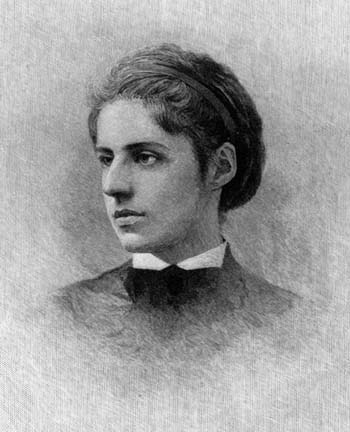
Emma Lazarus (1849-1887)

Emma Lazarus (1849-1887), although a prolific writer for such a short life of 38 years, is best known for her sonnet, “The New Colossus,” some lines of which are inscribed on a bronze plaque which was installed on the pedestal of the Statue of Liberty in 1903. While this poem wasn’t widely known in her lifetime, she was a recognized literary figure who was acquainted with many literary and political figures of the day. Ironically, “The New Colossus” later became so famous that it overshadowed her legacy as a whole. Read more about Emma Lazarus here.


The New Colossus

Not like the brazen giant of Greek fame,
With conquering limbs astride from land to land;
Here at our sea-washed, sunset gates shall stand
A mighty woman with a torch, whose flame
Is the imprisoned lightning, and her name
Mother of Exiles. From her beacon-hand
Glows world-wide welcome; her mild eyes command
The air-bridged harbor that twin cities frame.

‘Keep, ancient lands, your storied pomp!’ cries she
With silent lips. ‘Give me your tired, your poor,
Your huddled masses yearning to breathe free,
The wretched refuse of your teeming shore.
Send these, the homeless, tempest-tost to me,
I lift my lamp beside the golden door!’

“Abnegation” by Iolanda Leotta

The last bell tolls of the church,
not very far from my home,
echo, roar, the resonances
around the country hears, remind:
it’s time to pray.
But how many people
turn to the Creator to be blessed?

It’s midday, it’s almost lunch-time,
but who for a moment will remember
those who can’t feed?
The philanthropy, the charity,
if it exists yet,
few people want to pursue it–
simple souls ready to donate
without expecting love in return,
ready to die for a worthy cause,
without receiving glory and honor.
But what are awards and honors
If you’re a despicable person,
an impostor,
that using the cunning of the fox,
subjugates the lambs
for personal purpose?

Among the ashy doves that fly,
stands out one snow-white,
that often settles on the bell tower,
It symbolizes the utopian, futuristic,
“universal peace,” impossible to achieve.
There’s a need of mutual love,
but people die with selfishness, alienation,
bad mood.

It’s evening, the last bell tolls
announce the “Hail Mary.”
I think to the self-abnegation;
I see my mother’s tears
when she kneels to worship
“The Madonna of the Sea,”
sculpted by her son, on the garden wall.
It seems to say:
“Mother! I’ll never leave you,
How can I forget you and live on
you gave me life so many times?”


Iolanda Leotta was born in Italy. She holds a degree in Sciences of Linguistic Mediation. Recently, her poetry book L’esploratrice dei sentimenti e dei valori umani has been published in Italy, by Aletti editor. It was presented at the Federiciano International Poetry Festival, where the keynote speaker was Alessandro Quasimodo, theatrical director, actor, author, and son of the poet Salvatore Quasimodo, Nobel Prize for literature. Her poems may be found in many international literary anthologies. She attends the masterclasses with Francesco Gazzè, songwriter; Giuseppe Anastasi, singer and songwriter; Davide Rondoni, playwright; collaborates with Mogol, lyricist and record producer.

Two Poems by John Whitney Steele

Drop 

In memory of B.K.S. Iyengar (12/14/1918-8/20/2014)

You’ve limbered up in backbends, lifted
into Upward Bow. You stand,
arc your spine, prepare to drop
back to the floor, land on your hands.

You stop. The ground is there, but you can’t see
quite where, and though you have been gifted
with strength and flexibility, you freeze,
afraid you’ll sprain your wrist, crack your skull.

Once BKS did Headstand on the edge
of the Grand Canyon. Not a show of courage
but steady mind, exuberance, a way
to wake up every cell, a celebration.

Standing on the edge you never know.
Something says it’s now or never. Go.


Posterity

She placed her palm on torchlit stone,
spit red ochre at her hand,
left her mark, her stenciled clone,
a work of art, Neanderthal,
a language we still understand.

The permafrost is melting now,
releasing long held secrets:
fifty-thousand-year-old wolf pups
perfectly preserved, reindeer
killed by anthrax, disinterred.

When human beings are no more
what will we have left behind?
What hope have I to leave a mark
some future race will find?


John Whitney Steele is a psychologist, yoga teacher, assistant editor of Think: A Journal of Poetry, Fiction and Essays, and graduate of the MFA Poetry Program at Western Colorado University, where he studied with Julie Kane, David Rothman, and Ernest Hilbert. His chapbook, The Stones Keep Watch, is to be published by Kelsay Books in 2021. His poetry has appeared in numerous journals including Blue Unicorn, The Lyric, The Orchards, and Road Not Taken. Born and raised in Toronto and Foot’s Bay, Ontario. John lives in Boulder, Colorado, and enjoys hiking in the mountains. Website: http://johnwhitneysteelepoet.com

Two Poems by Felicia Nimue Ackerman

The Waist Is Larger than the Belt

The waist is larger than the belt–
For put them side by side–
The one the other will exceed
With ease–it cannot hide–

The foot is wider than the shoe–
For try them inch by inch–
The one the other won’t fit in–
Without a mighty pinch–

The mouth is greater than the will–
For test them both with cake–
The one the other will subdue–
As anodyne quells ache–


A Narrow Fellow in the Glass 

A narrow fellow in the glass
Is what I yearn to see–
But much I must forgo, alas
To make a slimmer me. 

No cookies, brownies, cake, or pie–
I may become unstrung.
The pleasure healthful foods supply
Is zero at the tongue.


Both poems originally appeared in The Emily Dickinson International Society Bulletin


Felicia Nimue Ackerman is a professor of philosophy at Brown University and has had about 200 poems published in a wide range of places.

“The Blue Chair Laments” by Mary Beth Hines

Jack Mullen left
alone against
the posted rules
he could not read
despite their bold
dark lettering and glasses
pressed onto his nose
he pushed himself
from contoured space
from cushions concave
with his weight
he set out on
his own two feet
in full belief
across the water
ridged mountains rose
tipped streaming sky
lost king’s thin crown
and sweeping gyre
of grey osprey
the knife-edged flash
the salt-stung prey
still Jack moved out
at steady pace
into the sun’s
sea-blinding light
not a Peter
more a Paul
he turned and beckoned
before he fell


Mary Beth Hines writes poetry, short fiction and non-fiction from her home in Massachusetts. Her recent work appears, or will soon appear, in journals including Amethyst Review, Blue Unicorn, Crab Orchard Review, I-70 Review, Orchards Poetry Journal, and The Road Not Taken among others. She is looking for a home for her first poetry collection. Find her on Facebook at https://www.facebook.com/marybeth.mullenhines/.

“The End of His Reign at the Coffee House” by Noreen Hennessy

Circles beneath his eyes,
slanted lines, the color of ash,
Steam curling in the air, his head
soaking in a hot cascade of water,
A quick dash downstairs
a bowl of oatmeal made by his father
every morning, moving him toward
his destiny.

Down the road, the coffee house awaits him
dishes, bees swarming on
cinnamon buns, women in aprons
engaged in warfare over
paychecks, designations of disinfected
tables, whispers, tears,
jeers, scenes of occasional shouting.
as they dash out the door
to breathe in smoke
or to spit out a quick “I quit”
only to return the next day.

All this buzzes behind him, as he quietly
opens the door moves through the kitchen, knowing
the smoke, fury of these battles will
rise up against him by noon. His hands rough,
reddened by endless table wiping, his nerves shot
from the women’s constant prodding for
him “to step up” go faster, faster, faster.

Hours pass as
his bite of lunch is left wasted, forgotten
in his frenzy, their panic, and his head becomes light
with minuscule stars shimmering in his sight
under fierce, fluorescent beams.
Geese cackle, the sun cracks through the
front window pours over the counter, as bread is
ushered out of an oven to be eaten by the chosen ones–
royalty of genes and good luck from parts near and far:
Connecticut, Rhode Island, New Jersey, The Dorset Country Club…

They arrive here in Vermont in a flood of pink pants,
crowned with masks dangling from one ear, to condemn the harried
women who rush to serve them their paninis, who frantically wipe,
scribble out checks, grab chips, desserts, bagels as being
“too brusque.” And to command him, that their coffee be
served swirled with caramel, that they will soon swoon
over, coo to him, standing idly by a little too closely,
sighing “oh that’s love” as he pours golden
syrup into their bitter cups, making in the foam that
floats on top, the perfect image of a leaf as only he can,
for each one. And for a few seconds, he grows
taller as he stirs the cups then places them
gently on silver trays.

He can hear the blare of trumpets
at days end, as the last steaming brew is bestowed on a royal waiting,
feel a plumed hat settle on his 19 year old head, velvet britches arrive
on his thighs, watch his hands grow more graceful as a
lute begins to play.
The smudged darkness
beneath his eyes
evaporates
for a moment, only to quickly reappear
as he locks the door
turns the sign to CLOSED,
feels the rush of his
young life passing him by,
the brush of feathers,
the crush of velvet,
falling to the floor
deflated
like him
who will pick himself up,
sweep the floor clean,
and call to give NOTICE
tomorrow.


Noreen Hennessy is new to poetry. She has given readings of her writing at Beyond Baroque Literary Foundation and at the 92nd St Y. Recently, one of her poems has been published online by Literary North.  She has been studying poetry in community workshops this past year at UVM and Dartmouth College. She lives in southern Vermont with her husband and son.

“Letter to a Haggard Young Doctor” by Sven Kretzschmar

And you my sister,
there in the dark shadows you rest
crouched, sleepless, empty of tears
for those you didn’t rescue
in the doubts of every winter.

Did you face the courage of the bewildered
when, for the first time, you had to sew up
the dead’s pockets,
so they couldn’t take with them the bad
luck they had in their lifetimes?

Have you ever dreamt
of taking a gander on the world
outside these cold long corridors,
ill-lit and strange,
and yet of so direful familiarness?

Get off your bench where you never find sleep!
The ambulanceman says there’s yet another one
and you’ll have to lie again saying
‘All will be fine.’,
when the least you could do for them
is nothing at all.


Sven Kretzschmar hails from County Saarland, Germany, his place of birth and residency. His poetry has been published widely in Europe and overseas, including with Poetry Jukebox in Belfast, in Writing Home. The ‘New Irish’ Poets (Dedalus Press, 2019), Poets Meet Politics (Hungry Hill Writing, 2020) Hold Open the Door (UCD Press, 2020), Voices 2020 (Cold River Press, 2020) and 100 Words of Solitude (Rare Swan Press, 2021), in The Irish TimesLive EncountersSkylight 47, Das Gedicht, Loch Raven ReviewWordpeace2 Meter Review and Selcouth Station. He was awarded 1st prize in the ‘Creating a Buzz in Strokestown’ competition in 2018 and was shortlisted for several other awards. See more at: https://trackking.wordpress.com/ and Instagram: @sven_saar_poetry