Two Translations by Rachel Lott

Translations from Rainer Maria Rilke’s Das Buch der Bilder

Maiden Melancholy

A knight, as from a proverb old,
comes riding into mind.

He came. So through the wood and wold
the storm may come and all enfold.

He passed. So evening’s benison
may pass before your prayers are done,
forsaken by the bell;
and though you’d cry aloud with woe,
you only whimper, long and low
into your kerchief cold.

A knight, as from a proverb old,
rides armored, far and fell.

His smile was fine, and softly shone
like antique light on elven-bone,
like homesickness, like Christmas snow
on darkling rooftops, like the row
of pearls set round a turquoise stone;
like soft moon-glow
upon a book loved well.

Read the original German “Mädchenmelancholie” here.


The Boy

When I grow up, I want to be like them.
They ride on wild horses through the night.
Their torches, in a trail of blazing light,
whip back like hair behind them in the wind.

I’d stand in front, as if to steer a barge,
large and like a flag I’d just unrolled,
dark, but with a helmet all of gold
alight and restless. At my back, in rank,
ten men from that same darkness in a flank,
with helmets glinting restlessly as mine,
now clear as glass, now dark and old and blind.

And one stands by me, trumpeting “make way!”
with blasts like lightning, driving all things back;
he trumpets us a loneliness so black
we speed like dreams along our rapid way.

The houses fall behind us to their knees,
beside us bow the alleys and the lanes,
we capture every place that tries to flee
and thunder on, our horses like the rains.

Read the original German “Der Knabe” here.


Rachel Lott has a background is in medieval philosophy (PhD, University of Toronto), and currently teaches Latin, logic, and English writing at private online secondary schools. In her spare time she writes and translates poetry. Her poems have appeared in First Things, the children’s magazine Cricket, and on the website of the Society of Classical Poets.
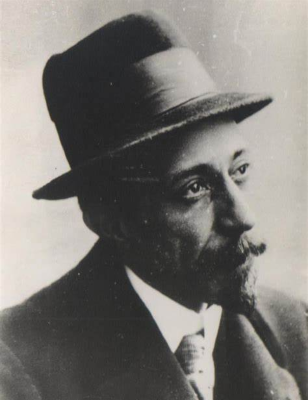
Translations of Dimitrie Anghel by Ana Neagu

Romanian poet Dimitrie Anghel (1872-1914)

A Romanian poet who fell in love with and seduced his friend’s wife, Dimitrie Anghel wrote many notable poems in addition to essays and prose in his home country. Ostracized in literary and social circles for the affair–and the divorce and devastation it subsequently caused–he shot himself in the chest after a domestic dispute where he wounded his now wife, Natalia, mistakenly thinking he had killed her.

Below are “The One” and “Travellers,” two translations of Anghel’s poems by Ana Neagu, a Romanian student in the MA Literary Program at the University of Bucharest.


The One

The beehives are buzzing in the glade
Under the giant azure bell,
All the land, from east to west,
Sounds as if a wind harp
Was somewhere hanging by a bough…

If you’d sit uneasy at the crossroads,
For the murmur comes from everywhere,
Like a mysterious guide,
It would lure you, and lead you,
Without your consent, the flower scent…

The glade is like a giant flower,
Changing rainbows of colors,
But it’s not just one, but thousands,
Spreading errant sparks
That ignite in the air and go out.

Like miniature temples
Honoring a secret cult,
In this beautiful Heaven,
Designedly made by nature,
You’ll find the white hives under their eaves.

Tireless run the bees in the light
Flitting to and fro,
A strand of strawflower is bending,
Sweet clover is rising
While lifeblood slowly turns to gold.

But, look, through the entrance,
The Bee Queen, the one among so many, steps into the light
And the drone lovers drunk on sunlight
Hearing her imperious call
Jump out of their drowsy form.

Lifting in the air, she draws a line,
A tinsel lightning on the blue sky,
And the groom bands come swarming,
Forming and breaking the line on her tail,
But she rises higher and higher to the glory of the skies.

Higher, higher still, and hurtling,
The bridegrooms race to catch her up,
But she’s a swift gold dot,
A dot is the beeyard in the glave,
A flower fallen from a bough.

Little by little, their thinned band breaks,
The powerless abandon their quest,
And in the dazzling fall,
Longingly gaze one last time
Upon the spark that only one still follows.

That one only has the queen,
But after this second of love,
She flies down satisfied
And he falls back in the sea of light
Under the giant azure bell.


Travellers

There’s silence and we travel, faces bathed in the moon…
Jingle bells are ringing through the night,
The wheelers trot like wildfire and I get scared when I see,
For a moment, the leaders bolting on the side
Chased by their shadows which set the pace…
At times the path is turning blue
When they ride down the hills and the moon hides out
A floral scent from God knows where
Reaches the carriage and we leave it behind
“It must be some girl’s spell, master,
Yes, a spell,” the coachman says smiling
And the bay steeds are now slower
And our words, my good friend,
Are getting fewer and sadder,
As we both know behind us
Something’s come undone
And it’s not the road, but the poor life;
The sweet perfume travelling the night
‘s no flower scent, nor spell, but
The longing of a traveller,
Which follows him wherever,
And wants to escape under high skies on the high seas…

A Translation of “Catullus 13” by Matthew T. Warnez

Catullus 13

Fabúllus, friend! Prepare to feast with me,
if fate allows, two days from now, or three.
But you must bring the meal—and make it great.
Yes, a good meal! And bring your charming date—
and wine, and salty speech, and jokes to tell.
If you bring these, my friend, you will dine well.

(Your dear Catúllus owns a spacious purse,
yet only cobwebs will the purse disburse.)

But, in exchange, you shall receive my love
or something more delightful from above:
I’ll share the fragrance that my bride applies,
which love supernal sweetly magnifies.
Once it is whiffed, you’ll beg that heav’n bestows—
this gift: to be in love, or be a nose.


***Original Latin***

Cēnābis bene, mī Fabulle, apud mē
paucīs, sī tibi dī favent, diēbus,
sī tēcum attuleris bonam atque magnam
cēnam, nōn sine candidā puellā
et vīnō et sale et omnibus cachinnīs.
Haec sī, inquam, attuleris, venuste noster,
cēnābis bene; nam tuī Catullī
plēnus sacculus est arāneārum.
Sed contrā accipiēs merōs amōrēs,
seu quid suāvius ēlegantiusve est:
nam unguentum dabŏ, quod meae puellae
dōnārunt Venerēs Cupīdinēsque;
quod tū cum olfaciēs, deōs rogābis
tōtum ut tē faciant, Fabulle, nāsum.

Gaius Valerius Catullus was a poet of the late Roman Republic whose poetry focused on everyday life instead of classical heroes. A significant influence of Ovid, Virgil, and Petrarch, his surviving works are still widely read and influential in contemporary poetry and art.


Matthew T. Warnez, B.H., is a Catholic religious brother and a campus minister.