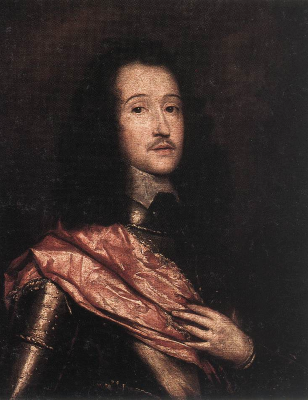
Richard Lovelace (1617–1657) was a prominent Cavalier poet of the 17th century, renowned for his lyrical elegance and association with the Royalist cause during the English Civil War. Born into a well-to-do Kentish family, Lovelace was educated at the prestigious Charterhouse School and later at Gloucester Hall, Oxford, where his charm, good looks, and poetic skill quickly gained him admiration and support among the literary elite. Known for his refined manners and loyalty to King Charles I, Lovelace’s life and work were deeply influenced by his unwavering commitment to the Royalist ideals of honor, loyalty, and courtly love.
Lovelace’s poetry is marked by its musical quality, emotive depth, and dedication to the ideals of chivalry. His most famous work, To Althea, from Prison, penned while he was briefly imprisoned for his Royalist sympathies, contains the immortal lines, “Stone walls do not a prison make, / Nor iron bars a cage.” This piece and others in his collection Lucasta (1649) express his belief in inner freedom and resilience, as well as his love for a woman he called Lucasta (thought to be a poetic pseudonym for his beloved Lucy Sacheverell). Lovelace’s verses often celebrate themes of loyalty, love, and liberty, reflecting his desire for both personal and political freedom during a time of national turmoil.
Lovelace’s commitment to the Royalist cause led him to serve in the military on behalf of King Charles I, fighting in the Bishops’ Wars in Scotland and later in the Civil War. However, his loyalty came at great personal cost. After repeated imprisonments and financial losses, he spent his later years in poverty and ill health, facing the bitter disillusionment that many Cavaliers experienced after the fall of the monarchy.
Lovelace’s legacy as a poet rests on his ability to merge graceful language with Cavalier ideals. His verses capture the spirit of a turbulent era, and his enduring works offer insight into the personal sacrifices of those loyal to a lost cause. Though his fame dwindled after his death, Lovelace’s poetry was rediscovered in the 19th century, appreciated for its lyrical beauty and its emblematic portrayal of honor and love. His work, including the two poems featured below, remains a touchstone of the Cavalier tradition, influencing later poets and reminding readers of the values of courage, loyalty, and resilience.
To Althea, From Prison
When Love with unconfinèd wings
Hovers within my Gates,
And my divine Althea brings
To whisper at the Grates;
When I lie tangled in her hair,
And fettered to her eye,
The Gods that wanton in the Air,
Know no such Liberty.
When flowing Cups run swiftly round
With no allaying Thames,
Our careless heads with Roses bound,
Our hearts with Loyal Flames;
When thirsty grief in Wine we steep,
When Healths and draughts go free,
Fishes that tipple in the Deep
Know no such Liberty.
When (like committed linnets) I
With shriller throat shall sing
The sweetness, Mercy, Majesty,
And glories of my King;
When I shall voice aloud how good
He is, how Great should be,
Enlargèd Winds, that curl the Flood,
Know no such Liberty.
Stone Walls do not a Prison make,
Nor Iron bars a Cage;
Minds innocent and quiet take
That for an Hermitage.
If I have freedom in my Love,
And in my soul am free,
Angels alone that soar above,
Enjoy such Liberty.
To Lucasta, Going to the Wars
Tell me not (Sweet) I am unkind,
         That from the nunnery
Of thy chaste breast and quiet mind
         To war and arms I fly.

True, a new mistress now I chase,
         The first foe in the field;
And with a stronger faith embrace
         A sword, a horse, a shield.

Yet this inconstancy is such
         As you too shall adore;
I could not love thee (Dear) so much,
         Lov’d I not Honour more.


I’ve written parodies of both poems. They were in English Studies Forum and The Providence Journal
LikeLiked by 1 person