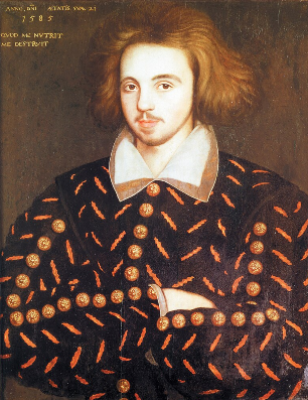
Christopher Marlowe (1564–1593) remains a towering figure of the English Renaissance, celebrated for his profound influence on Elizabethan drama and poetry. Born in Canterbury, the son of a shoemaker, Marlowe attended the King’s School and later Corpus Christi College, Cambridge, where he excelled in classical studies and earned a reputation for his brilliance and unorthodox thinking. His education, likely subsidized by influential patrons, provided him with the foundation for his later works that would redefine the English stage.
A contemporary of William Shakespeare, Marlowe is often credited with elevating the theatrical art form through his use of blank verse and grandiose themes. His plays, marked by their intellectual depth, bold exploration of power, and complex characters, include masterpieces such as Tamburlaine the Great, Doctor Faustus, and The Jew of Malta. These works delve into themes of ambition, morality, and human striving, reflecting Marlowe’s fascination with the limits of human potential and the price of overreaching.
Marlowe’s most famous play, Doctor Faustus, tells the story of a man who sells his soul to the devil in exchange for knowledge and power, a narrative that mirrors the playwright’s own interest in challenging societal and theological norms. His lyrical poetry, such as the pastoral elegy The Passionate Shepherd to His Love, showcases his ability to craft both profound and delicate verse, securing his place among the great poets of his age.
Despite his artistic achievements, Marlowe’s life was as dramatic and enigmatic as his works. A suspected spy for Queen Elizabeth’s government, he operated in shadowy political circles, which may have contributed to his mysterious death. In 1593, at just 29 years old, Marlowe was fatally stabbed in what was officially deemed a dispute over a debt, though speculation persists regarding political intrigue or espionage.
Marlowe’s untimely death robbed the world of a playwright whose genius might have rivaled or surpassed Shakespeare’s. Nevertheless, his influence endures, particularly in the development of blank verse and the portrayal of ambitious, larger-than-life characters. Marlowe’s legacy lies in his fearless exploration of human desire and defiance, his works offering a daring and innovative vision that continues to resonate with audiences and readers, cementing his status as a cornerstone of English literature.
Marlowe’s most recognizable poem (found below) would be “The Passionate Shepherd to His Love,” which was famous enough for Sir Walter Raleigh to write a response a few years later. Another notable work was the unfinished “Hero and Leander,” a lengthy poem which is also exerpted below.
The Passionate Shepherd to His Love
Come live with me and be my love,
And we will all the pleasures prove,
That Valleys, groves, hills, and fields,
Woods, or steepy mountain yields.
And we will sit upon the Rocks,
Seeing the Shepherds feed their flocks,
By shallow Rivers to whose falls
Melodious birds sing Madrigals.
And I will make thee beds of Roses
And a thousand fragrant posies,
A cap of flowers, and a kirtle
Embroidered all with leaves of Myrtle;
A gown made of the finest wool
Which from our pretty Lambs we pull;
Fair lined slippers for the cold,
With buckles of the purest gold;
A belt of straw and Ivy buds,
With Coral clasps and Amber studs:
And if these pleasures may thee move,
Come live with me, and be my love.
The Shepherds’ Swains shall dance and sing
For thy delight each May-morning:
If these delights thy mind may move,
Then live with me, and be my love.
It lies not in our power to love or hate
an excerpt from “Hero and Leander“
It lies not in our power to love or hate,
For will in us is overruled by fate.
When two are stripped, long ere the course begin,
We wish that one should lose, the other win;
And one especially do we affect
Of two gold ingots, like in each respect:
The reason no man knows; let it suffice
What we behold is censured by our eyes.
Where both deliberate, the love is slight:
Who ever loved, that loved not at first sight?

 Sparks of Calliope
Two wonderful poems, Randal, and the second is remarkable for another reason: it provides the only known reference Shakespeare makes to a contemporary: in As You Like It, we have, “Dead shepherd, now I find thy saw of might: / ‘Who ever loved that loved not at first sight?'” and then furthermore we get: “When a man’s verses cannot be understood, nor a man’s good wit seconded with the forward child Understanding, it strikes a man more dead than a great reckoning in a little room.” Clearly, a reference to the murder of Marlowe in a Deptford Tavern, which allegedly in the coroner’s report was over a ‘reckoning’ about the bill (but which more likely was a government assassination job). The connection between Marlowe and Shakespeare is truly intriguing, as is the ‘what-if’ had Marlowe lived.
LikeLiked by 1 person