It was an era of the car chapel. Rosary hanging from rear-view mirror / Saint Christopher medal, complete with glove-compartment prayer book. Magnetic Sacred Heart statue on the dashboard.
Mother was devout. I was fourteen. Life was cold. She was fifty when she learned to drive, after my father’s disease took him. A sorrowful blessing. Jesus would show us the way / take care of us.
Her first car / a blue cracker-box / Renault. it gave her new freedom. Saturday confession. Sunday Mass. Weekdays reserved for work. Dashboard Jesus kept his promise. He watched over us.
I was twenty-two, that night. My son was eighteen months. Darkness and sleet partnered to do their worst. She worked late / did not come home. Phone ringing off the hook. It was the police / I knew.
Inebriated / he backed down the on-ramp / lights off. He was unharmed. Twisted metal and blood-filled highway. They pried my mother out. A long night at the hospital. I learned to pray / I dared to hope.
Mom’s car accordioned / she survived. When finally conscious, she said “go to the car.” The ravage was complete. Floating upon water and blood was a plastic box / tiny baby moccasins / there where she said.
On the dashboard stood that statue / staring down at me. I can never forget that day. After months of surgeries, my mother recovered. My son wore the moccasins. I began to understand her devotion. I shed my disbelief like skin. Dashboard Jesus Saves!
“Dashboard Jesus” first appeared in Black Moon Magazine
Ann Christine Tabaka was nominated for the 2017 Pushcart Prize in Poetry. She is the winner of Spillwords Press 2020 Publication of the Year; her bio is featured in the “Who’s Who of Emerging Writers 2020 and 2021,” published by Sweetycat Press. She is the author of 15 poetry books and one collection of short stories. She lives in Delaware with her husband and four cats. Her most recent credits include poems in The Closed Eye Open, The World of Myth, and GloMag.
Now that I live on a well-traveled street, you’d think I’d pass candy on the designated day. I was at Shady Grove for the first hour. The servers were vampires, I was wearing a poncho. The lights were off (how I like it) when I got home, not a soul in sight. And it was trash night. So I gathered the usual garbage and recycling, set it by the door. And when I opened it a kid vaporized from nowhere chanting trick or treat! trick or treat! give me something good to eat! Staring at me carrying white marinara-stained bag and a baby blue bag in the darkness of the porch and I said, I don’t have anything, thank you– I mean, sorry. In my navy sweatpants I walked briskly to the curb, the wind wanting to push me toward the black gravel of the road but I swiveled the direction of home. A gaggle of swan tweens flew toward me! I covered my face, put my head down, walked up the blind trio of stairs far from the rustling footsteps and laughter and wind and turned the living room light off, shawled myself with the couch blanket and reached for a crinkling half-bag of factory favorites, a Milky Way or Kit-Kat somewhere on my rug.
James Croal Jackson is a Filipino-American poet who works in film production. He has three chapbooks: Count Seeds With Me (Ethel Zine & Micro-Press, 2022), Our Past Leaves (Kelsay Books, 2021), and The Frayed Edge of Memory (Writing Knights, 2017). He edits The Mantle Poetry from Pittsburgh, PA. Find him at jamescroaljackson.com.
I’ll smile through my fingertips, leap far, stretch to the sky, dare a cloud, a wave to rock and on moon to walk I’ll attempt. Adventures expect me.
This girl’s not done, make a day a month, laugh in the rain, dance on ice. On moon to walk and a wave to rock, run with wild horses – still want it all.
Feed my skin, water my soul, jump, splash, make a mess, it will wash off, a wave to rock and on moon to walk- dreams take shape still; bright, bold, sharp. Alive!
I’ll carve the rest of my life, dreams will feed my mind, blossom, erupt. On moon to walk and a wave to rock- I’m only 50. Blink of an eye.
Snow Must Go On
On gleaming streets, oily with rain, a joke of life below my pane my eyes count potholes, while my hands scrub oily pans, life’s big charade.
I dive into the kitchen sink – my nighttime drama, end of play, with one spectator and one star, a sheltered life, no crack upset.
Low heat, faint simmer, never boil the mirror of my train of thoughts out of the blue, a bubble forms like ice trapped in the heart of blaze.
I am the master of my play with only bitterness’ applause, last raw the show must end sometime, last call, yet this slow simmer wins each time.
How long can this play be played out? The echo of an empty room is proof enough, till all applaud my monologue, or death will bow.
The water trickles to a drop, electric kettle boils, then stops – safe mood in place, cup off the shelf, tea leaves n hand, the storm restored; for now, show must go on.
Patricia Furstenberg, with a medical degree behind her, has authored 18 books imbued with history, folklore, and legends. The recurrent motives in her writing are unconditional love and war. Her essays and poetry have appeared in various online literary magazines. Romanian-born, she resides with her family in South Africa.
My daughter keeps telling me I am so lucky to be here. She means instead of in her five-bedroom home, Which always has space for another child But not for a grandmother in a wheelchair. I am so lucky to be here. My room is yellow as the sun, Which warms my face When I roll out onto the porch And endure people I have nothing in common with Except age and abandonment. For so long I dreaded being shut away from the world, But I am so lucky to be here, The best nursing home in Rhode Island, Instead of where I would be if people knew That what killed my unfaithful husband Was not an accident.
“I Am So Lucky to Be Here” first appeared in Providence Journal
Simplify
Simplify, simplify, lectured Thoreau, Chop your own wood and eat food that you grow. Farming, however, is messy and gritty. So I say: Simplify, live in the city!
Felicia Nimue Ackerman is a professor of philosophy at Brown University and has had over 220 poems published in a wide range of places, including ten in past issues of Sparks of Calliope.
Only black-and-tan clumps cling anymore to our oaks (raking finally making sense),
which stand silent as pickets this side of winter’s no-longer fierce or precise approach.
I’m over a father’s death, an angry mother’s post-mortem reach (though there it is again),
the delusion that autumn’s demise warns us of anything. Those fears? Fading—their threatening hues
mere harmless colors after all. Instead, a dogwood’s scrawny pecs spread stripped limbs to greet us
into the new season’s breach, a wind-scrambled blueprint of tangled twigs, leaf eddies, and rain.
What’s to come used to command such aching concentration, demands collected in the heart. Now, subdued,
it signals no sad story tracking itself across some dismal arena dressed in black, elegiac notes—but noodles muted
scales that free the blood and coast us toward a more cordial space: a flip requiem, perhaps, for chronic requiems.
Second day of gun season,
and they’ve already bagged some ninety-odd bucks. A fine-looking local, camo hat jaunty over jostled blond hair, bolt-action Winchester babied between olive-green sleeves, poses on the front page— got a ten-pointer (if I know how to count it right). Me, I’ve just posted warnings, cancelled all maneuvers, withheld all furloughs, mandated all my dears close ranks at home base for the duration.
“Flip Requiem” and “Second day of gun season,” were first published in The 3288 Review.
D. R. James’s latest of ten collections are Mobius Trip and Flip Requiem (Dos Madres Press, 2021, 2020); his micro-chapbook All Her Jazz is free, fun, and printable-for-folding at Origami Poems Project; and individual poems have appeared in a wide variety of anthologies and journals. He lives in the woods near Saugatuck, Michigan. You can find his collections on Amazon.com.
“I don’t want to disappoint you,”
He says as he tries to convince me
He’s not perfect.
As if I think he’s perfect.
With that crooked nose
That causes soft snores
That head that surely
Makes his Mama’s hips still hurt
Though damned if I care
About those things
The wounded puppy heart
So big and so broken
Capable of love
But scared to love anew
And those eyes
Brown in some light
Green in others
A bursting star of both
When the sun hits just right
Are not conducive to
Quick poems about gazing
Into your lover’s soul
I could sit and list his flaws
As easily as I list his graces
With the depth and detail
Only a poet could convey
And find no more
And no less
Beauty in either
No, he’s not perfect
Nothing worth exploring
Ever is
Shirt
The shirt you gave me
When I left
No longer smells like you.
You took it off with a sad smile
And handed it to me to place
In a Ziplock bag
As you did before every trip.
You knew I didn’t
Love you anymore.
You knew that I was never
Coming back.
But it brought comfort
To us both, going
Through that same routine.
At first I pulled it out
On lonely nights and inhaled
The scent of sweat and cigarettes
And a life left behind.
Eventually it got mixed
Into the pile of clothes and
Placed in a drawer.
You called last night
To tell your kids you love them
And sent a picture of your sad smile
When they, too busy to come to the phone,
Told me to tell you they love you too.
Today I found that shirt.
I buried my face in it
And inhaled. But there was
Nothing
Left of you.
Jodie Baeyens is a single mother and poet who teaches to support her writing habit. When she isn’t trying to find the pen she was just holding, she can be found in the forest dancing beneath the full moon. Originally hailing from New York, she now considers herself a citizen of the world because she has never felt that she belonged in any one place. Her poetry was recently featured in Door is a Jar and in Peregrine’s Fall Journal. Her forthcoming chapbook, Conversations We Never Had, was the Winner of the 2022 Vibrant Poet Award. Follow her writing at Mylifeincoffeespoons.com or on Facebook.
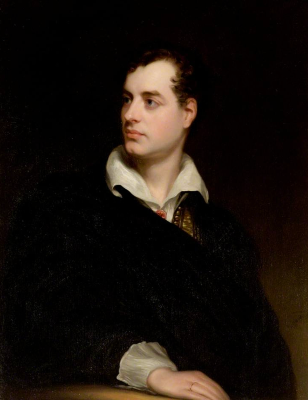
Best known just as Lord Byron, British poet George Gordon Byron (1788 -1824) was a contemporary of Percy Bysshe Shelley during the English Romantic period. Byron is best known for poems like “Don Juan” and for his philandering love life.
Byron was notoriously bad at handling his finances and prone to engage in desperate and indiscriminate love affairs, which include rumors of homosexual and incestual encounters.
Byron was quite famous and beloved during the Regency period, enjoying prominence in London society and the rare appreciation not always afforded a poet’s work during their lifetime. However, his money and relationship issues eventually led to his self-imposed exile from England for the remainder of his life. He traveled Europe, tarried in Italy, but ended up dying of illness while fighting against the Turks in the Greek War of Independence. Byron’s body was returned to England for burial in Westminster Abbey, but this burial was refused due to the poet’s “questionable morality.” Byron was ultimately buried in the Church of St. Mary Magdelene, with a memorial to him finally being placed in Westminster Abbey in 1969, 145 years after his death.
Aside from his most famous (and very lengthy) poem, “Don Juan,” the following two poems are among Lord Byron’s most beloved and enduring.
She Walks in Beauty
She walks in beauty, like the night
Of cloudless climes and starry skies;
And all that’s best of dark and bright
Meet in her aspect and her eyes;
Thus mellowed to that tender light
Which heaven to gaudy day denies.
One shade the more, one ray the less,
Had half impaired the nameless grace
Which waves in every raven tress,
Or softly lightens o’er her face;
Where thoughts serenely sweet express,
How pure, how dear their dwelling-place.
And on that cheek, and o’er that brow,
So soft, so calm, yet eloquent,
The smiles that win, the tints that glow,
But tell of days in goodness spent,
A mind at peace with all below,
A heart whose love is innocent!
And Thou art Dead, as Young and Fair
And thou art dead, as young and fair
As aught of mortal birth;
And form so soft, and charms so rare,
Too soon return’d to Earth!
Though Earth receiv’d them in her bed,
And o’er the spot the crowd may tread
In carelessness or mirth,
There is an eye which could not brook
A moment on that grave to look.
I will not ask where thou liest low,
Nor gaze upon the spot;
There flowers or weeds at will may grow,
So I behold them not:
It is enough for me to prove
That what I lov’d, and long must love,
Like common earth can rot;
To me there needs no stone to tell,
‘T is Nothing that I lov’d so well.
Yet did I love thee to the last
As fervently as thou,
Who didst not change through all the past,
And canst not alter now.
The love where Death has set his seal,
Nor age can chill, nor rival steal,
Nor falsehood disavow:
And, what were worse, thou canst not see
Or wrong, or change, or fault in me.
The better days of life were ours;
The worst can be but mine:
The sun that cheers, the storm that lowers,
Shall never more be thine.
The silence of that dreamless sleep
I envy now too much to weep;
Nor need I to repine
That all those charms have pass’d away,
I might have watch’d through long decay.
The flower in ripen’d bloom unmatch’d
Must fall the earliest prey;
Though by no hand untimely snatch’d,
The leaves must drop away:
And yet it were a greater grief
To watch it withering, leaf by leaf,
Than see it pluck’d to-day;
Since earthly eye but ill can bear
To trace the change to foul from fair.
I know not if I could have borne
To see thy beauties fade;
The night that follow’d such a morn
Had worn a deeper shade:
Thy day without a cloud hath pass’d,
And thou wert lovely to the last,
Extinguish’d, not decay’d;
As stars that shoot along the sky
Shine brightest as they fall from high.
As once I wept, if I could weep,
My tears might well be shed,
To think I was not near to keep
One vigil o’er thy bed;
To gaze, how fondly! on thy face,
To fold thee in a faint embrace,
Uphold thy drooping head;
And show that love, however vain,
Nor thou nor I can feel again.
Yet how much less it were to gain,
Though thou hast left me free,
The loveliest things that still remain,
Than thus remember thee!
The all of thine that cannot die
Through dark and dread Eternity
Returns again to me,
And more thy buried love endears
Than aught except its living years.
A sage and pupil journeyed on Into a darkened valley-glade.
Its air was laden with the scent Of unctuous and bitter saps.
They carried on for many nights Beneath the forest canopies.
But no light seemed to guide their way— No light but that of starlit streams.
The travelers listened to a choir Of cicadas singing their song.
The summer breezes drifted through The fog-enveloped maze of oaks.
“Some walk the night,” observed the sage, “But no clear path reveals itself.
“They wander never knowing that
They lost the road so long ago.”
The sage went on, “Then there are those
Who journey through the denser woods.
“They fear they might be found”—he stopped
And peered into the starlit stream.
The Sea
Restless, I awaken, As the city stirs, Street lights flicker like stars, And the sea whispers.
Languid ocean vessels Reach the quiet shores Of exotic islands And the sea whispers.
Like a sailor’s prayers Or an ancient dirge, Which the graying waves hum As the sea-storms surge.
Through the darkling grottoes And cavern waters Lay the countless demesnes Where the sea whispers.
Like some magic seashell On an antique shore, Echoing so softly Its forgotten lore.
Over golden beaches, Glistening ocean pearls, And ships long forgotten, Her dark current whirls.
Like a forlorn Naiad Who weeps and shivers In her hallowed grottoes And sacred rivers—
Hoping for love’s tidings, Her quiet vespers, Over briny torrents, She softly whispers.
Like a majestic swan With its broken wings Whose delicate soul flies As the night tide sings.
So my dreaming spirit Soundlessly slumbers As the clouds veil the moon And the sea whispers.
David B. Gosselin is a poet, translator, writer, and researcher based in Montreal. He is the founder of The Chained Muse and writes on Substack at Age of Muses.
The Greeks observed, in their curving theaters, just how the straight path of dodging fate revolves one towards its center. The mask of the tragic presenter expressed each face’s frown. And to steal another’s crown of fate, that’s twice as grim when two spools too quickly grow slim, two wound-up knitting skeins are uncoiled and cut in twain as they hug, intertwined. It’s true, the planets align once every hundred years or so, veering to smile at their wandering fellow spheres. Then the sun’s commandment steers them away to orbit alone.
The Hebrews knew, praying beneath their domes in the sand, that though cupped in Heaven’s hand, one can’t escape its turning. When a golden temple is burning and sorrow fills the sky, and the new moon on high occults each brilliant star and eyelids close and the scarred breast, submerged in sobbing, quickens its sharp throbbing till hollowed, voided, cold fingers can still be folded in prayer: it warms the heart, unveils celestial charts concealed in infinity— but it’s not enough to save a temple built of gold.
Andrew Benson Brown was a graduate student at George Mason University before taking too many classes outside his discipline coincided with the reality of Debt. He now works as a children’s caseworker in rural Missouri. In his spare time, he reads obscure classics, writes things of little market value, and exercises far more than is befitting for a modern intellectual.
 Sparks of Calliope