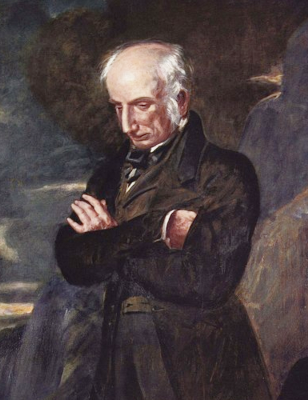
Poet Laureate of the United Kingdom under Queen Victoria from 1843-1850, British poet William Wordsworth (1770-1850) was a major poet of the English Romantic period, friend to fellow Romantic poet Samuel Taylor Coleridge, and another “classical” poet whose success and veneration belies the real criticism and challenges he endured.
A faithful supporter of the Church of England, some of the criticism directed at Wordsworth, both then and now, is due to his adherence to his religious beliefs when the literary elite found it more fashionable to espouse secular themes and values prevalent during the Enlightenment (and currently enjoying renewed popularity). Wordsworth lived for a time in France and was at first enamored with the ideas of Republicanism which brought about the French Revolution, but then became horrified by the atrocities witnessed during the “Reign of Terror.” These early experiences undoubtedly influenced his work. As he progressed in his career, Wordsworth was fortunate enough to witness his earlier works gaining appreciation over time as the views of the Enlightenment gave way to 19th-century Romanticism.
While his semi-autobiographical poem, “The Prelude,” is often considered his best work, Wordsworth’s talent is also widely recognized in shorter works, including “I Wandered Lonely as a Cloud” and “Composed upon Westminster Bridge, September 3, 1802” found here below.
I Wandered Lonely as a Cloud
I wandered lonely as a cloud
That floats on high o’er vales and hills,
When all at once I saw a crowd,
A host, of golden daffodils;
Beside the lake, beneath the trees,
Fluttering and dancing in the breeze.
Continuous as the stars that shine
And twinkle on the milky way,
They stretched in never-ending line
Along the margin of a bay:
Ten thousand saw I at a glance,
Tossing their heads in sprightly dance.
The waves beside them danced; but they
Out-did the sparkling waves in glee:
A poet could not but be gay,
In such a jocund company:
I gazed—and gazed—but little thought
What wealth the show to me had brought:
For oft, when on my couch I lie
In vacant or in pensive mood,
They flash upon that inward eye
Which is the bliss of solitude;
And then my heart with pleasure fills,
And dances with the daffodils.
Composed upon Westminster Bridge, September 3, 1802
Earth has not any thing to show more fair:
Dull would he be of soul who could pass by
A sight so touching in its majesty:
This City now doth, like a garment, wear
The beauty of the morning; silent, bare,
Ships, towers, domes, theatres, and temples lie
Open unto the fields, and to the sky;
All bright and glittering in the smokeless air.
Never did sun more beautifully steep
In his first splendour, valley, rock, or hill;
Ne’er saw I, never felt, a calm so deep!
The river glideth at his own sweet will:
Dear God! the very houses seem asleep;
And all that mighty heart is lying still!
Can’t but admit I found this place to feel
peace in all its rubble, rock by rock,
clambering: here, if you stop and kneel
on one knee at around, say, two o’clock,
you’ll see the brown rune-chiseled cross gone gold
with flaring in the sun; you’ll feel it all,
the rites that echoed, all the bells, the old
grand transubstantiating folderol
at rest. At last. The peace, at last, of death.
Something, though, disturbs me, even here,
where prayer seems preternatural as breath
and ruin’s coldly piled up atmosphere
is charged with its own past, which, after all,
sleeps fitfully upon its own downfall.
Stopped
I didn’t want to think I saw it—just breakage: scrappy leaves out in the wrack, sticks whirling, only time at all to trust to bring it all in time brilliantly back come spring. I had to get somewhere by ten and sat in traffic waiting for the light to toggle green so I could go again. My blinker said I would be merging right as if that were the only thing to say to all those cars behind me and beside. This was a day like any other day. I had to get there—get there—so to ride unseeing through what-all there was to see was, as I wished, how it had to be.</p>
Terence Culleton, a two-time Pushcart nominee, has published three collections of formally crafted narrative and lyric poems, including A Communion of Saints and Eternal Life (both out through Anaphora Literary Press) and, most recently, A Tree and Gone, a collection of formal English sonnets out in 2021 through Future Cycle Press. Sonnets from A Tree and Gone have appeared in Antiphon, Better Than Starbucks (featured poem), Blue Unicorn, Eclectic Muse, Innisfree, Orbis (Readers’ Choice), Raintown Review, Schuylkyll Valley Journal (featured poet), and numerous other anthologies and journals. A Tree and Gone is available at Amazon or through his website, terenceculletonpoetry.com.
In doll country
we are building a miniature
replica of our home,
a nutshell study
of rooms and hallways
forensically scaled
and measured.
There is hot and cold water
and a garage with cars
with running motors.
The locks on the doors
and windows work
with the mimed precision
of a Black Forest cuckoo clock,
its bird call and woodland scene
of hares and deer like the summer diorama
we watch from our backyard patio,
the moon as small as a penknife
in a polymer sky.
In the miniature replica
of our home
in doll country,
tiny felt tiebacks hold open
a repository stage-set with unburials—
like hunger stones revealed
in a drought ravaged river,
they tell us to weep.
Our visitors are entertained
and delighted
by our small sufferings.
And to think
that the parch marks
suggest something more—
a nesting doll
persisting, outliving us
and returning with the dark force
of sleeping giants.
“Doll Country” was first published by Roi Fainéant Press.
High Summer
We’ve jumped for centuries
clocked to the theurgy of stone and water.
Poised on the lip of the quarry’s dark summit
preparing backflips, readying cannonballs—
the spring-fed water bracing to skelp our skin
in its oozing crater.
To dream before the bending of the sky,
between the source and the mouth
is like an hourglass tipped on its side—
a bulbed, two-headed flower
as iridescent as a rainbow worming passage
through the submerged shadows of the quarry-cave.
Looking into the gold, and beyond the gold
and already the moment has passed.
Sun floaters drift like spores
threshed from an ancient combine.
The sky cataracts with thunderheads
and sudden death cap currents prickle
and sting the horizon.
The wind’s hot, buzzing swarm
gathers on our necks
and rankles our distant reflections.
We’ve jumped for centuries
clocked to the theurgy of stone and water.
Preparing backflips, readying cannonballs—
youth unfurls behind us,
and summer’s shadows lengthen
like dragon wings thrashing against extinction.
Damon Hubbs lives in a small town in Massachusetts. He graduated with a BA in World Literature from Bradford College. When not writing, Damon can be found growing microgreens, divining the flight pattern of birds, and ambling the forests and beaches of New England with his wife and two children. His poetry has appeared or is forthcoming in Book of Matches, The Dawntreader, Lothlorien Poetry Journal, The Chamber Magazine, and Young Ravens Literary Review.
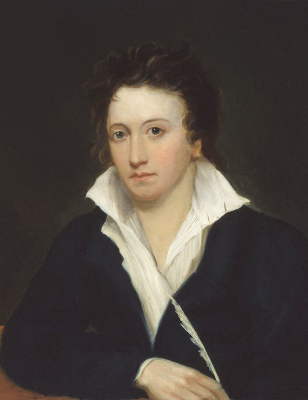
An important influence of later poets such as Robert Browning and W. B. Yeats and a contemporary of John Keats, Percy Bysshe Shelley (1792-1822) is widely considered a major poet of the English Romatic period, and has been described by one modern critic as “a lyric poet without rival.”
An atheist who only lived to the age of 29, the challenges overcome to attain literary prominence were not enough to prevent his success, although much of his acclaim came after his tragic death in a boating accident in the Gulf of La Spezia, near modern day Italy. Both Shelley’s first wife and his second wife’s sister committed suicide, arguably in part due to their complicated relationship with the poet. His second wife was Mary Godwin Shelley of Frankenstein fame.
Much of Percy Shelley’s poetry was overtly political, if not radical for the times, and published posthumously to avoid the persecution and prosecution that surely would have commenced if such material was published in his lifetime. In addition to the poets mentioned previously, a diverse group of luminaries including Mahatma Ghandi, Karl Marx, and George Bernard Shaw were said to be admirers of his work. Shelley’s literary reputation was more marginal than one would expect during and after his lifetime, even into the 20th century when critics such as T.S. Eliot and W. H. Auden fiercely disparaged his work. But as similar viewpoints to his increased in favor in the mid to late 1960s, Shelley’s critical reputation has unsurprisingly improved.
The following two poems, “Ozymandias” and “To a Skylark,” are among Shelley’s most recognized.
Ozymandias
I met a traveller from an antique land, Who said—”Two vast and trunkless legs of stone Stand in the desert….Near them, on the sand, Half sunk a shattered visage lies, whose frown, And wrinkled lip, and sneer of cold command, Tell that its sculptor well those passions read Which yet survive, stamped on these lifeless things, The hand that mocked them, and the heart that fed; And on the pedestal, these words appear: My name is Ozymandias, King of Kings; Look on my Works, ye Mighty, and despair! Nothing besides remains. Round the decay Of that colossal Wreck, boundless and bare The lone and level sands stretch far away.
To a Skylark
Hail to thee, blithe Spirit!
Bird thou never wert,
That from Heaven, or near it,
Pourest thy full heart
In profuse strains of unpremeditated art.
Higher still and higher
From the earth thou springest
Like a cloud of fire;
The blue deep thou wingest,
And singing still dost soar, and soaring ever singest.
In the golden lightning
Of the sunken sun,
O’er which clouds are bright’ning,
Thou dost float and run;
Like an unbodied joy whose race is just begun.
The pale purple even
Melts around thy flight;
Like a star of Heaven,
In the broad day-light
Thou art unseen, but yet I hear thy shrill delight,
Keen as are the arrows
Of that silver sphere,
Whose intense lamp narrows
In the white dawn clear
Until we hardly see, we feel that it is there.
All the earth and air
With thy voice is loud,
As, when night is bare,
From one lonely cloud
The moon rains out her beams, and Heaven is overflow’d.
What thou art we know not;
What is most like thee?
From rainbow clouds there flow not
Drops so bright to see
As from thy presence showers a rain of melody.
Like a Poet hidden
In the light of thought,
Singing hymns unbidden,
Till the world is wrought
To sympathy with hopes and fears it heeded not:
Like a high-born maiden
In a palace-tower,
Soothing her love-laden
Soul in secret hour
With music sweet as love, which overflows her bower:
Like a glow-worm golden
In a dell of dew,
Scattering unbeholden
Its aëreal hue
Among the flowers and grass, which screen it from the view:
Like a rose embower’d
In its own green leaves,
By warm winds deflower’d,
Till the scent it gives
Makes faint with too much sweet those heavy-winged thieves:
Sound of vernal showers
On the twinkling grass,
Rain-awaken’d flowers,
All that ever was
Joyous, and clear, and fresh, thy music doth surpass.
Teach us, Sprite or Bird,
What sweet thoughts are thine:
I have never heard
Praise of love or wine
That panted forth a flood of rapture so divine.
Chorus Hymeneal,
Or triumphal chant,
Match’d with thine would be all
But an empty vaunt,
A thing wherein we feel there is some hidden want.
What objects are the fountains
Of thy happy strain?
What fields, or waves, or mountains?
What shapes of sky or plain?
What love of thine own kind? what ignorance of pain?
With thy clear keen joyance
Languor cannot be:
Shadow of annoyance
Never came near thee:
Thou lovest: but ne’er knew love’s sad satiety.
Waking or asleep,
Thou of death must deem
Things more true and deep
Than we mortals dream,
Or how could thy notes flow in such a crystal stream?
We look before and after,
And pine for what is not:
Our sincerest laughter
With some pain is fraught;
Our sweetest songs are those that tell of saddest thought.
Yet if we could scorn
Hate, and pride, and fear;
If we were things born
Not to shed a tear,
I know not how thy joy we ever should come near.
Better than all measures
Of delightful sound,
Better than all treasures
That in books are found,
Thy skill to poet were, thou scorner of the ground!
Teach me half the gladness
That thy brain must know,
Such harmonious madness
From my lips would flow
The world should listen then, as I am listening now.
So many days blend into one. The moon in the sky yields to the rise of the sun. Laundry, bills, homework, skinned knees, Will I make this appointment? Where are my keys?
So many days blend into one. Until one day, an idea came from my son…
Let’s dig for some stuff in the yard for fun. Then compare our treasures one by one. After that, we will find a spot and bury it, And put a sign that says, “Memories,” so we won’t forget.
It sounded fun, but I never knew How much this day would mean, just me and you. Many details of days fade in a life-paced at sprint run.
But this day, I remember every single one.
The joy on your face when you found a rock of gold, The smear of dirt across your cheek so bold, Sunglasses pushing back your crazy hair, The pizza pajama shirt you wanted to wear.
A long piece of green mystery pulled from the soil, That shimmered and sparkled under the light on the coil. A nut with a hat, one shaped like a kiss, Could we find anything better than this?
A TV set looking rock, seashells in the mix, Dried leaves, plant roots, and little fragile sticks. The touch of your little fingers in my hand, As you handed me a new surprise pulled from the land.
How carefully you wrote on the sign, Directing us to remember every ounce of our time. Placing it firmly in the dirt above our buried treasure, Wishing this moment would last forever.
Your laughter, your smile, the blue sky, and smell of discovered wonders, Replay in my mind with such vivid, joyful sounds and colors. So many things fade as the years go by, and yet, The happiness of this day I will never forget.
Kelly Okoniewski is a poet, writer, and copyeditor. Her poetry has been published in WestWard Quarterly, and her writing has been published in Chicken Soup for the Soul. She hopes her work makes people feel a sense of inspiration and connection. Kelly lives in Pennsylvania with her husband and son.
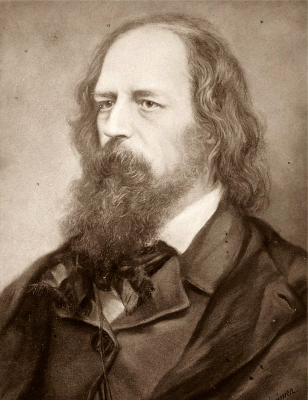
As Poet Laureate for Queen Victoria, English poet Alfred Tennyson was well acquainted with literary success. At the age of 20, he received the Chancellor’s Gold Medal from Cambridge for his poem, “Timbuktu.” One year later, he published his first poetry collection, Poems, Chiefly Lyrical, which included some of the best pieces he wrote. Appointed Poet Laureate in 1850 after the death of William Wordsworth, Tennyson held the position for 42 years, until his death in 1892.
But even the most successful of poets (and people) must learn to deal with the challenges and disappointments that are inevitable in a life well lived. Tennyson’s critics often argued that Tennyson’s poetry was overly sentimental. His second volume of poetry received such a negative critical reception that Tennyson didn’t publish again for 10 years. His literary career continued through personal and professional hardship, experiencing both the inspirational highs and lows often glossed over in the success stories we collectively celebrate.
The following two poems were highlights of Tennyson’s writing career. “The Charge of the Light Brigade” is a narrative poem written by in 1854 by Tennyson as Poet Laureate to memorialize the costly failed charge executed by the British Light Brigade during the Crimean War. Written just three years before he died, “Crossing the Bar” was desired by Tennyson to be included as the last poem in all future editions of his poetry.
The Charge of the Light Brigade
I.
Half a league, half a league, Half a league onward, All in the valley of Death Rode the six hundred. ‘Forward, the Light Brigade! Charge for the guns!’ he said: Into the valley of Death Rode the six hundred.
II.
‘Forward, the Light Brigade!’ Was there a man dismay’d? Not tho’ the soldier knew Some one had blunder’d: Their’s not to make reply, Their’s not to reason why, 15 Their’s but to do and die: Into the valley of Death Rode the six hundred.
III.
Cannon to right of them, Cannon to left of them, Cannon in front of them Volley’d and thunder’d; Storm’d at with shot and shell, Boldly they rode and well, Into the jaws of Death, Into the mouth of Hell Rode the six hundred.
IV.
Flash’d all their sabres bare,
Flash’d as they turn’d in air
Sabring the gunners there,
Charging an army, while
All the world wondered.
Plunged in the battery-smoke
Right through the line they broke;
Cossack and Russian
Reeled from the sabre stroke
Shattered and sundered.
Then they rode back, but not
Not the six hundred.
V.
Cannon to right of them,
Cannon to left of them,
Cannon behind them
Volleyed and thundered;
Stormed at with shot and shell,
While horse and hero fell.
They that had fought so well
Came through the jaws of Death,
Back from the mouth of hell,
All that was left of them,
Left of six hundred.
VI.
When can their glory fade?
O the wild charge they made!
All the world wondered.
Honour the charge they made!
Honour the Light Brigade,
Noble six hundred!
Crossing the Bar
Sunset and evening star,
      And one clear call for me!
And may there be no moaning of the bar,
      When I put out to sea,

   But such a tide as moving seems asleep,
      Too full for sound and foam,
When that which drew from out the boundless deep
      Turns again home.

   Twilight and evening bell,
      And after that the dark!
And may there be no sadness of farewell,
      When I embark;

   For tho' from out our bourne of Time and Place
      The flood may bear me far,
I hope to see my Pilot face to face
      When I have crost the bar.
He who turned our English tongue into songs no one had sung now has fallen and now lies in a place that gives no prize, under several feet of loam in a narrow wooden home.
Rhymes no longer meet his ears. Now the autumn frost appears not to delve where he now sleeps in a land where no one weeps; where no dog lies past a pine; no one cherishes his swine.
Now our formalists are left in a tidy little cleft. Like the Spartans at the gates, each composes and then waits. Time will tell if taste returns with some newer well-wrought urns.
John J. Brugaletta is the author of ten volumes of poetry, including his Selected Poems (Future Cycle Press). His poems have appeared in Extreme Formal Poems, The Formalist, Measure, The Random House Treasury of Light Verse, and TRINACRIA. He is Professor Emeritus of literature at California State University, Fullerton.
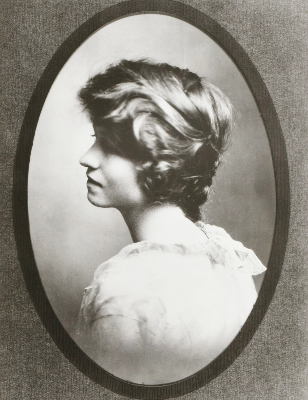
A highly regarded poet and social figure of the 1920s, Edna St. Vincent Millay was the first woman to receive the Pulitzer Prize for Poetry. She received the award in 1923 for her poem “Ballad of the Harp Weaver.” Despite being subjected to the ignorant criticism of traditional forms prevalent in the Modernist movement, Millay received the Frost Medal for her lifetime contribution to American Poetry in 1943.
Millay’s reputation as a major poet posthumously improved as identity politics gained influence in literary circles beginning in the 1960s and 1970s. Millay’s feminist activism and her unconventional (for the time) sexual escapades led critics to occasionally overlook the traditional writing style they usually regarded with such loathing.
The following two poems were highlights of Millay’s writing career. “Renascence” was submitted to a poetry contest in The Lyric Year in 1912 when Millay was 20. The poem was selected as the winner by the contest backer before it was shortly thereafter decided the poem did not meet the arbitrary criterion created by the other judges of being “socially relevant.” “Renascence” was ultimately awarded fourth place in that contest. The second poem featured here, “What lips my lips have kissed, and where, and why,” is widely regarded as Millay’s most famous poem.
Renascence
All I could see from where I stood
Was three long mountains and a wood;
I turned and looked another way,
And saw three islands in a bay.
So with my eyes I traced the line
Of the horizon, thin and fine,
Straight around till I was come
Back to where I’d started from;
And all I saw from where I stood
Was three long mountains and a wood.
Over these things I could not see;
These were the things that bounded me;
And I could touch them with my hand,
Almost, I thought, from where I stand.
And all at once things seemed so small
My breath came short, and scarce at all.
But, sure, the sky is big, I said;
Miles and miles above my head;
So here upon my back I’ll lie
And look my fill into the sky.
And so I looked, and, after all,
The sky was not so very tall.
The sky, I said, must somewhere stop,
And—sure enough!—I see the top!
The sky, I thought, is not so grand;
I ‘most could touch it with my hand!
And reaching up my hand to try,
I screamed to feel it touch the sky.
I screamed, and—lo!—Infinity
Came down and settled over me;
Forced back my scream into my chest,
Bent back my arm upon my breast,
And, pressing of the Undefined
The definition on my mind,
Held up before my eyes a glass
Through which my shrinking sight did pass
Until it seemed I must behold
Immensity made manifold;
Whispered to me a word whose sound
Deafened the air for worlds around,
And brought unmuffled to my ears
The gossiping of friendly spheres,
The creaking of the tented sky,
The ticking of Eternity.
I saw and heard, and knew at last
The How and Why of all things, past,
And present, and forevermore.
The Universe, cleft to the core,
Lay open to my probing sense
That, sick’ning, I would fain pluck thence
But could not,—nay! But needs must suck
At the great wound, and could not pluck
My lips away till I had drawn
All venom out.—Ah, fearful pawn!
For my omniscience paid I toll
In infinite remorse of soul.
All sin was of my sinning, all
Atoning mine, and mine the gall
Of all regret. Mine was the weight
Of every brooded wrong, the hate
That stood behind each envious thrust,
Mine every greed, mine every lust.
And all the while for every grief,
Each suffering, I craved relief
With individual desire,—
Craved all in vain! And felt fierce fire
About a thousand people crawl;
Perished with each,—then mourned for all!
A man was starving in Capri;
He moved his eyes and looked at me;
I felt his gaze, I heard his moan,
And knew his hunger as my own.
I saw at sea a great fog bank
Between two ships that struck and sank;
A thousand screams the heavens smote;
And every scream tore through my throat.
No hurt I did not feel, no death
That was not mine; mine each last breath
That, crying, met an answering cry
From the compassion that was I.
All suffering mine, and mine its rod;
Mine, pity like the pity of God.
Ah, awful weight! Infinity
Pressed down upon the finite Me!
My anguished spirit, like a bird,
Beating against my lips I heard;
Yet lay the weight so close about
There was no room for it without.
And so beneath the weight lay I
And suffered death, but could not die.
Long had I lain thus, craving death,
When quietly the earth beneath
Gave way, and inch by inch, so great
At last had grown the crushing weight,
Into the earth I sank till I
Full six feet under ground did lie,
And sank no more,—there is no weight
Can follow here, however great.
From off my breast I felt it roll,
And as it went my tortured soul
Burst forth and fled in such a gust
That all about me swirled the dust.
Deep in the earth I rested now;
Cool is its hand upon the brow
And soft its breast beneath the head
Of one who is so gladly dead.
And all at once, and over all
The pitying rain began to fall;
I lay and heard each pattering hoof
Upon my lowly, thatched roof,
And seemed to love the sound far more
Than ever I had done before.
For rain it hath a friendly sound
To one who’s six feet underground;
And scarce the friendly voice or face:
A grave is such a quiet place.
The rain, I said, is kind to come
And speak to me in my new home.
I would I were alive again
To kiss the fingers of the rain,
To drink into my eyes the shine
Of every slanting silver line,
To catch the freshened, fragrant breeze
From drenched and dripping apple-trees.
For soon the shower will be done,
And then the broad face of the sun
Will laugh above the rain-soaked earth
Until the world with answering mirth
Shakes joyously, and each round drop
Rolls, twinkling, from its grass-blade top.
How can I bear it; buried here,
While overhead the sky grows clear
And blue again after the storm?
O, multi-colored, multiform,
Beloved beauty over me,
That I shall never, never see
Again! Spring-silver, autumn-gold,
That I shall never more behold!
Sleeping your myriad magics through,
Close-sepulchred away from you!
O God, I cried, give me new birth,
And put me back upon the earth!
Upset each cloud’s gigantic gourd
And let the heavy rain, down-poured
In one big torrent, set me free,
Washing my grave away from me!
I ceased; and through the breathless hush
That answered me, the far-off rush
Of herald wings came whispering
Like music down the vibrant string
Of my ascending prayer, and—crash!
Before the wild wind’s whistling lash
The startled storm-clouds reared on high
And plunged in terror down the sky,
And the big rain in one black wave
Fell from the sky and struck my grave.
I know not how such things can be;
I only know there came to me
A fragrance such as never clings
To aught save happy living things;
A sound as of some joyous elf
Singing sweet songs to please himself,
And, through and over everything,
A sense of glad awakening.
The grass, a-tiptoe at my ear,
Whispering to me I could hear;
I felt the rain’s cool finger-tips
Brushed tenderly across my lips,
Laid gently on my sealed sight,
And all at once the heavy night
Fell from my eyes and I could see,—
A drenched and dripping apple-tree,
A last long line of silver rain,
A sky grown clear and blue again.
And as I looked a quickening gust
Of wind blew up to me and thrust
Into my face a miracle
Of orchard-breath, and with the smell,—
I know not how such things can be!—
I breathed my soul back into me.
Ah! Up then from the ground sprang I
And hailed the earth with such a cry
As is not heard save from a man
Who has been dead, and lives again.
About the trees my arms I wound;
Like one gone mad I hugged the ground;
I raised my quivering arms on high;
I laughed and laughed into the sky,
Till at my throat a strangling sob
Caught fiercely, and a great heart-throb
Sent instant tears into my eyes;
O God, I cried, no dark disguise
Can e’er hereafter hide from me
Thy radiant identity!
Thou canst not move across the grass
But my quick eyes will see Thee pass,
Nor speak, however silently,
But my hushed voice will answer Thee.
I know the path that tells Thy way
Through the cool eve of every day;
God, I can push the grass apart
And lay my finger on Thy heart!
The world stands out on either side
No wider than the heart is wide;
Above the world is stretched the sky,—
No higher than the soul is high.
The heart can push the sea and land
Farther away on either hand;
The soul can split the sky in two,
And let the face of God shine through.
But East and West will pinch the heart
That can not keep them pushed apart;
And he whose soul is flat—the sky
Will cave in on him by and by.
What lips my lips have kissed, and where, and why
What lips my lips have kissed, and where, and why,
I have forgotten, and what arms have lain
Under my head till morning; but the rain
Is full of ghosts tonight, that tap and sigh
Upon the glass and listen for reply,
And in my heart there stirs a quiet pain
For unremembered lads that not again
Will turn to me at midnight with a cry.
Thus in the winter stands the lonely tree,
Nor knows what birds have vanished one by one,
Yet knows its boughs more silent than before:
I cannot say what loves have come and gone,
I only know that summer sang in me
A little while, that in me sings no more.
The white-haired custodian helps me with hauling my hi-fi to my second-floor apartment,
a studio, with one door and a window too high for jumping.
At the first landing, he gestures me to the window. Come take a look. Down there. On a cement slab,
a man in powder-blue sweater lies face-down, arms spread into wings, legs buckled backwards.
The cops think he jumped from up there. I step back. Nothing to be afraid of . . . only a dead body.
I had just exchanged my unlocked family house for a dim hallway of numbered doors, chain-bolt rattles.
And my futon, lobster trap table, Chianti-basket candle holders, Night Hawks in the kitchenette
fail to make here a home, until Sven delivers from his stash in the basement, four glass blocks
to hold up my door desk. I thought they’d work. He switches on my desk lamp.
Knowing he and his wife dwell just beneath me, among pressed cottage curtains,
cream cakes, and Hummels, I brave the cobwebby back staircase from my car, sleep better.
All summer, he places orange cones in my space behind the building, shoos away Red Sox fans. They’ll park
in your living room, if you don’t lock your door, and without a word, sweeps bottle glass
from his immaculate front steps, trashed by my out-of-hand student party the night before.
Later that night, he taps on my door, jingles the keys left outside in my lock. Thought you might need these.
America’s Main Street
On three-hundred-mile car days, the water in our portable window AC hotter than the summer blaze, my sister and I whining for a pool – any small oval dug before a rustic motor court, screen doors slamming in the wind, outhouses at the rear.
Our always-new, pastel-with-white-stripe De Soto, yearly cruising Route 66 – its ruler-flat horizons, endless cornfields, no-stoplight towns, stormy vistas, Triptik detours, Burma Shaves, cut-out blondes and jackrabbits, cowboy mannequins, trading-post warnings about baby rattlers, knotty pine everything. And soaring over it all, the flying horsepower of the Mobilgas red Pegasus.
Those rattlers, a dusty array of plastic baby rattles in a cage, casting doubt on our genuine arrowheads carved by the braves themselves and on our authentic fossils and gold nuggets.
My mother saving for, planning those neon-lit, root beer, carhop, stalagtite-mines, wigwam weeks, and my father, the only driver, delivering us intact to all of it, master of macadam.
Oh, to cruise once more with them this singular street, they too singular, to thank them for their ongoing gift – my roadwise, wide-range awakening. Pool irrelevant.
Ann Taylor is a Professor of English at Salem State University in Salem, Mass. where she teaches both literature and writing courses. She has written two books on college composition, academic and freelance essays, and a collection of personal essays, Watching Birds: Reflections on the Wing. Her first poetry book, The River Within, won first prize in the 2011 Cathlamet Poetry competition at Ravenna Press. A chapbook, Bound Each to Each, was published in 2013. Her collection, Héloïse and Abélard: the Exquisite Truth, published in 2018, is based on the twelfth-century story of their lives, and her most recent collection, Sortings, was published by Dos Madres Press, in June 2020. She is currently at work on a new collection of poems, called Taking Care.
I have a diary entry about Buddy Holly,
Richie Valens and J.P. Richardson, aka
The Big Bopper. I remember the classroom’s
rickety wood floor. I’m keen on hardwood
floors but this floor lacked gloss. Still,
it’s what I recall best about that room,
where I learned about the plane crash
then went home and wrote about it.
Art Costello’s brother came in
one morning in boots, jeans, shirtless
with a crop of dark hair spilled down his
brow and in his hand a brown paper bag,
Art’s lunch, he handed to Sister John at
her desk up front. a long pole’s hook
opened and closed windows, we were
at basement level, the girl’s playground
east of where we sat. My diary is green,
diamond-pattered, with a dark blue spine,
a latch for a key lost years ago.
I can open it and find what I wrote that day.
I remember Sister’s face, Art’s
close-together features made him older
and worried. His brother came in shirtless
on a warm day. We were all startled.
It was quick, quiet, nobody said anything.
He was muscled but not overly so. His
hair spilled over like Richie Valens’ hair.
I’d seen Richie, Buddy and The Big Bopper
but only on TV. Clean-cut Buddy Holly
always wore a tie. Our wood floor
was uneven, a level below the playground.
Word of the crash went ‘round our room.
The Animals
They teach us to believe in ourselves,
kindness lessons.
A while back I was mean to a dog.
It started one Saturday afternoon.
About to leave my house I gave each dog
a biscuit shaped like a bone
but denied her.
Even though she’s dead 14 months
I still see the look in her eyes that day,
disbelief, sorrow. A Catahoula mix
not by nature affectionate.
Now I have a dog who slept at my side
many nights, then suddenly found
a big pillow in a room other than mine.
More comfortable there than with me,
he teaches me I’m alone,
an ongoing lesson, it’s okay being alone,
a lesson my mother used to teach
and, I assume, your mother taught you,
because she chose to.
Outside a pavilion balloons floated up
into the sky an hour after the service
for your mom.
I’m with animals and I’m alone.
I’m okay. But that Saturday I denied Lori,
the Catahoula, a treat I wasn’t.
I was anything but kind.
Days like that may come again.
I can’t predict the future. But I know
what my mom taught me and what I think
your mom taught. It’s continual.
Now they’re not here, our mothers,
the animals teach us.
Peter Mladinic has published three books of poems: Lost in Lea, Dressed for Winter, and Falling Awake in Lovington, all with the Lea County Museum Press. He lives in Hobbs, New Mexico.
 Sparks of Calliope